
OPERATIONAL EXCELLENCE · LEAN / TPS · BUSINESS TRANSFORMATION
Make Problems Visible. Improve Flow. Build Performance That Lasts.
TrueLean Solutions helps manufacturing and operations-driven organizations turn operational complexity into clear priorities, disciplined systems, stronger leadership, and measurable business performance.
We work alongside leaders and frontline teams to identify the constraints that matter most, improve the way work flows, strengthen daily execution, and build operating systems your organization can sustain.
Prefer to prepare first? Use the Operational Audit Preparation Checklist to organize your operating information, performance measures, and priorities before a conversation.
25+ Years Leadership Experience
Canada & U.S. Multi-Site Experience
Lean/TPS Six Sigma & ISO Systems
Practical systems.Solutions that fit the operation.
Capable people.Ownership where the work happens.
Sustainable performance.Improvement that continues after the engagement.
SELECTED VALIDATED PERFORMANCE RESULTS
Representative results achieved across operational improvement work. Actual outcomes depend on baseline conditions, scope, execution, and client participation.
START WITH YOUR PRIORITY
What are you trying to improve?
Operational symptoms rarely point to one isolated cause. Select the issue closest to your current condition to recognize the warning signs, explore a relevant resource, and identify the TrueLean service that may help.
Delivery and OTIF
Missed promise dates, growing backlog, schedule changes, frequent expedites, material shortages, or orders waiting between functions.
Discuss this challengeCapacity and Throughput
Overtime is increasing, output remains below demand, bottlenecks move between areas, or additional labour and equipment seem necessary.
Discuss this challengeInventory and Material Flow
Excess inventory exists alongside shortages, work in process keeps growing, materials are difficult to locate, or replenishment is unreliable.
Discuss this challengeDowntime and OEE
Equipment stoppages recur, preventive maintenance is inconsistent, recovery is slow, or OEE losses are measured but not eliminated.
Discuss this challengeQuality and Rework
Scrap, rework, customer complaints, late defect detection, repeated corrective actions, or unstable first-pass yield are affecting performance.
Discuss this challengeDaily Management
Teams spend too much time firefighting, KPI ownership is unclear, meetings are inconsistent, escalation is slow, or actions are not sustained.
Discuss this challengeFacility and Warehouse Flow
Travel distances are excessive, congestion disrupts work, slotting is ineffective, space is under pressure, or receiving-to-shipping flow is unclear.
Discuss this challengeOperational Transformation
Problems cross multiple functions, Lean efforts have stalled, priorities compete, leadership is not aligned, or improvements do not last.
Discuss this challengeTHE TRUELEAN IMPROVEMENT FRAMEWORK
A disciplined path from current state to sustainable performance.
Improvement is grounded in evidence, connected to business priorities, and owned by the people who operate and manage the process.
Assess
Observe the work, establish a reliable baseline, and separate symptoms from underlying causes.
Plan
Connect priorities to business needs, define targets, clarify ownership, and build a practical roadmap.
Implement
Work alongside teams to stabilize processes, apply countermeasures, and establish standards and routines.
Improve
Measure performance, evaluate operational and financial impact, learn, adjust, and standardize what works.
Sustain
Transfer knowledge, reinforce ownership, and embed reviews, audits, coaching, and leader standard work.
SERVICES
Practical support across the operating system.
Services are tailored to the client’s maturity, priorities, resources, and operating environment.
Operational Assessments & Transformation Roadmaps
Establish an objective view of current performance, operating risks, constraints, and highest-value opportunities before investing in solutions.
- Leadership discovery and on-site operational assessment
- SQDCIP, flow, management-system and technology-readiness review
- Prioritized gap analysis and opportunity matrix
- 30-60-90-day roadmap and executive readout
Lean Manufacturing & Flow
Improve the way work and material move through the operation while building stable, repeatable processes.
- Value-stream mapping and waste elimination
- Standard work, line balancing and cellular flow
- Pull systems, Kanban, JIT and changeover improvement
- Capacity, productivity, lead-time and practical 5S
Facility, Warehouse & Inventory Optimization
Improve space utilization, material movement, storage, inventory accuracy, and end-to-end warehouse flow.
- Current- and future-state facility layout
- Receiving, storage, picking, packing and shipping flow
- ABC classification, cycle counting and slotting
- Material-handling reduction, relocation and implementation planning
Operational Management Systems
Create visibility, accountability, and disciplined execution from the frontline to leadership.
- SQDCIP dashboards and tiered accountability meetings
- Leader standard work and structured Gemba routines
- KPI ownership, review cadence and escalation
- Annual Operations Planning, Hoshin Kanri, governance and benefits tracking
Problem-Solving & Quality Improvement
Build repeatable methods for containing problems, identifying root causes, reducing variation, and strengthening process control.
- A3, 5 Whys, fishbone, Pareto and corrective action
- Scrap, rework, complaints and variation reduction
- SOPs, process controls and audits
- Frontline problem-solving capability
Maintenance & Equipment Reliability
Strengthen equipment availability through disciplined maintenance, operator ownership, and fact-based reliability improvement.
- Equipment criticality and preventive-maintenance review
- Autonomous maintenance and operator inspection routines
- Downtime, failures, spare parts and maintenance-planning analysis
- OEE and reliability improvement
Supply Chain, Planning & Delivery
Strengthen material availability, planning discipline, inventory strategy, supplier performance, and customer delivery.
- Sales and operations alignment, demand planning and production scheduling
- Supplier performance, purchasing, shortages and material availability
- Inventory and replenishment strategy
- Lead-time, service-level, on-time delivery and supply-chain risk improvement
Lean Leadership & Capability Development
Develop the leadership behaviors, coaching routines, and internal capability required to sustain continuous improvement.
- Frontline leader and supervisor development
- Coaching, accountability, engagement and effective daily meetings
- Change-management and transformation support
- Succession, cross-training, capability matrices and knowledge transfer
Operational Technology & Automation Readiness
Use ERP, digital tools, and practical automation to strengthen understood operational processes rather than automate waste or complexity.
- Digital and automation readiness assessment
- ERP utilization, dashboards and operational data visibility
- Operational technology and automation feasibility, ROI and implementation planning
- Human-centered automation and AI-supported operational applications
Fractional & Advisory Leadership
Provide owners and executives with experienced operational guidance without the commitment of a full-time executive role.
- Interim or fractional operational guidance
- Owner and executive advisory support
- Transformation governance and project recovery
- Independent validation of investments, improvement plans and vendor proposals
FOR YOUR INDUSTRY
Lean principles adapted to the realities of your operation.
TrueLean does not copy a factory template from one industry into another. We apply proven operating principles to the customer demand, process constraints, technology, workforce, quality requirements, and business economics of each environment.
Discrete & Industrial Manufacturing
Metal fabrication, machining, stamping, forming, assembly, furniture, building products, mechanical systems, electronics, and other high-mix or repetitive manufacturing environments.
Automotive & Tiered Supply
Flow, quality, launch readiness, standardized work, material systems, equipment reliability, IATF-aligned operating discipline, and delivery performance.
Warehouse & Distribution
Receiving, storage, slotting, replenishment, picking, packing, shipping, inventory accuracy, material handling, labor productivity, and daily management.
Process, Chemical & Regulated Operations
Quality systems, process control, safety, planning, inventory, maintenance, flow, traceability, and practical improvement within ISO and regulated environments.
High-Volume Service Operations
Scheduling, dispatch, administrative flow, customer response, handoffs, queues, field-service coordination, KPI visibility, and scalable workflows.
Growth, Transfer & Transition
Plant and process transfers, warehouse and distribution start-ups, facility layouts, operational recovery, automation readiness, leadership transition, and capability building.
HOW IMPROVEMENT CREATES VALUE
From operating problem to verified result.
These anonymized cases explain the starting condition, improvement approach, and measured outcome. Results reflect the approved scope and measurement period for each case. Actual outcomes depend on baseline conditions, execution, and client participation.
 Representative image
CASE STUDY 01
Delivery and Capacity Recovery
An established manufacturing assembly plant in the Greater Toronto Area.
Problem
Customer commitments were under pressure because shortages, schedule changes, production constraints, and overtime were being managed as separate issues.
Approach
The work traced order flow, identified the primary constraint, aligned material readiness with capacity, levelled production, and established visible daily management.
64% to 93%OTIF Delivery
58% to 88%Schedule Attainment
32%Lead-Time Reduction
41%Overtime Reduction
View methods and verification
Improvement Methods
- Value Stream Mapping
- Theory of Constraints and Drum-Buffer-Rope
- Tier 1 and Tier 2 Daily Visual Management
- Heijunka and levelled scheduling
Verified Scope
Baseline: Demand-based order release, recurring material shortages, excessive work in process, schedule disruption, and weekend overtime.
Final condition: Constraint-based flow supported by synchronized planning, material readiness, and daily visual management.
Period: Six months, including a three-month baseline and three-month verification period.
Scope: Order management, production planning, assembly, shipping, and logistics.
 Representative image
CASE STUDY 02
Inventory and Material Flow Improvement
An established discrete assembly and industrial manufacturing operation in the Greater Toronto Area.
Problem
Overcrowded storage, uncontrolled staging, inaccurate records, and material searches caused emergency purchasing, interrupted production, and unnecessary handling.
Approach
The work analyzed demand, part velocity, storage, replenishment, material routes, and inventory controls to create standardized point-of-use flow.
26%Inventory Reduction
Over $1MWorking Capital Released
71% to 98.2%Inventory Accuracy
82%Fewer Material Stoppages
View methods and verification
Improvement Methods
- 5S and workplace organization
- Pull systems and visual Kanban
- Plan for Every Part
- Water Spider and standardized material routes
- ABC-weighted cycle counting
Verified Scope
Additional result: Material search and travel time decreased by 45% for material handlers.
Baseline: Congested storage, ghost inventory, emergency purchasing, material shortages, and operators searching for components.
Final condition: Standardized storage, point-of-use inventory, visual replenishment, daily cycle counting, and fixed-route delivery.
Period: Nine months, including a three-month baseline and six months of post-implementation tracking.
Scope: Raw material warehousing, receiving and inspection, line-side storage, replenishment, and assembly feeding.
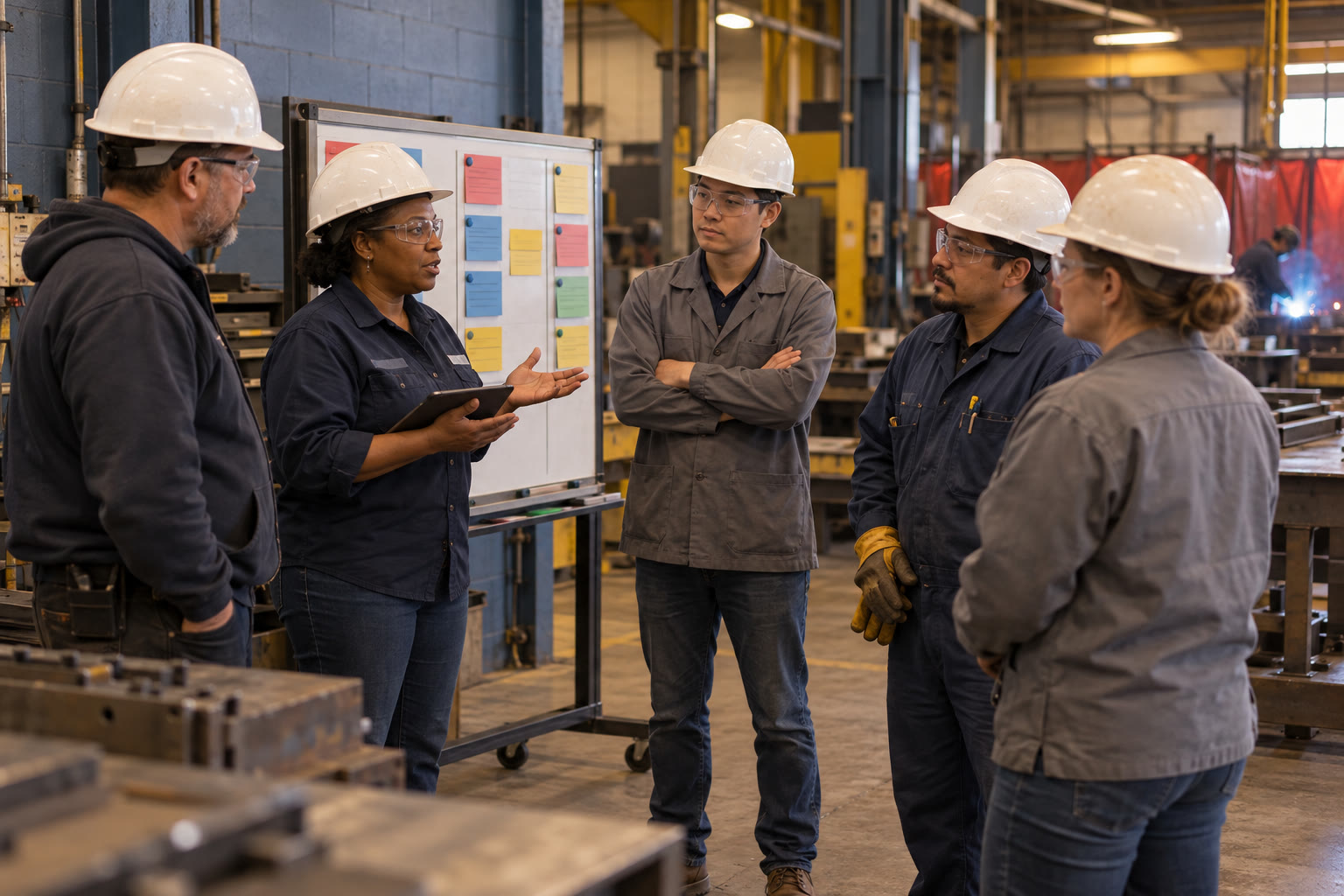 Representative image
CASE STUDY 03
Daily Management and Sustained Execution
An established high-volume discrete assembly manufacturer in the Greater Toronto Area.
Problem
Issues were recorded in disconnected systems with unclear ownership, inconsistent escalation, reactive meetings, and limited follow-through.
Approach
A sitewide daily management system connected shift-level conditions with plant decisions through tiered meetings, escalation standards, leader routines, and structured problem solving.
4.2 days to 6 hoursRoadblock Resolution
38% to 91%On-Time Actions
81% to 93%First-Pass Yield
62% to 76%OEE
View methods and verification
Improvement Methods
- Tier 1 through Tier 3 Daily Management
- Process confirmation and leader standard work
- Standardized escalation matrix
- 5 Whys, A3, and 8D problem solving
Verified Scope
Baseline: Disconnected issue tracking, inconsistent ownership, overdue actions, reactive meetings, and recurring problems.
Final condition: Visible performance, assigned ownership, due dates, escalation paths, daily follow-up, and leadership coaching.
Period: Four months, covering baseline assessment, implementation, stabilization, and verification.
Scope: Manufacturing, quality, maintenance, frontline supervision, and the plant leadership team.
LEARN ABOUT LEAN
Practical learning for leaders who want better operations, not more jargon.
Explore practical insights that connect Lean/TPS principles with daily management, leadership, flow, problem-solving, and sustainable business transformation.
Lean Is More Than a Toolbox
5S, Kaizen, Kanban, VSM, and standard work matter, but sustainable improvement depends on the management system and leadership behaviors surrounding them. Learn how daily visibility, problem-solving, respect for people, and disciplined follow-through turn tools into capability.
Explore Lean Resources →The best leaders never stop learning.
Strong operational leaders ask better questions, go to the work, listen to the people closest to the process, and create conditions where problems can be surfaced and solved.
Just-in-Time vs. Just-in-Case
Inventory can protect the operation, but it can also hide instability. Understand the balance between flow, resilience, replenishment, risk, and customer service.
Start with people experiencing improvement.
Before asking teams to learn an entire improvement system, help them see one problem differently, improve the work, and experience the value of participation.
BLOG & RESOURCE LIBRARY
Practical resources to help leaders learn, share ideas, and improve operations.
Explore practical guides, checklists, articles, insights, and educational resources designed to make Lean/TPS and operational excellence easier to understand and apply. Resources can be read online, shared with your team, or downloaded for practical use.
PDF GUIDE
View Guide →
Lean / TPS Starter Guide
A concise introduction to seeing waste, flow, constraints, and operating problems through a Lean/TPS lens.
PDF GUIDE
View Guide →
Lean / TPS Practical Guide
A practical guide for applying Lean/TPS thinking to identify waste, improve flow, address constraints, and strengthen daily operations.
CHECKLIST
View Checklist →
Operational Audit Preparation Checklist
A practical checklist of data, metrics, process information, and business priorities to prepare before an operational assessment.
LINKEDIN NEWSLETTER
Subscribe on LinkedIn ↗
The Operational Edge
Practical perspectives on leadership, operational excellence, Lean/TPS, continuous improvement, and business transformation.
ABOUT TRUELEAN SOLUTIONS
Operational leadership experience, not theory alone.
TrueLean Solutions is a Canadian operational excellence, Lean/TPS, and manufacturing transformation advisory practice serving manufacturing and operations-driven organizations across Canada and the United States.
Our purpose is to help organizations build better operating systems that make problems visible, enable people to solve them, and consistently deliver value to customers.
Understand before recommendingRespect people and their knowledgeKeep solutions practicalBuild capability, not dependencyMeasure and validateLeave the organization stronger
ENGAGEMENT MODELS
Start with the scope that fits the business need.
Operational Clarity Assessment
For leaders who need an objective picture of current conditions, constraints, risks, and highest-value priorities.
- Leadership discovery and on-site assessment
- Performance, flow and management-system review
- Prioritized findings and opportunity matrix
- Executive readout and 30-60-90-day roadmap
Performance Improvement Sprint
For a defined operational challenge requiring focused analysis, countermeasures, and implementation support.
- Validated baseline and problem definition
- Root-cause and process analysis
- Focused Kaizen or improvement activity
- KPIs, ownership and sustainment plan
Operational Excellence Transformation
For organizations seeking broader, sustainable change across systems, processes, leadership, and culture.
- Diagnose and align
- Stabilize critical operating fundamentals
- Improve flow, reliability, quality, delivery and cost
- Develop capability and validate benefits
EXPECTED BUSINESS OUTCOMES
Improvement should create measurable value.
Targets are established jointly at the start of each engagement. Results are measured against an agreed baseline, and verified benefits are distinguished from estimates and assumptions.
Safety & WorkplaceSafer work, clearer standards and ownership.
QualityLess scrap and rework, stronger process control.
Delivery & FlowShorter lead times and better schedule attainment.
Cost & ProductivityHigher capacity, less waste and better cost visibility.
Inventory & Supply ChainBetter accuracy, replenishment and supplier performance.
Leadership & Management SystemClear accountability, meaningful KPIs and stronger routines.
FAQ
Questions leaders commonly ask.
Practical answers before you commit time or resources.
Does Lean/TPS work outside automotive manufacturing?
Yes. The underlying principles address universal operational challenges such as flow, waste, variation, quality, capacity, inventory, problem-solving, leadership, and customer value. The methods should be adapted to the operating environment rather than copied mechanically.
How quickly should we expect results?
It depends on the problem, baseline, and scope. Focused improvements can create value quickly, while broader changes involving systems, reliability, leadership, and culture require more time. Success measures are agreed before implementation so progress can be evaluated objectively.
How do you manage employee resistance to change?
We begin by understanding the work and involving the people closest to it. Employees often hold essential process knowledge. Participation strengthens understanding, ownership, and the likelihood that improvements will be sustained.
How much leadership involvement is required?
Leadership should provide visible sponsorship, timely decisions, access to relevant information, and support for process owners. TrueLean provides structure, analysis, facilitation, coaching, and implementation support while the client retains ownership of the business and its decisions.
SCHEDULE A CONSULTATION
Start with a practical conversation about your operation.
Tell us where performance is falling short, where the business needs to go, and what may be standing in the way. We will use the initial conversation to determine whether an assessment, focused improvement initiative, or broader engagement is appropriate.
Info@trueleansolutions.ca
JPena@trueleansolutions.ca
trueleansolutions.ca
LinkedIn: TrueLean Solutions