
Lean organizations do not begin by trying to make every process faster. They first establish conditions that make work predictable, visible, repeatable, and capable of revealing problems.
A workplace where materials have no defined location, methods change by operator, equipment conditions are unknown, abnormalities are difficult to see, and priorities change constantly is not ready for sophisticated improvement.
Workplace stability provides the foundation. It does not mean eliminating every variation or creating a rigid environment where people cannot think. It means establishing enough consistency to distinguish normal from abnormal, understand why performance changes, respond to problems systematically, and improve from a known baseline.
01 · Learning Objectives
By the end of this module, you should be able to:
- Explain why basic stability should precede advanced Lean methods.
- Recognize common signs of workplace and process instability.
- Distinguish workplace organization from simple housekeeping.
- Explain the operational purpose of 5S and 6S.
- Understand how visual management makes abnormalities visible.
- Explain the role of standards and standardized work in continuous improvement.
- Recognize how equipment, materials, methods, information, and people interact to create stability.
- Identify useful stability measures rather than relying only on output metrics.
- Describe leadership's responsibility for establishing and sustaining stable operating conditions.
- Apply the TrueLean framework to assess and improve workplace stability.
02 · Key Terms Used in This Module
The following terms will appear throughout this module and are useful for understanding workplace stability and operating-system performance.
A composite measure of equipment effectiveness based on Availability, Performance, and Quality.
Material that has entered the production process but has not yet become finished product.
A systematic approach to improving equipment effectiveness and reliability through proactive maintenance, employee involvement, and shared responsibility for maintaining basic equipment conditions.
A sequencing method in which material is processed in the order it enters a defined queue or lane, helping control WIP and prevent older material from being stranded.
A visual or audible signaling method used to communicate an abnormal condition and, where applicable, request assistance or escalation.
The customer-demand rhythm, calculated as available production time divided by required customer quantity.
The currently established best-known method for performing work safely, consistently, and effectively under defined operating conditions.
The use of visual information and controls to make expected conditions, actual performance, and abnormalities understandable at the point of work.
03 · Why Stability Comes Before Optimization
Organizations frequently begin Lean transformation with ambitious objectives: increase throughput, reduce lead time, improve OEE, reduce inventory, introduce pull, and improve labor productivity.
Those objectives are reasonable. But improvement becomes difficult when the operating system underneath them is unstable.
Consider a production area where:
- Tools cannot consistently be found.
- Operators use different methods.
- Material arrives unpredictably.
- Machines repeatedly experience minor stops.
- Work instructions are outdated.
- Priorities change during the shift.
- Defects are discovered downstream.
- Staffing decisions are reactive.
- Abnormalities are not visually obvious.
Trying to optimize this environment can produce misleading conclusions. A supervisor may believe an operator is slow when the real issue is missing material. A planner may increase inventory because schedules are unreliable. Maintenance may blame operators for equipment problems while basic conditions have deteriorated. Management may add capacity when existing capacity is simply unstable.
Before asking “How can we make this faster?”, leaders should often ask: “What prevents this process from performing consistently?”
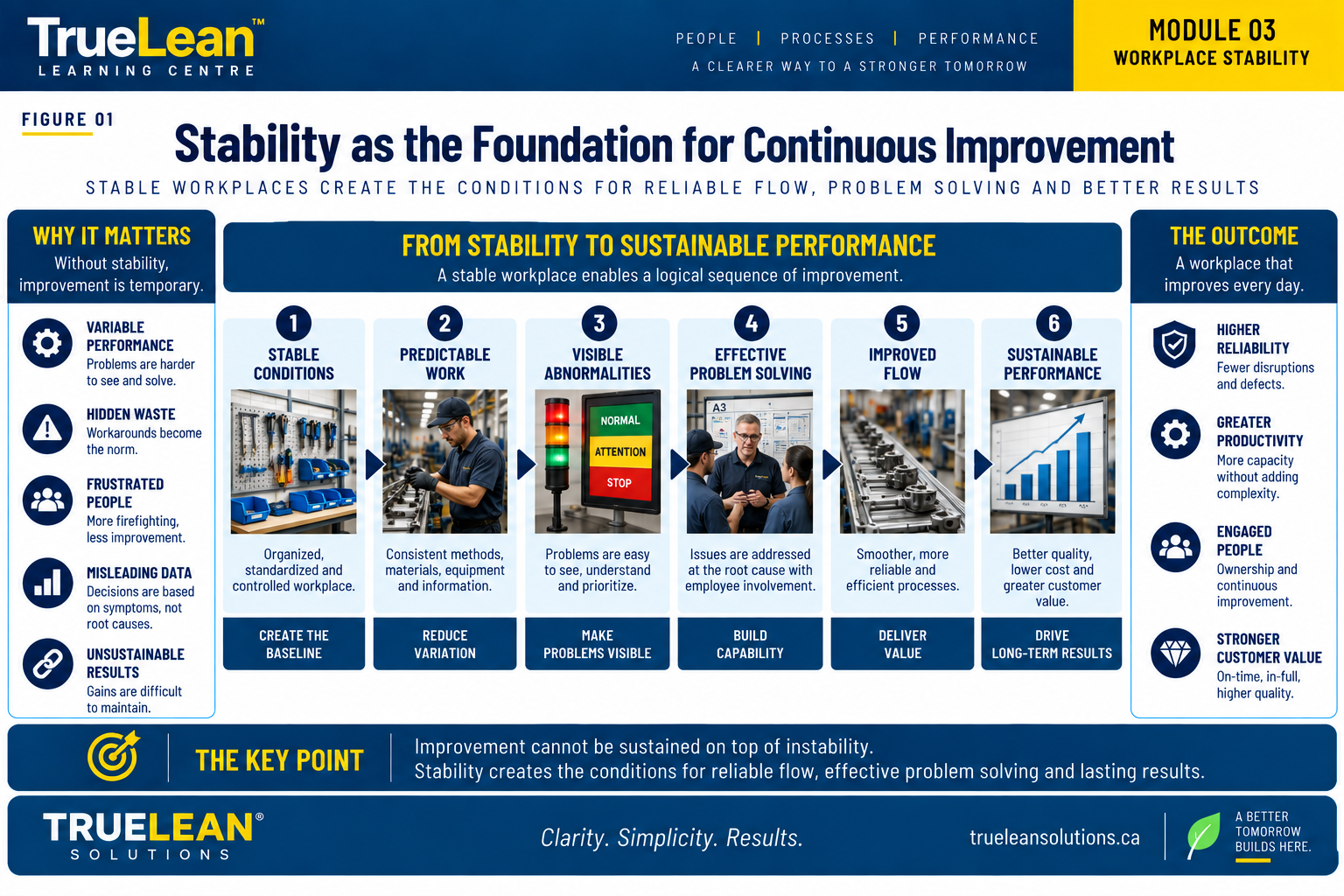
Stability is not the final objective. It creates the conditions under which improvement becomes meaningful.
04 · What Workplace Stability Actually Means
A stable workplace does not mean that every day produces exactly the same result. Manufacturing naturally experiences variation in product mix, demand, equipment, materials, staffing, and operating conditions.
The objective is to establish controlled operating conditions so that meaningful deviations can be recognized.
- Methods — Is there an agreed way to perform the work?
- Materials — Are the correct materials available, identifiable, and positioned where required?
- Machines — Are basic equipment conditions maintained and abnormalities detected early?
- People — Are employees trained and capable of performing the expected work?
- Information — Are priorities, standards, performance, and abnormalities visible?
These factors interact. A perfectly organized workstation cannot compensate for unreliable material supply. Excellent standardized work cannot compensate for equipment that repeatedly fails. A visual board provides little value when leaders do not respond to the abnormalities it reveals.
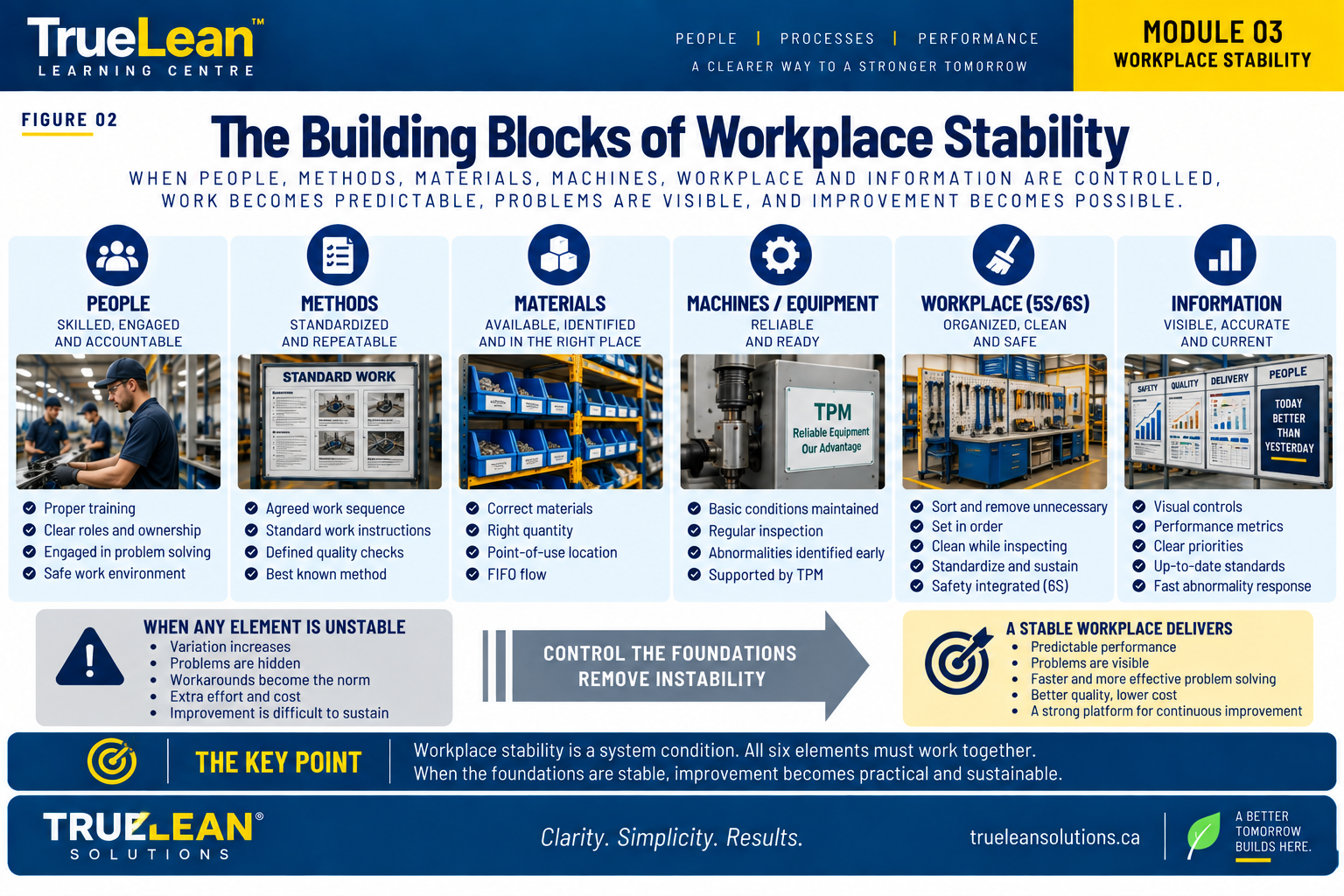
Workplace stability is a system condition, not a single Lean tool.
05 · Standards and Standardization
The words standard and standardization are sometimes interpreted as restrictions on employee creativity. In Lean thinking, their purpose is different.
A standard defines the currently agreed condition or method. Standardization creates enough consistency to make deviations observable.
Without a baseline, people cannot reliably determine whether a change improved the process. If three operators perform the same operation using substantially different sequences, output variation may be visible, but its causes are difficult to diagnose.
Standard → Observe → Identify Gap → Improve → Establish New Standard
The standard is not the end of improvement. It is the starting point for the next improvement.
06 · 5S/6S: More Than Housekeeping
One of the most common Lean implementation mistakes is reducing 5S to workplace cleaning. A clean factory may be desirable, but cleanliness alone does not create operational excellence.
The traditional 5S sequence is Sort → Set in Order → Shine → Standardize → Sustain. Safety should be integrated throughout every one of these activities. Some organizations use 6S to make Safety an explicit sixth element, reinforcing visibility, ownership, and organizational focus.
Sort
Remove unnecessary items and clarify what is actually required to perform the work.
Set in Order
Establish logical locations for necessary items to reduce searching, motion, confusion, and incorrect selection.
Shine
Clean while inspecting so leaks, loose fasteners, wear, contamination, damaged cables, missing guards, and other abnormalities become visible.
Standardize
Define expected locations, quantities, inspection conditions, and responsibilities.
Sustain
Integrate the expectations into everyday management, leader routines, and follow-through.
Safety
Whether treated as embedded in 5S or made explicit as the sixth S, safety must be designed into how work is organized, performed, and maintained.
Safety should be integrated throughout every 5S activity. Some organizations use 6S to make Safety an explicit sixth element, reinforcing visibility, ownership, and organizational focus.
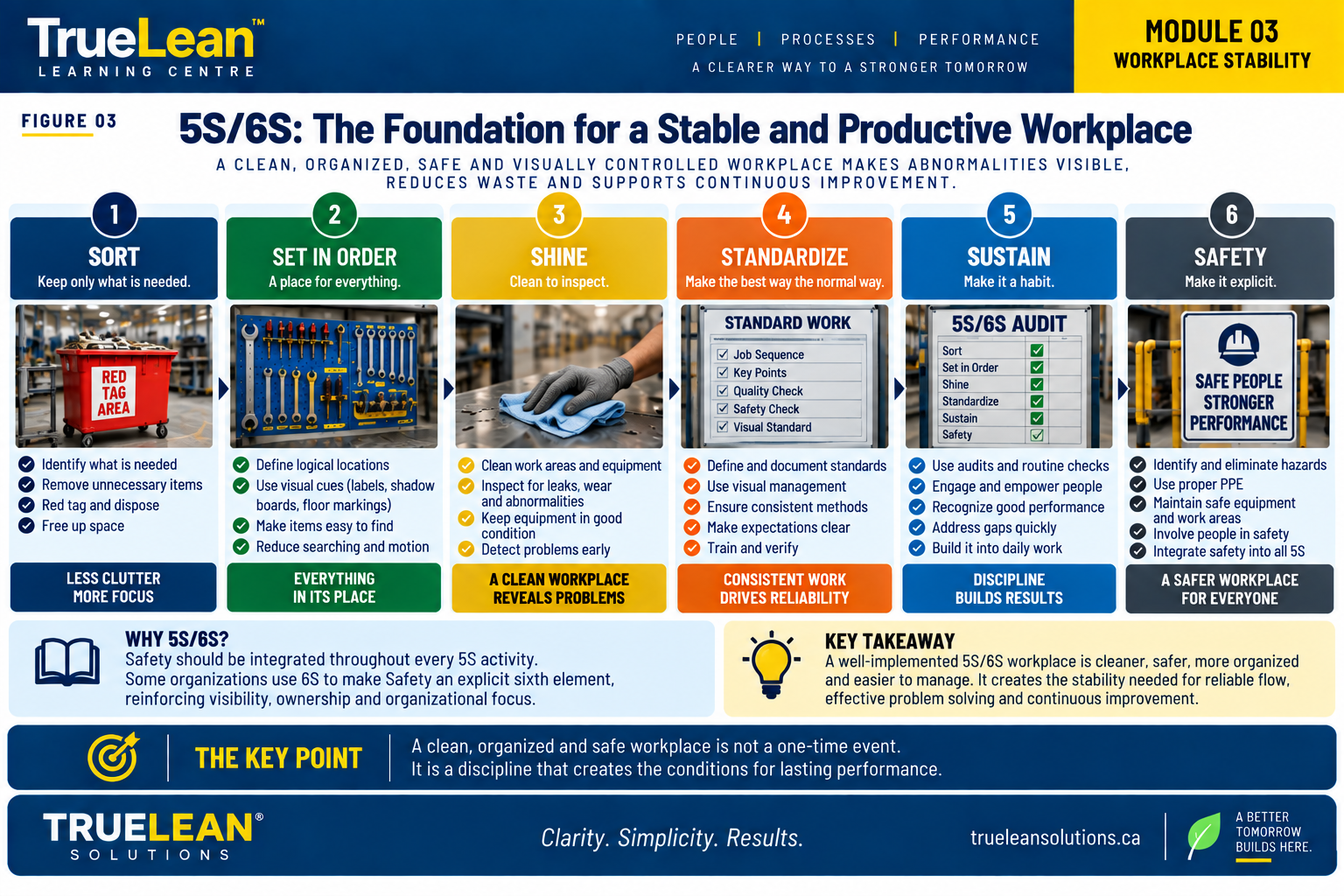
The goal is not a beautiful workplace. The goal is a workplace where abnormal conditions become difficult to hide.
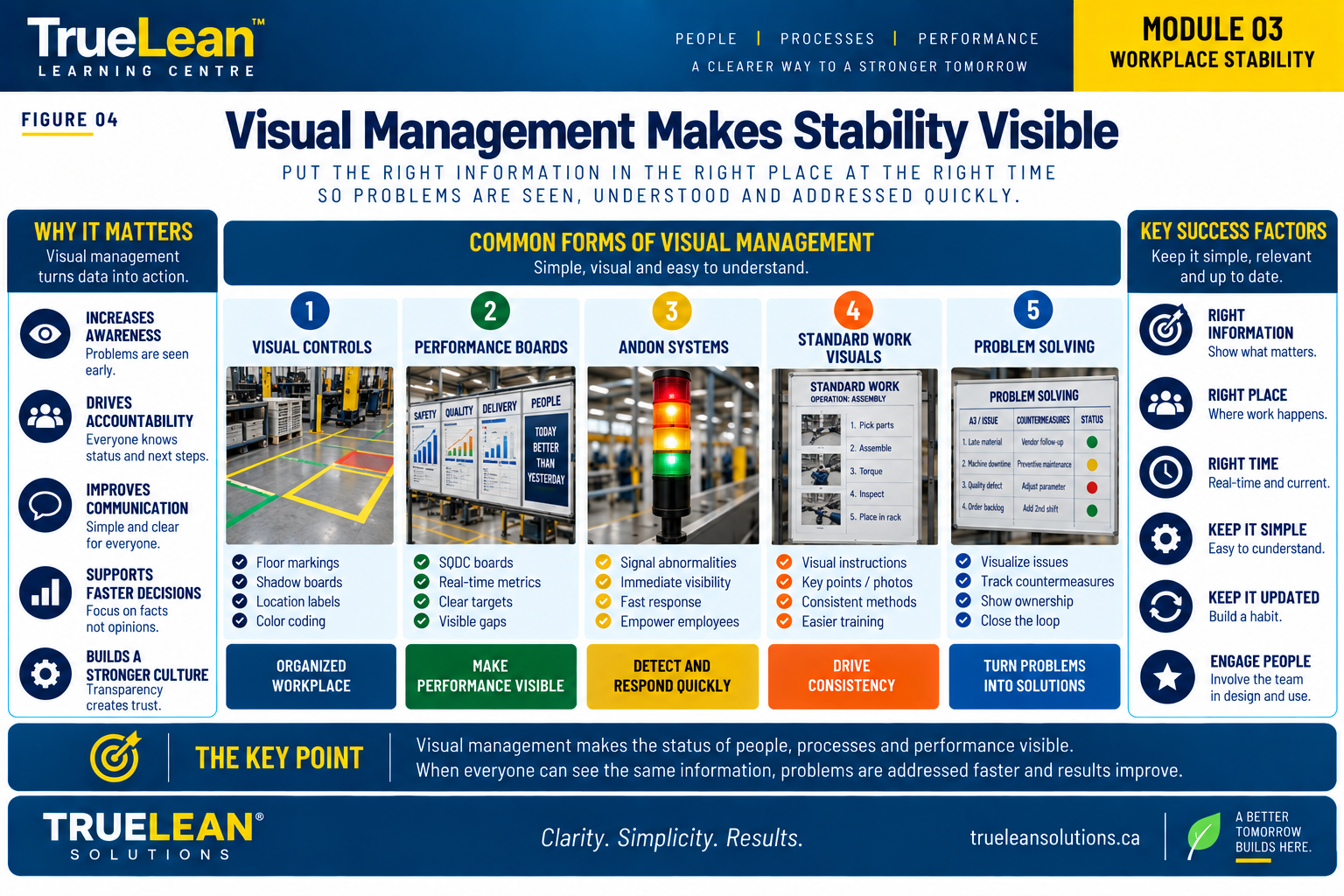
07 · Visual Management: Make Normal and Abnormal Obvious
A strong visual workplace answers important operating questions quickly: What should be happening? What is actually happening? Are we ahead or behind? Where should material be? Is the machine available? Is there a quality problem? Who owns the response?
Good visual management reduces dependence on memory, tribal knowledge, spreadsheets hidden on computers, and verbal explanations.
- Location markings and point-of-use controls
- Minimum/maximum levels and FIFO lanes
- Production status and hourly tracking boards
- Andon signals
- Shadow boards
- Quality boundary samples
- Standardized work displays
- Maintenance indicators
Can someone standing at the process recognize an abnormal condition without conducting an investigation first?
Installing visual devices is not the objective. The visual must cause appropriate action. A red condition that remains red for three days without response is not effective visual management; it is visible neglect.
08 · Standardized Work as a Baseline for Improvement
Standardized work should not become a binder written by engineering and stored away from the people doing the work.
At its core, standardized work establishes the best currently known method for performing work safely, consistently, and effectively under defined conditions.
Depending on the process, it may define:
- Work sequence
- Expected timing and takt relationship
- Standard work-in-process
- Quality checkpoints
- Safety requirements
- Critical process conditions
The people performing the work should be deeply involved in developing and improving it because they interact with the process continuously. Employee involvement, however, does not mean everybody chooses a different preferred method. The organization needs an agreed baseline from which deliberate improvement can occur.
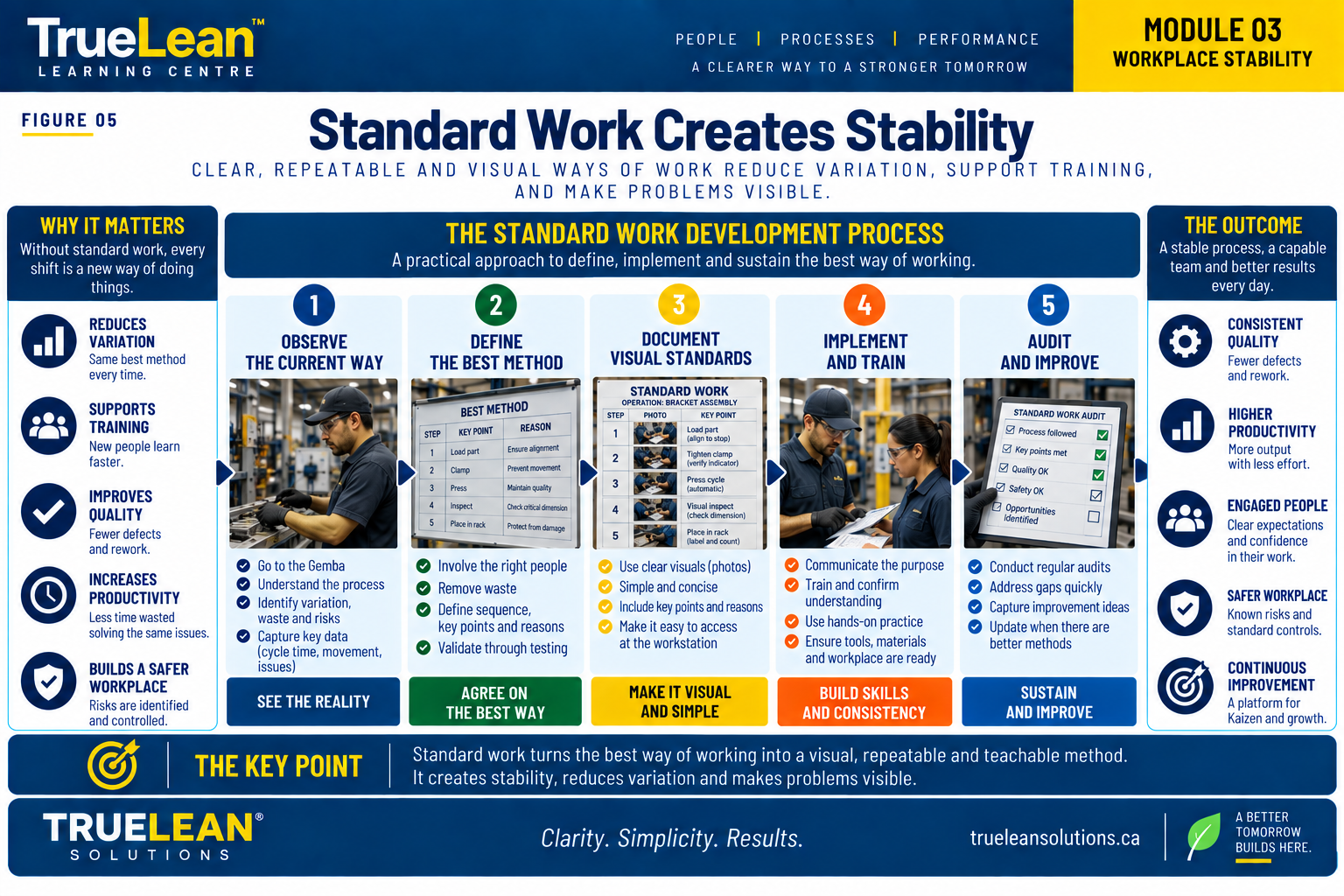
Standardized work should evolve as knowledge improves.
09 · Basic Equipment and Process Conditions
Workplace stability also depends on equipment reliability. Many organizations respond to equipment instability primarily through maintenance work orders.
Lean thinking asks an earlier question: Are the basic conditions required for reliable operation being maintained?
- Lubrication and cleanliness
- Fastening and alignment
- Correct settings and operating parameters
- Inspection points
- Wear conditions
- Sensors and guards
- Utilities and basic machine conditions
Repeated minor stops can be particularly damaging because organizations gradually accept them as normal. A sensor reset five times per shift, a recurring jam, a fixture that constantly needs adjustment, or a conveyor that occasionally stops may not appear catastrophic, but collectively they consume capacity and create instability.
This is why TPM emphasizes restoring and maintaining basic equipment conditions, not simply calculating OEE.
10 · Point-of-Use Control
Stability also depends on ensuring that necessary resources are available where the work occurs:
- Tools
- Fixtures
- Gauges
- Components
- Consumables
- Work instructions
- Quality standards
- Safety equipment
Consider an operator who walks 20 metres several times per hour to obtain components. The organization may measure the operator's output while failing to measure the system that forces the motion.
What does the employee need to complete the work correctly, and where should it be positioned?
11 · How Instability Creates Waste
The eight wastes introduced in Module 02 do not occur independently from operating conditions. Instability frequently creates them.
- Missing materials → Waiting
- Poor workplace layout → Motion
- Unreliable schedules → Excess inventory
- Equipment problems → Waiting + defects
- Unclear methods → Defects + overprocessing
- Poor information → Overproduction
- Unclear responsibilities → Waiting
- Employees excluded from improvement → Underutilized talent
Attacking individual wastes without correcting their underlying operating conditions can produce temporary improvement.
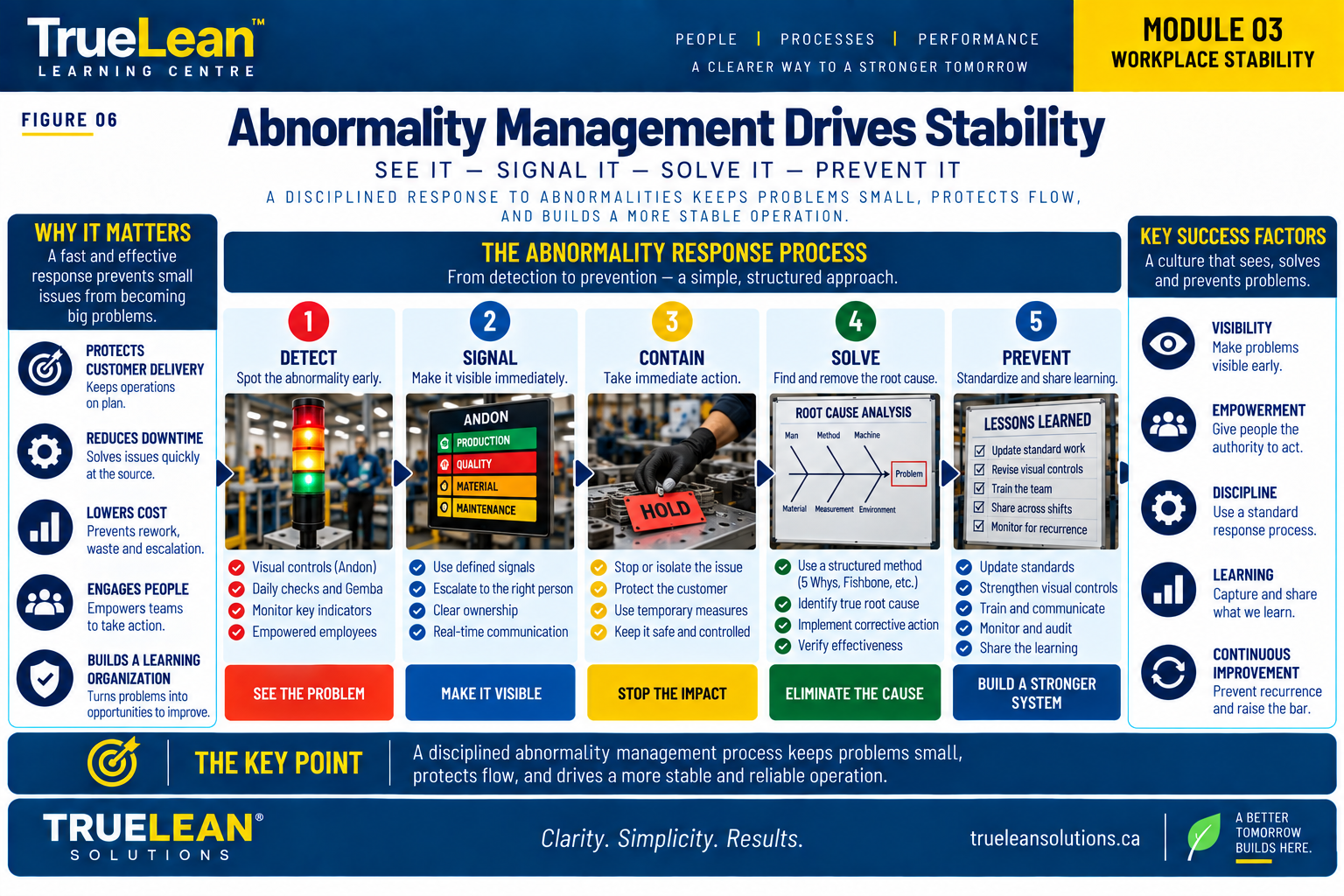
Lean leaders look beyond the visible symptom to the condition that repeatedly creates it.
12 · Manufacturing Example — The “Slow Operator”
Consider a fabrication cell expected to produce 40 assemblies per hour. Actual output averages 31. Management concludes that operator performance needs improvement.
A Gemba observation tells a different story. During one hour:
- 6 minutes lost searching for fixtures
- 4 minutes lost waiting for material
- 3 minutes lost resetting equipment
- 2 minutes lost clarifying the production schedule
- 3 minutes lost correcting a quality issue from the previous operation
Total interruption: 18 minutes. The operator had only 42 minutes of reasonably available production time.
Initial interpretation: Operator productivity = 77.5% of target.
Better interpretation: The operating system is consuming approximately 30% of available production time through instability.
Those two interpretations lead to completely different management actions. One may produce pressure. The other produces improvement.
13 · Observe Before You Standardize
There is another danger: standardizing a poor process. Before defining the standard, leaders and employees should observe the actual work.
- What does the operator actually do?
- Where does waiting occur?
- What requires searching?
- Where does information come from?
- What decisions must the employee make?
- What conditions change between cycles?
- Where do defects originate?
- What workarounds have become normal?
- What prevents the job from being performed as intended?
Observation generates questions. Evidence tests them.
Standardization should capture an understood process—not institutionalize existing waste.
14 · Common Mistakes
Treating 5S as a Cleaning Campaign
The workplace looks better temporarily, but operating behavior does not change.
Auditing Instead of Managing
High audit scores can coexist with poor operational performance. The purpose of an audit is to expose conditions requiring action, not generate a score.
Creating Standards Without Operators
Standards developed away from the work often fail to reflect actual operating conditions.
Making Everything Visual
Too many signs, boards, labels, and colours create visual noise. Visual management should make important information easier to understand.
Accepting Recurring Abnormalities
When people repeatedly work around the same problem, the abnormal condition gradually becomes the unofficial standard.
Blaming People for System Instability
Performance pressure cannot compensate indefinitely for unreliable equipment, material, information, or methods.
Implementing Advanced Lean Systems Too Early
Kanban, flow cells, takt-based management, and other methods become fragile when basic operating conditions are unreliable.
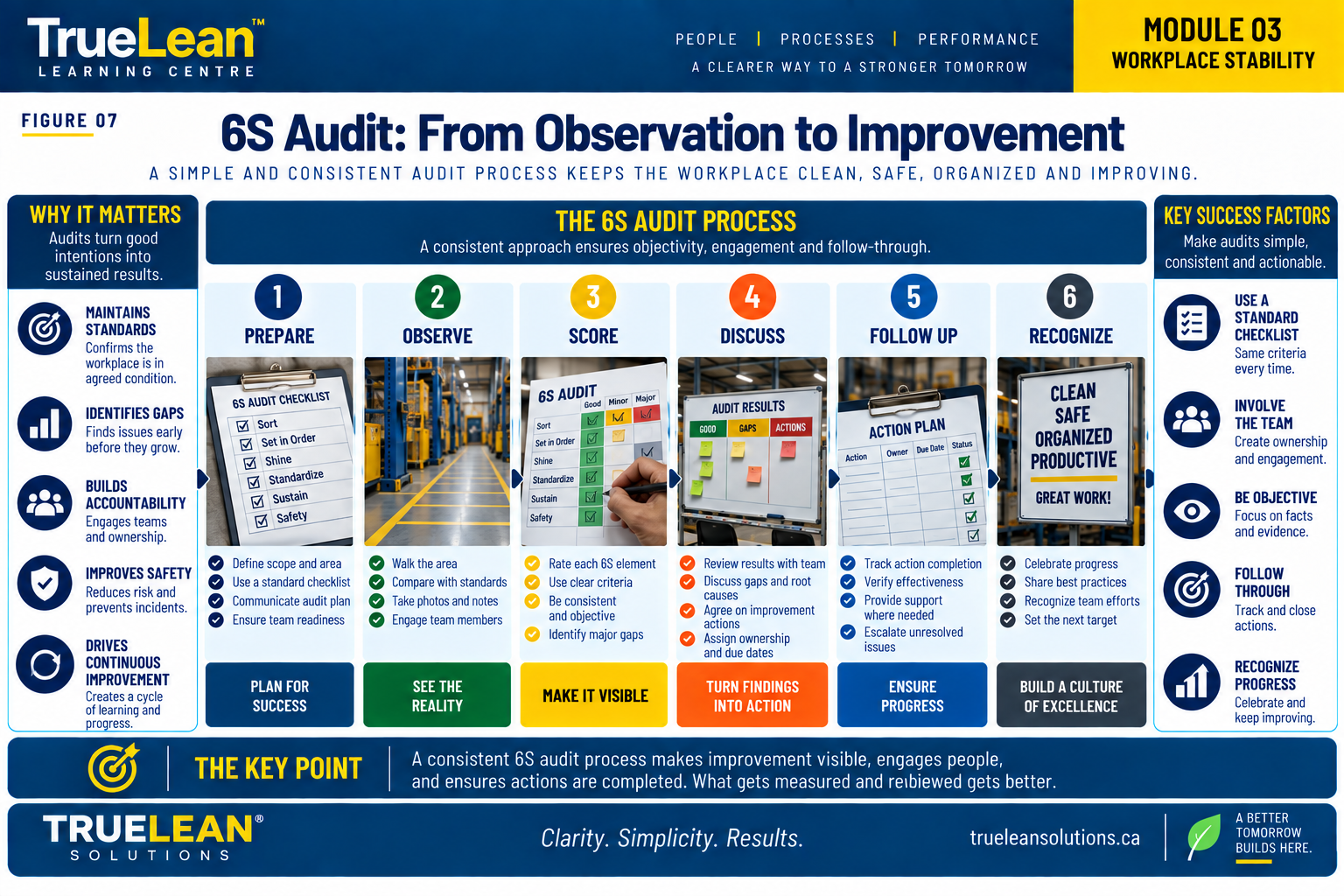
15 · Measure What Matters
Workplace stability should be measured using evidence that reflects the operating system. No single metric proves stability; leaders should look for patterns across the system.
| Dimension | Examples of Useful Measures |
|---|---|
| Process | Cycle-time variation, first-pass yield, schedule attainment, hourly attainment and changeover consistency. |
| Equipment | Minor stops, breakdown frequency, downtime, mean time between failures and abnormal-condition closure. |
| Material | Shortages, line-side availability, replenishment failures and inventory accuracy. |
| Workplace | Search time, abnormal conditions identified and closed, and adherence to defined locations and quantities. |
| People | Standardized-work adherence, training completion, cross-training coverage and employee improvement participation. |
16 · Leadership Responsibilities
Workplace stability cannot be delegated to a Lean coordinator. Leadership establishes the operating expectations that determine whether stability survives.
Leaders should:
- Define expected conditions.
- Observe work regularly at the Gemba.
- Ask about abnormalities rather than only results.
- Remove barriers employees cannot resolve.
- Ensure standards remain current.
- Respond to recurring problems.
- Reinforce ownership and follow-through.
- Provide resources for corrective action.
- Recognize improvement.
- Avoid normalizing workarounds.
If employees raise problems and nothing happens, they eventually stop raising them. Problems becoming visible is evidence that the management system is working.
Bob Emiliani's work is useful here because it challenges organizations to treat Lean as a management system and a different way of thinking and leading, rather than as a collection of improvement tools. That perspective reinforces the leadership responsibility to change routines, behaviors, and management practices—not merely install 5S boards or conduct events.
17 · Applying the TrueLean Improvement Framework
Workplace stability becomes valuable when it leads to disciplined, evidence-based improvement.
Assess: Observe current conditions and identify instability in methods, materials, machines, people, and information. Document evidence rather than assumptions.
Plan: Prioritize the conditions creating the greatest operational impact. Define the expected condition, ownership, measures, actions, and timing.
Implement: Establish practical controls such as workplace organization, visual controls, basic equipment conditions, point-of-use materials, standardized work, and daily accountability.
Improve: Use actual performance gaps to drive structured problem solving. Test countermeasures and update standards when improvements are validated.
Sustain: Embed expectations into leader standard work, Gemba routines, tiered accountability, training, audits, and performance reviews.
ASSESS → PLAN → IMPLEMENT → IMPROVE → SUSTAIN
18 · Key Takeaways
- Stability precedes optimization. Accelerating an unstable process often accelerates its problems.
- 5S/6S is an operating discipline, not a housekeeping program.
- Standards enable improvement by creating a baseline from which deviations can be understood.
- Visual management must trigger response; visibility without action adds little value.
- Repeated workarounds are evidence of weaknesses in the operating system.
- Observe before blaming. What looks like an employee performance issue may be system instability.
- Leaders own the system. Sustainable stability requires leadership routines, response, and follow-through.
Create enough stability to make abnormalities visible, then use those abnormalities to learn and improve.
19 · Continue Learning
Module 04 — Flow & Capacity
Once stable operating conditions exist, the next challenge is understanding how work moves through the system.
Module 04 will examine Flow, Bottlenecks, Capacity, Cycle Time, Takt, WIP, Constraints, and Balance—and how leaders can improve throughput without simply adding people, equipment, or inventory.
Return to Learning Centre20 · Practical Resource
TrueLean Workplace Stability Assessment
A future downloadable assessment can evaluate five dimensions: Workplace Organization, Standardized Work, Visual Management, Equipment Conditions, and Daily Management.
Rather than functioning as another generic 5S checklist, the assessment should test whether the workplace actually creates the conditions for reliable operational performance.
Need help applying this to your operation?
TrueLean Solutions helps manufacturing leaders assess current conditions, identify the operating issues that matter most, and build practical improvement roadmaps based on evidence.
Schedule a Consultation21 · Sources & Further Reading
The following sources provide the technical foundation for this module and additional perspectives on Lean management, workplace stability, standardized work, equipment reliability, and continuous improvement. Further reading is included for those who want to explore these concepts in greater depth.
Foundational Sources
These sources directly support the technical concepts taught in this module.
- Toyota Motor Corporation — Toyota Production System
- Taiichi Ohno — Toyota Production System: Beyond Large-Scale Production
- Lean Enterprise Institute — Standardized Work
- Lean Enterprise Institute — Toyota Production System
- Seiichi Nakajima — Introduction to TPM: Total Productive Maintenance
Further Reading
These works provide deeper context, practical examples, and broader perspectives on Lean leadership and management systems.
- Jeffrey K. Liker — The Toyota Way
- Masaaki Imai — Gemba Kaizen
- Mike Rother & John Shook — Learning to See
- Bob Emiliani et al. — Better Thinking, Better Results, 2nd ed.
- Bob Emiliani — The Triumph of Classical Management Over Lean Management