
Lean is not about making every activity faster. It begins by understanding what the customer actually values, following how that value moves through the operation, and identifying the conditions that consume resources without improving the outcome.
Learning Objectives
By the end of this module, you should be able to:
- Define value from the customer's perspective.
- Distinguish value-creating work, necessary or incidental work, and waste.
- Recognize the traditional seven wastes and the commonly used eighth waste of non-utilized talent.
- Explain Muda, Mura and Muri and how they interact.
- Recognize why visible waste is often a symptom of deeper operating-system conditions.
- Observe work at the Gemba and follow material and information through the process.
- Use operational evidence to validate improvement opportunities.
- Select measures that show whether waste is actually being reduced and customer performance improved.
01 · Customer Value Comes First
Lean begins with a fundamental question: What does the customer actually value?
Every manufacturing organization performs thousands of activities. People schedule production, move material, operate equipment, inspect parts, enter transactions, attend meetings, prepare reports, expedite orders, correct defects and solve problems. All of these activities consume time and resources, but activity is not the same as value.
From a Lean perspective, value is ultimately judged from the customer's point of view. An activity does not become valuable simply because it is difficult, expensive, technically sophisticated, or something the organization has always done.
Activity is not the same as value.
Depending on the product and market, customers may value quality, function, reliability, delivery, responsiveness, safety, service and competitive cost. Lean therefore asks leaders to understand precisely what the customer requires and then examine how effectively the entire operating system delivers that requirement.
02 · Three Ways to Think About Work
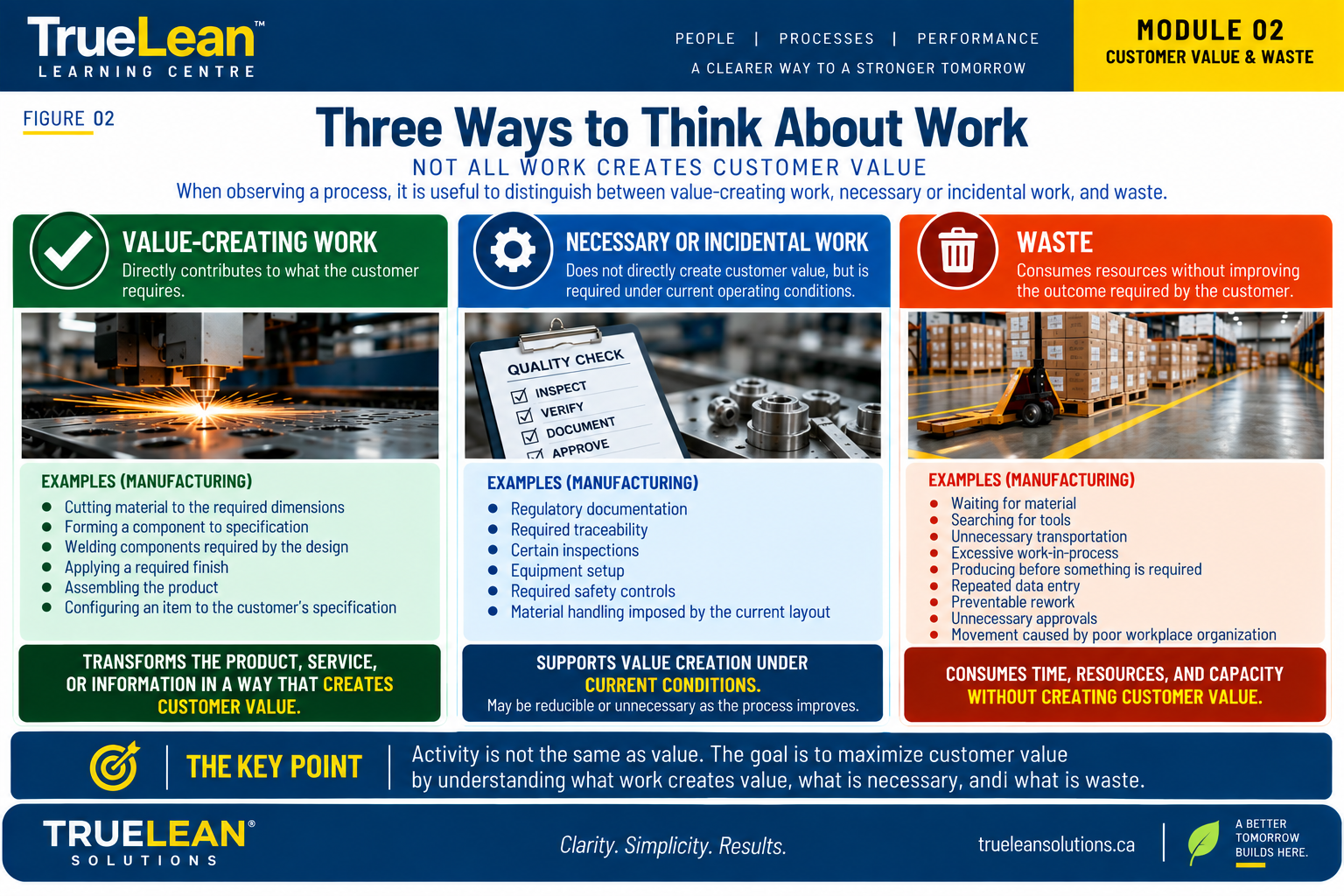
When observing a process, it is useful to distinguish three broad categories of activity.
Value-Creating Work
These activities transform the product, service or information in a way that contributes directly to what the customer requires. Examples may include cutting material to required dimensions, forming a component to specification, welding components required by the design, applying a required finish, assembling the product, or configuring an item to the customer's specification.
Necessary or Incidental Work
Some activities may not directly create customer value but are required under current operating conditions. Examples can include regulatory documentation, required traceability, certain inspections, equipment setup, safety controls and material handling imposed by the current layout.
The phrase under current conditions matters. An activity that is necessary today may become reducible or unnecessary after the underlying process improves.
Waste
Waste consumes resources without improving the outcome required by the customer. Waiting, searching, unnecessary transportation, excessive WIP, producing too early, repeated data entry, preventable rework and unnecessary approvals are common examples.
People are not waste. Poorly designed systems create waste.
03 · Follow the Value Stream
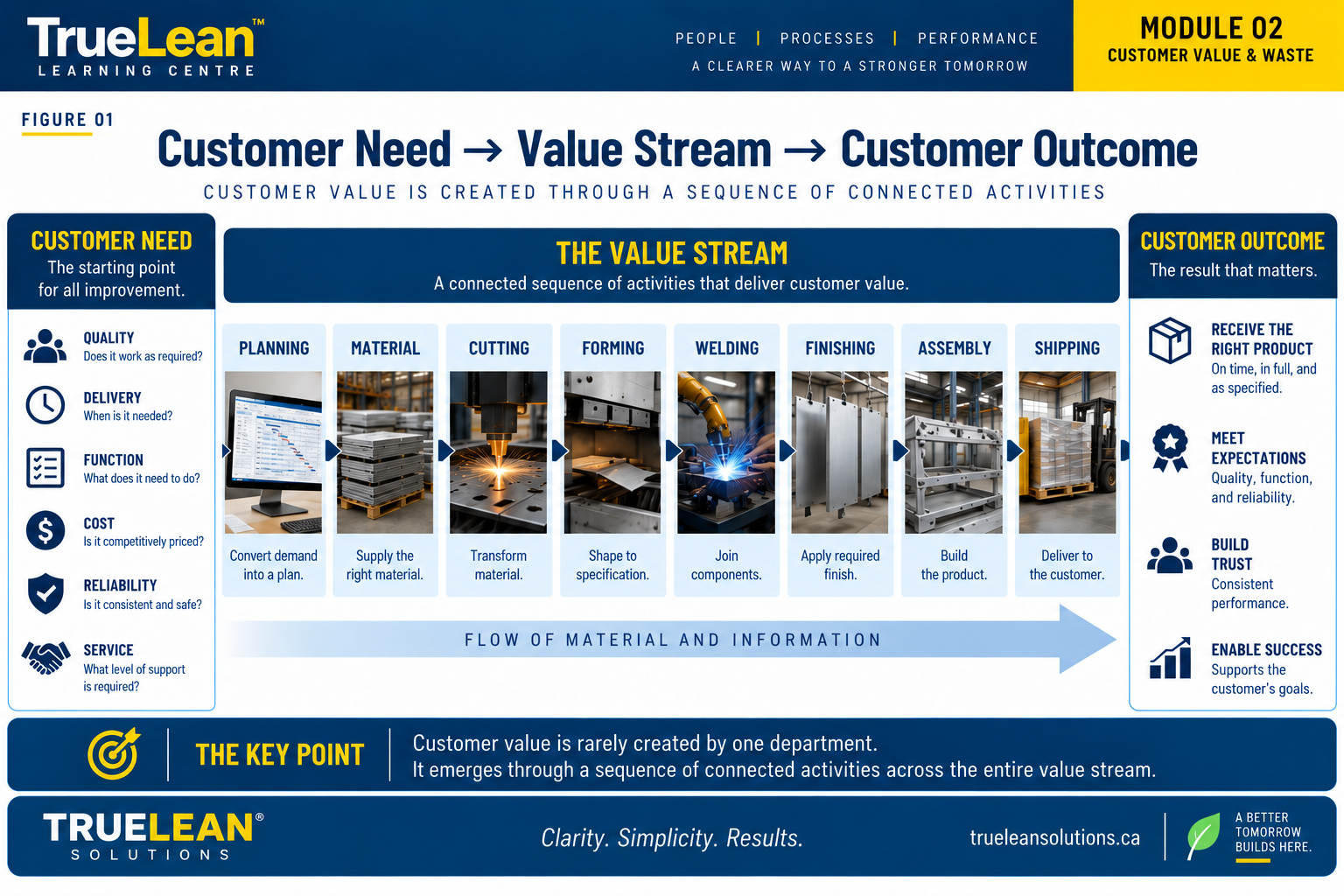
Customer value is rarely created by one department operating independently. It emerges through a connected sequence of activities.
A simplified manufacturing value stream may look like: Customer Demand → Planning → Material → Cutting → Forming → Welding → Finishing → Assembly → Shipping → Customer.
Material flows through this system, but information flows through it as well. An organization can have highly efficient individual departments while the overall value stream performs poorly.
Local optimization does not necessarily optimize the system. Lean asks leaders to follow the flow of material and information across organizational boundaries rather than view each department in isolation.
04 · Understanding the Wastes
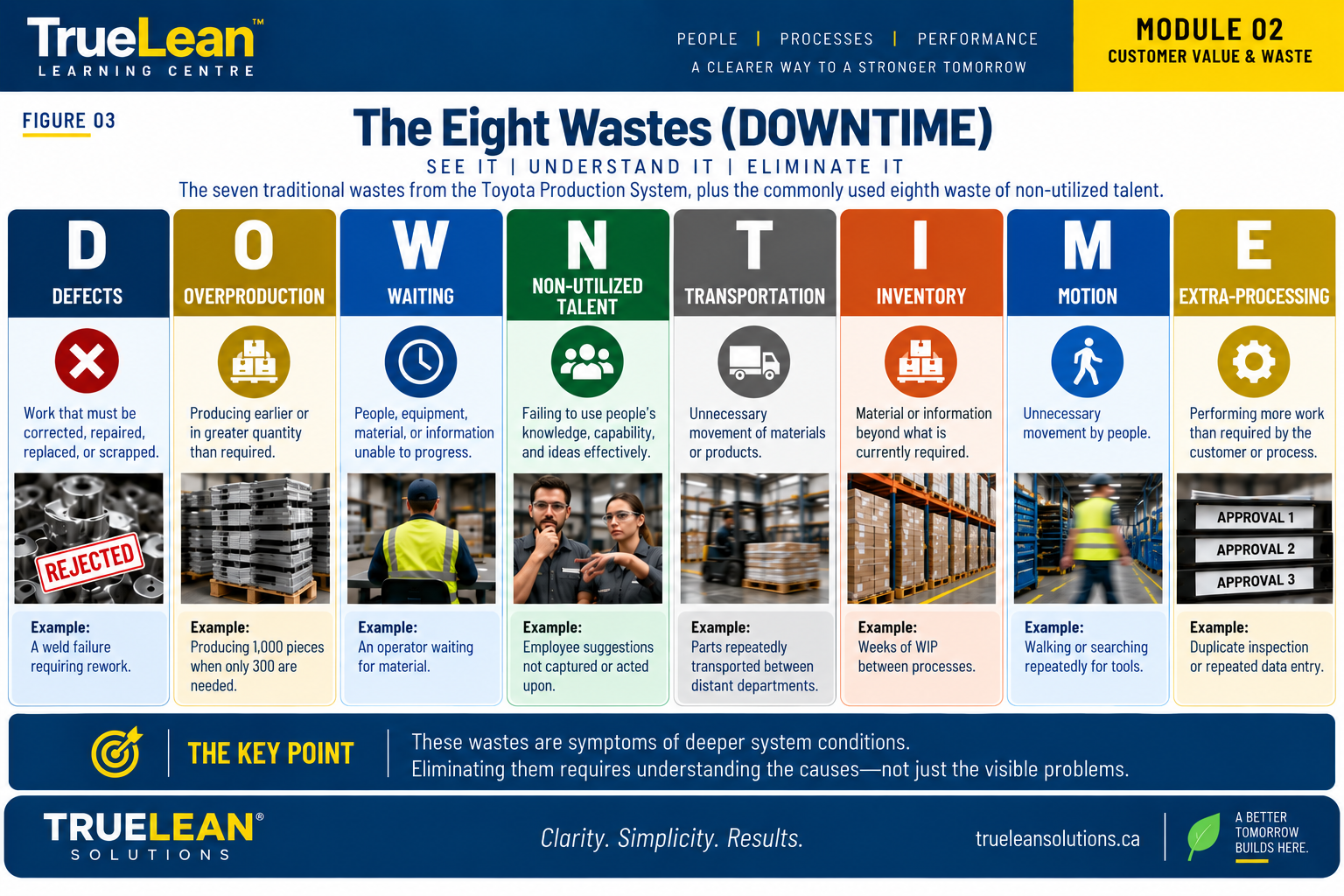
Taiichi Ohno's traditional TPS formulation is commonly described through seven categories of waste: overproduction, waiting, transportation or conveyance, processing, inventory, motion and defects or correction. Many contemporary Lean programs add an eighth category: non-utilized talent.
This produces the widely used mnemonic DOWNTIME.
| Waste | What It Means | Manufacturing Example |
|---|---|---|
| Defects | Work that must be corrected, repaired, replaced or scrapped. | A weld failure requiring rework. |
| Overproduction | Producing earlier or in greater quantity than required. | Producing 1,000 pieces when only 300 are needed. |
| Waiting | People, equipment, material or information unable to progress. | An operator waiting for material. |
| Non-utilized Talent | Failing to use people's knowledge, capability and ideas effectively. | Employee suggestions are never captured or acted upon. |
| Transportation | Unnecessary movement of materials or products. | Parts repeatedly transported between distant departments. |
| Inventory | Material or information beyond what is currently required. | Weeks of WIP between processes. |
| Motion | Unnecessary movement by people. | Walking or searching repeatedly for tools. |
| Extra-Processing | Performing more work than required by the customer or process. | Duplicate inspection or repeated data entry. |
The traditional TPS/Lean foundation is commonly described as seven wastes. The eighth waste of non-utilized talent is a widely used contemporary extension. TrueLean keeps that distinction explicit.
05 · Why Overproduction Deserves Special Attention
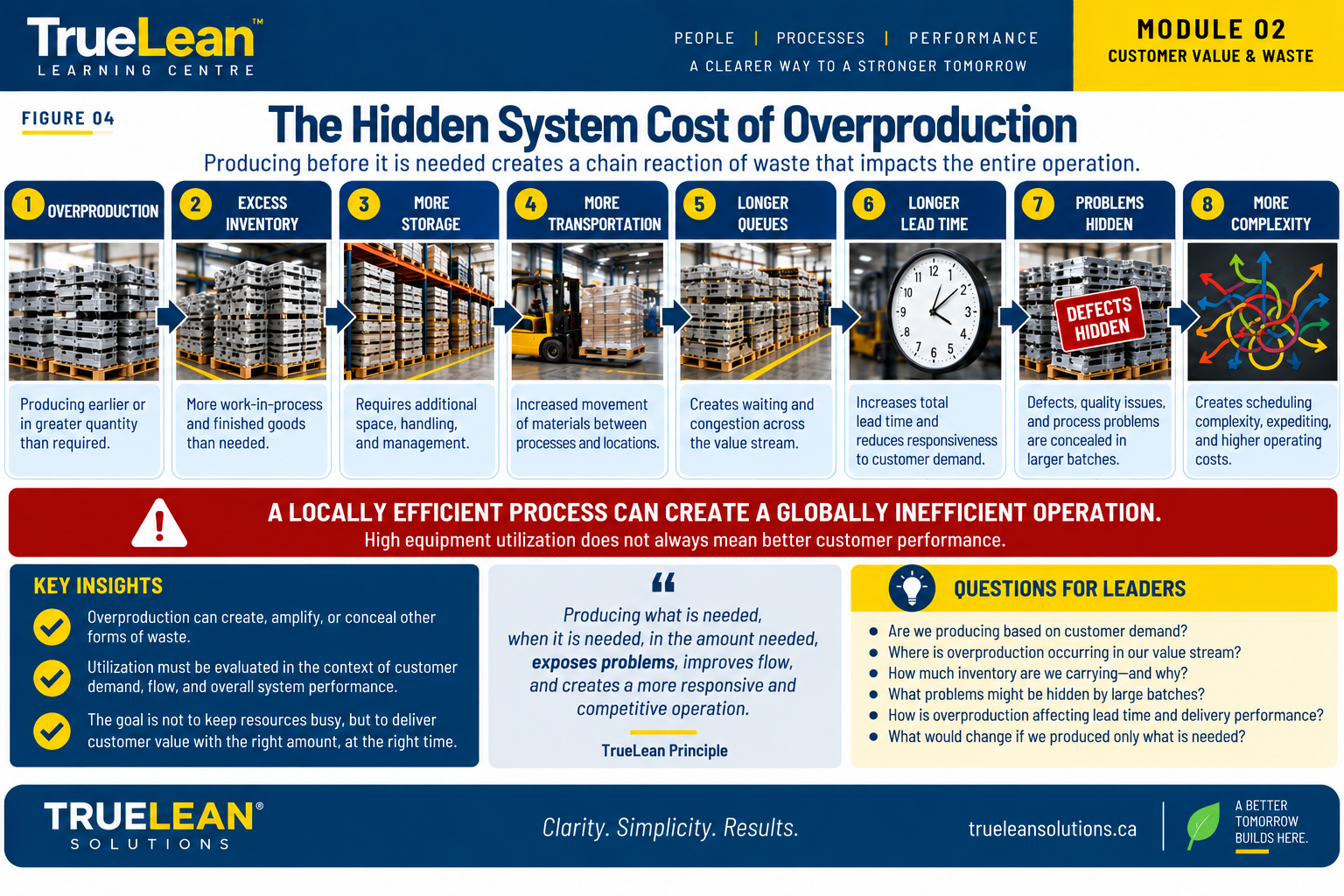
Suppose a cutting operation can produce far more parts than the downstream process currently requires. Management may encourage the machine to continue producing because stopping it appears inefficient. The departmental metric can look excellent while the value stream becomes less responsive.
Overproduction can lead to excess inventory, added storage, unnecessary transportation, longer queues, longer lead time, hidden problems and greater scheduling complexity.
A locally efficient process can contribute to a globally inefficient operation.
06 · Waste Is More Than Muda
Finding visible waste is useful. It is not enough.
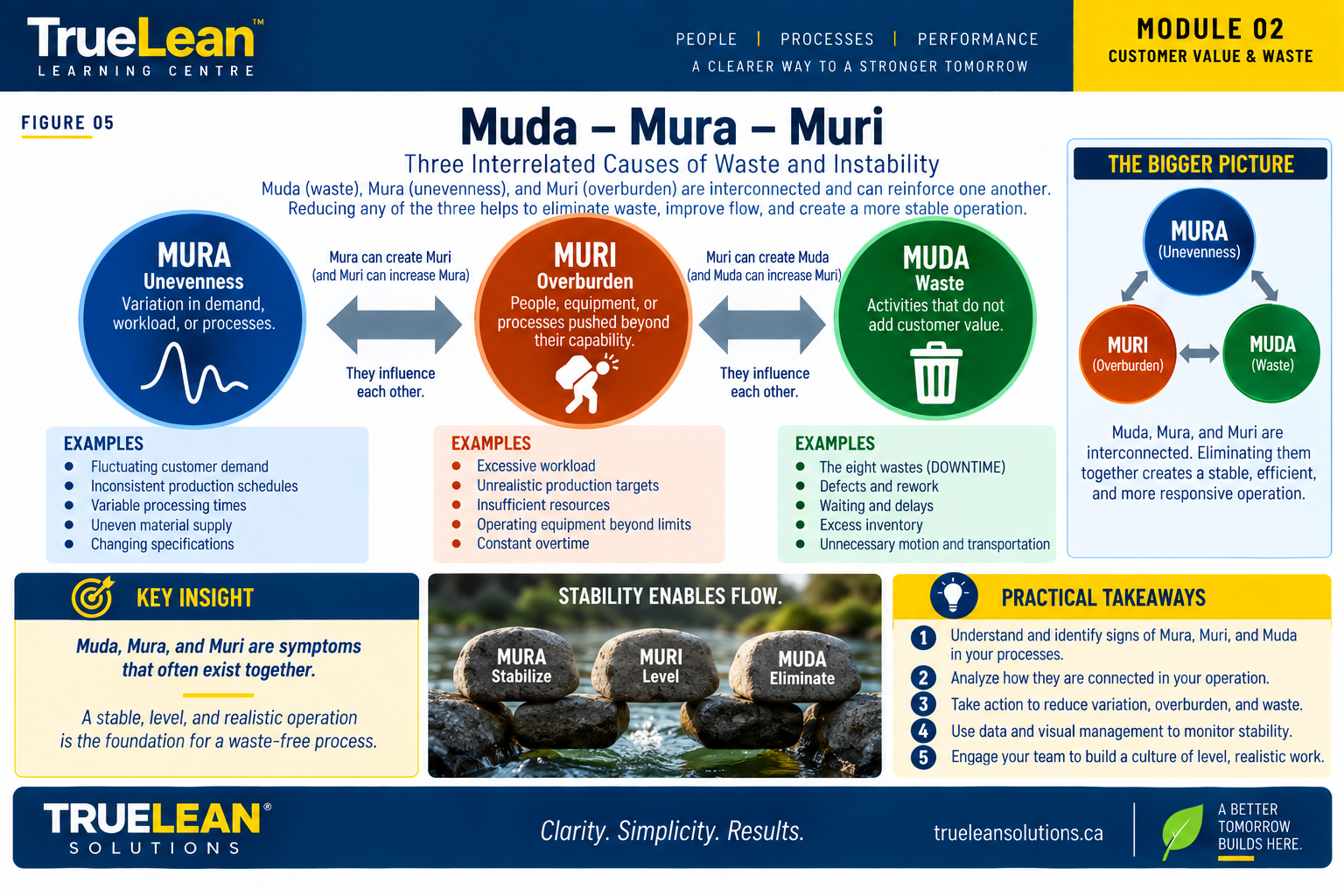
Muda — Waste
Activities that consume resources without creating required customer value, such as waiting, rework, unnecessary movement, excess inventory and unnecessary processing.
Mura — Unevenness
Irregularity or imbalance in workload, demand, scheduling, production or process conditions. Examples include unstable schedules, inconsistent batch releases, variable processing times and uneven material supply.
Muri — Overburden
Conditions that place unreasonable or unsustainable demands on people, equipment or processes, such as excessive overtime, unrealistic targets, unsafe ergonomic demands or equipment being repeatedly pushed beyond practical capability.
Muda, Mura and Muri can influence and reinforce one another. The leadership task is to understand the actual relationship in the process rather than assume a predetermined cause.
07 · Why Waste Becomes Normal
Some of the most significant waste in an operation becomes almost invisible—not because it cannot be seen, but because everyone becomes accustomed to it.
Pallets in aisles, excessive WIP, recurring overtime, queues around equipment, daily expediting, repeated quality holds, disconnected spreadsheets and constant schedule changes can gradually become accepted as normal operating practice.
A process is not healthy simply because the organization has become skilled at working around its problems.
08 · Go See the Work
Waste identification should not begin and end with a spreadsheet. Leaders need to observe actual operating conditions.
At the Gemba, useful questions include:
- What should be happening right now?
- What is actually happening?
- What does the customer require?
- Where does material stop?
- Where does information stop?
- Where are people waiting or rushing?
- Where does WIP accumulate?
- Where is work repeated?
- Where are abnormalities hidden?
- What prevents the process from progressing as intended?
Observation is not an employee inspection exercise. The objective is to understand the process.
09 · Manufacturing Example: The Bottleneck That Wasn't the Whole Problem
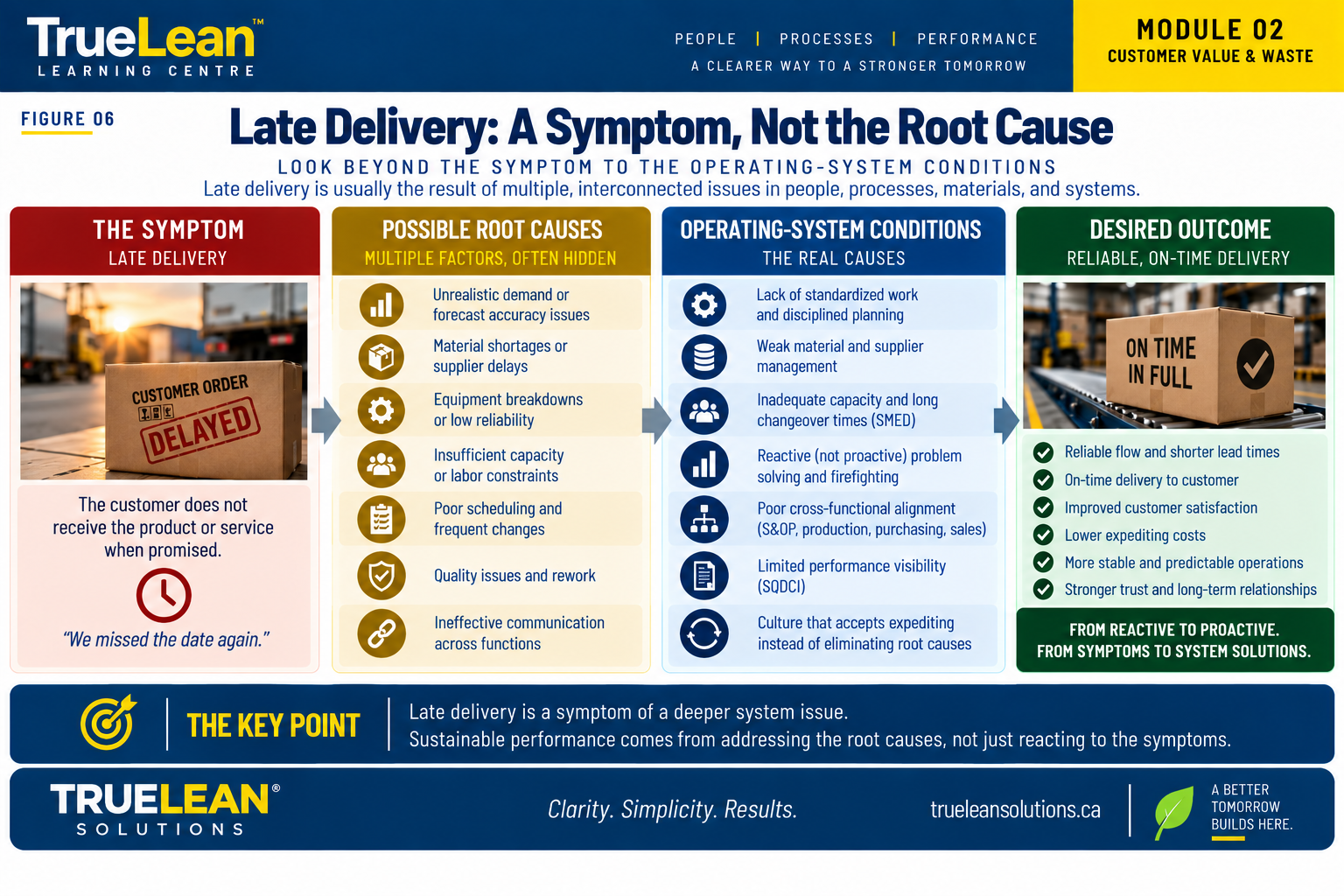
Consider a metal-fabrication operation: Laser Cutting → Forming → Welding → Finishing → Assembly → Shipping. Customers are experiencing late deliveries, and management sees a large queue in front of welding.
The initial conclusion is: “Welding needs to work faster.”
But that statement is a hypothesis—not a diagnosis. A process walk reveals large upstream batches, frequent priority changes, irregular arrivals at welding, searching through WIP for urgent jobs, expedites bypassing the normal sequence, surges into finishing, and assembly alternating between shortages and excess inventory.
The visible symptom is late delivery. The operating pattern is: Large Batches → Excess WIP → Uneven Flow → Priority Changes → Searching → Waiting → Expediting → Overburden → Delivery Instability.
10 · Observe Before You Improve
Step 1 — Define the Requirement
Understand what the customer needs, required quantity, quality expectations, delivery requirement and relevant demand pattern.
Step 2 — Follow the Work
Walk the process in sequence. Whenever practical, follow an actual order, component, transaction or information flow rather than examining departments independently.
Step 3 — Separate Work From Delay
Identify where transformation occurs and where the product or information waits, moves, queues, is stored, inspected, corrected or processed repeatedly.
Step 4 — Examine Muda, Mura and Muri
Do not stop when visible waste is identified. Ask what conditions are creating it.
Step 5 — Validate With Evidence
Determine frequency, duration, quantity, location, impact and pattern. Observation generates questions. Evidence tests them.
11 · Common Mistakes
Turning Lean Into a Waste Hunt
Teams create a long list of DOWNTIME examples but never investigate why those conditions exist. Connect observed waste to process and management-system conditions.
Treating People as Waste
Improve the system in which people perform their work.
Removing Necessary Controls Too Quickly
An inspection may appear non-value-creating but may currently protect the customer from an incapable upstream process. Understand why the control exists before removing it.
Maximizing Utilization Instead of Flow
Evaluate utilization within customer demand and overall system requirements.
Looking Only for Muda
Examine Muda, Mura and Muri together.
Starting With a Solution
Understand the problem before selecting the countermeasure.
12 · Measure What Matters
Waste reduction should eventually become visible in operational performance, but no single metric proves an operation is Lean. A balanced view is more useful.
| Performance Dimension | Measures | What They Help Reveal |
|---|---|---|
| Customer | OTIF, Lead Time | Whether the system reliably delivers what the customer requires. |
| Flow | WIP, Queue Time, Travel Distance | Where work stops, accumulates or moves unnecessarily. |
| Quality | First-Pass Yield, Scrap, Rework | Whether work is completed correctly without correction. |
| Stability & Capability | Schedule Adherence, Changeover Time, Overtime, Expedites | Whether the operating system performs predictably and sustainably. |
Increasing output while WIP, overtime, expedites and lead time all increase may not represent genuine system improvement.
13 · Leadership Responsibilities
Lean leadership requires managers to:
- Clarify Value — ensure teams understand customer and business requirements.
- Go See — observe actual work and operating conditions.
- Make Problems Visible — expose abnormalities early rather than reward hiding them.
- Ask Before Prescribing — understand the condition before choosing a countermeasure.
- Protect People From Overburden — do not transfer unsustainable pressure onto employees.
- Challenge the System — examine scheduling, layout, information, standards, equipment, policies and management practices.
- Develop People — build capability to recognize abnormalities, investigate causes, test countermeasures and improve standards.
CLARIFY → GO SEE → MAKE VISIBLE → ASK → PROTECT → CHALLENGE → DEVELOP
14 · Applying the TrueLean Improvement Framework
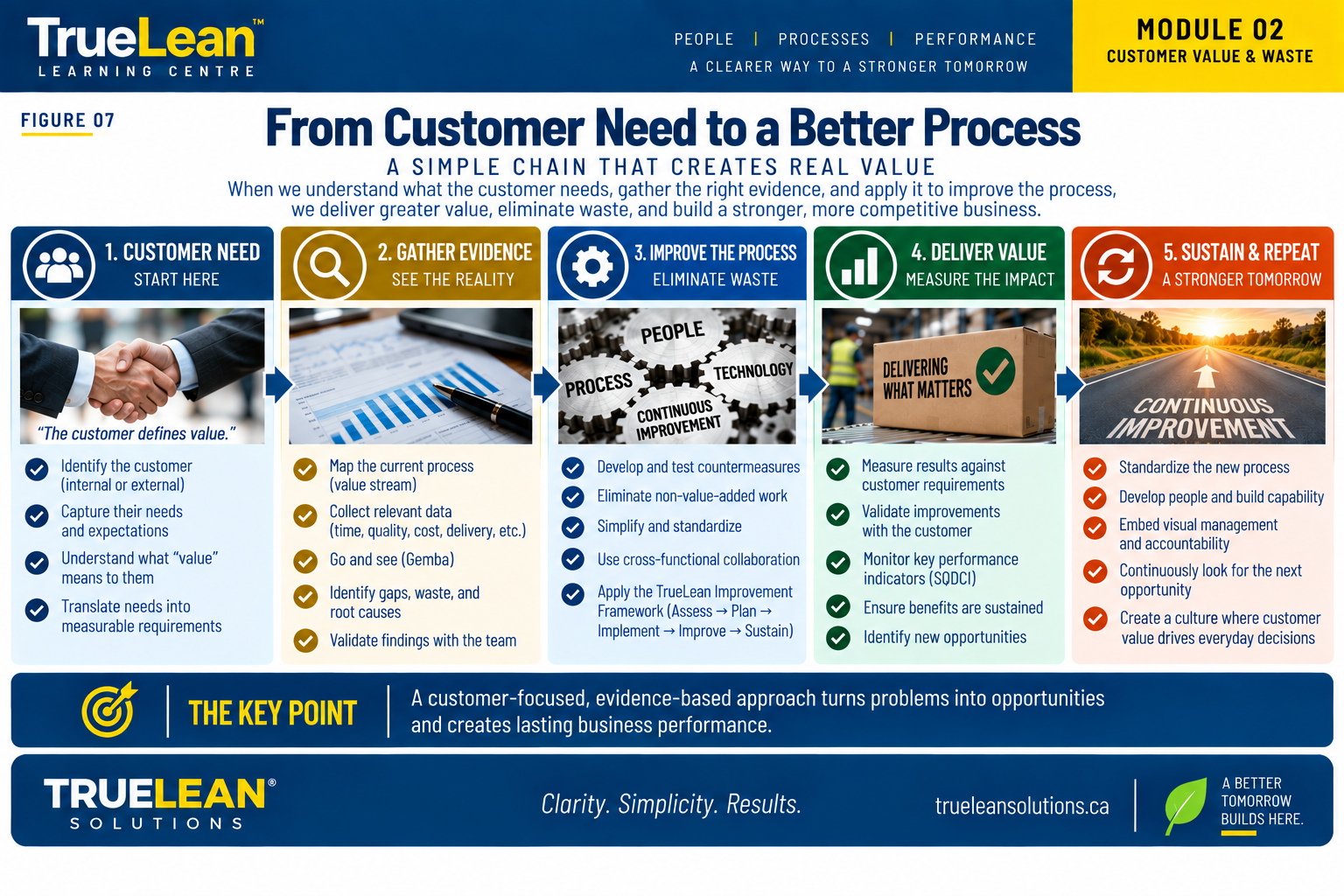
Waste identification becomes valuable when it leads to disciplined improvement. The TrueLean Solutions Improvement Framework organizes that journey through five stages.
Assess: Understand customer requirements, current flow, Muda, Mura, Muri and available evidence.
Plan: Prioritize the system conditions having the greatest impact on customer and business performance.
Implement: Change processes, standards, layouts, controls or operating practices based on evidence.
Improve: Evaluate results, learn from implementation and refine the operating system.
Sustain: Integrate improvements into standard work, daily management, leadership routines and organizational capability.
The five-stage TrueLean Solutions Improvement Framework — Assess, Plan, Implement, Improve and Sustain — is a proprietary TrueLean framework informed by established operational excellence, Lean/TPS and continuous-improvement principles.
15 · Key Takeaways
- Value begins with the customer.
- Activity is not the same as value.
- Work can be viewed as value-creating, necessary under current conditions, or waste.
- The traditional seven wastes remain an important TPS/Lean foundation; non-utilized talent is a widely used contemporary eighth category.
- Muda, Mura and Muri are interconnected.
- People are not waste; the responsibility is to improve the system in which people work.
- Follow the value stream, not just departments.
- Go See before prescribing solutions.
- Observation must be validated with evidence.
- Local efficiency must not damage overall flow or customer performance.
- Waste reduction should improve measurable operational performance.
- Lean leadership develops the organization's capability to recognize and solve problems.
The goal is not to eliminate activity indiscriminately. The goal is to understand what creates value, what currently supports value creation, and what consumes resources without improving the outcome.
16 · Continue Learning
Module 03 — Workplace Stability
Learn how workplace organization, standards, visual conditions, abnormalities, 5S/6S and basic process discipline create the foundation required before more advanced Lean systems can perform reliably.
Return to Learning CentrePractical Resource
Use the TrueLean Lean Leadership & Management System Assessment to examine leadership behaviour, management-system maturity and operational evidence across your organization.
Need help applying this to your operation?
TrueLean Solutions helps manufacturing leaders assess current conditions, identify the operating issues that matter most, and build practical improvement roadmaps based on evidence.
Schedule a Consultation