
Lean is one of the most widely used — and frequently misunderstood — approaches to operational improvement. In some organizations, Lean means 5S. In others, it means Kaizen events, Kanban boards, Value Stream Mapping, cost reduction, or the work of a Continuous Improvement department. All of those may have a place. But none of them individually represents Lean.
01 · LEAN FUNDAMENTALS
What Is Lean?
At its core, Lean is a disciplined way of thinking about how an organization creates value: understanding what customers need, examining how work actually happens, reducing waste and unnecessary effort, solving problems, developing people, and continuously improving the system that delivers that value.
Lean is a disciplined way of managing and improving work so an organization creates greater customer value while systematically reducing waste, solving problems, developing people, and improving the performance of the overall system.
Lean begins with customer value
An operation can become extremely efficient at performing work that does not create meaningful value for the customer. That is not operational excellence.
Leaders first need to understand what customers actually require from the product and the process delivering it.
Lean focuses on the system
Consider a simple example: one department reduces cycle time by 20%, but the additional output then waits three days before the next process can accept it.
The local process improved. The value stream may not have. Lean requires leaders to look beyond local efficiencies and evaluate end-to-end performance.
Lean develops capability
A strong operation should progressively develop the ability to:
02 · AVOIDING COMMON MISCONCEPTIONS
What Lean Is Not
Lean is not simply cost cutting
Cost improvement can be a legitimate result of Lean. Arbitrary cost reduction, however, can destabilize an operation.
A stronger question is: What prevents this process from creating customer value safely, reliably and efficiently?
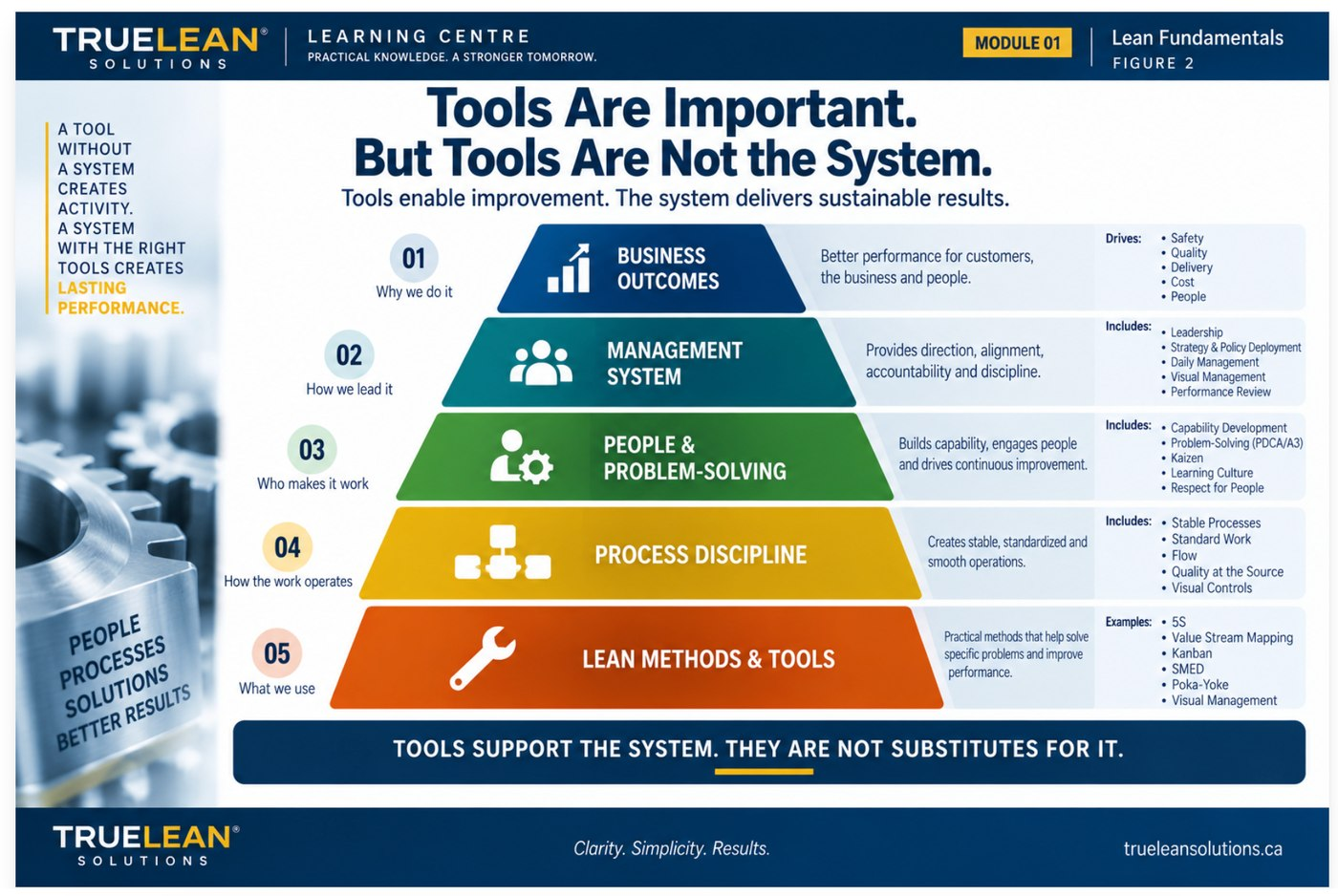
Lean is not a toolbox
5S, Kanban, Standard Work, SMED, Poka-Yoke, Visual Management and Value Stream Mapping address particular operating conditions. The problem should determine the method — not the method determine the problem.
Lean is not the Continuous Improvement department
Continuous Improvement professionals can provide expertise, facilitation and coaching, but operational performance belongs to operational leadership and the people who run the processes.
Lean is not a series of Kaizen events
If standards disappear, visual controls become outdated and leaders return to previous routines, the organization conducted an event. It did not build a sustainable improvement system.
Lean is not copying Toyota
Toyota's system deserves serious study, but copying visible practices without understanding the operating conditions and problems those practices address rarely creates the same capability.
03 · LEAN & TPS
Where Did Lean Come From?
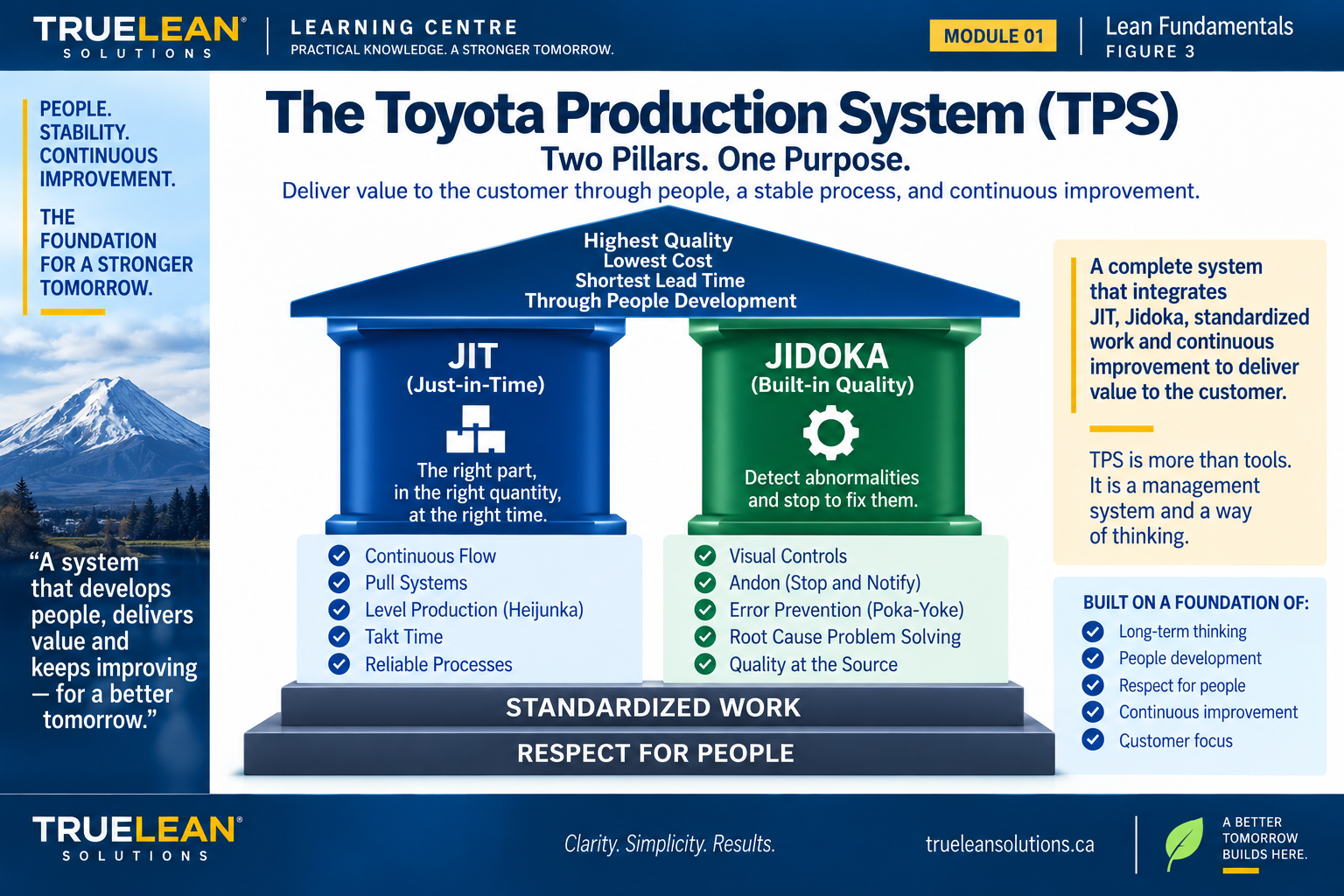
Modern Lean thinking is strongly connected to the development of the Toyota Production System, commonly known as TPS.
Toyota identifies Jidoka and Just-in-Time as the two fundamental pillars of the Toyota Production System.
Jidoka
Jidoka develops the capability to make abnormalities visible and prevent problems from continuing unchecked through the process.
In practical operational terms: do not knowingly pass a problem downstream.
Just-in-Time
Just-in-Time means providing what is needed, when it is needed, and in the quantity needed.
Achieving this requires flow, synchronization, clear demand signals and sufficiently stable processes.
Lean and TPS are closely related, but they should not be treated as automatically interchangeable terminology. TPS is Toyota's production system. Lean has developed into a broader body of management and improvement thinking strongly influenced by TPS.
04 · LEAN THINKING
The Five Principles of Lean
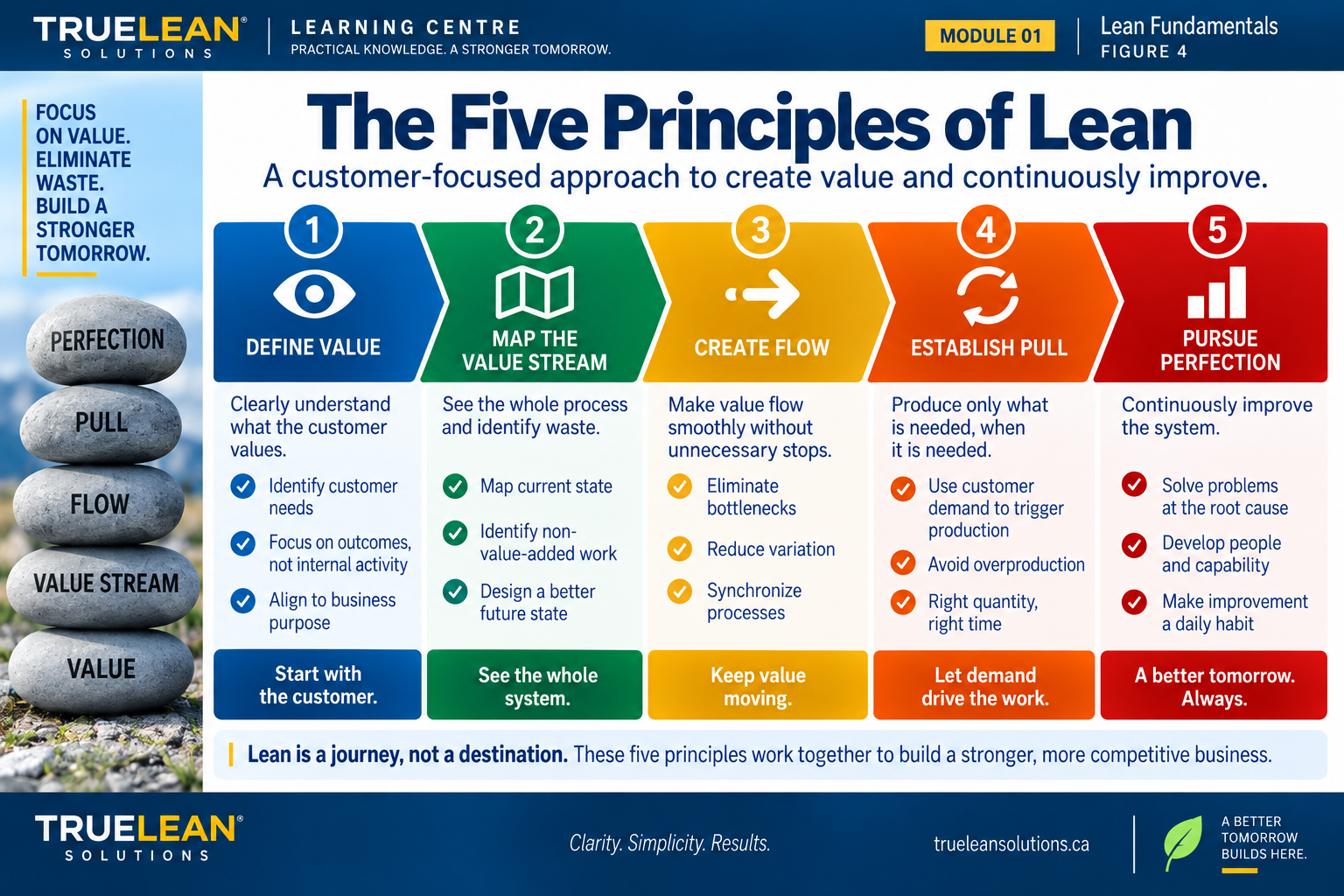
A widely recognized framework for Lean thinking consists of five principles: Value, Value Stream, Flow, Pull, and Perfection.
Introduced by James P. Womack and Daniel T. Jones in Lean Thinking, the principles provide a useful way to examine how value moves through an organization.
1. Define Value
Understand what creates meaningful value from the customer's perspective.
2. Identify the Value Stream
See the complete flow of activities required to deliver that value. Identify waste, delays, constraints, handoffs and opportunities for improvement.
3. Create Flow
Connect value-creating activities and reduce unnecessary waiting, interruption, queues and barriers that prevent work from moving smoothly.
4. Establish Pull
Connect production and replenishment to downstream demand so work is performed when it is actually needed.
5. Pursue Perfection
Continue removing waste, strengthening processes, developing people and improving customer value. Lean is an ongoing learning process rather than a one-time implementation.
05 · PEOPLE & PROBLEM-SOLVING
People, Process & Problem-Solving
Processes do not improve themselves.
People see abnormalities, investigate causes, develop countermeasures, establish standards and learn.
If employees are expected to expose problems, leaders need to create conditions where revealing a problem is more valuable than hiding one.
When a frontline employee identifies a problem, does the management system encourage investigation and learning — or does it create pressure to keep production moving and hide the abnormality?
06 · SYSTEM THINKING
How Lean Works as a System
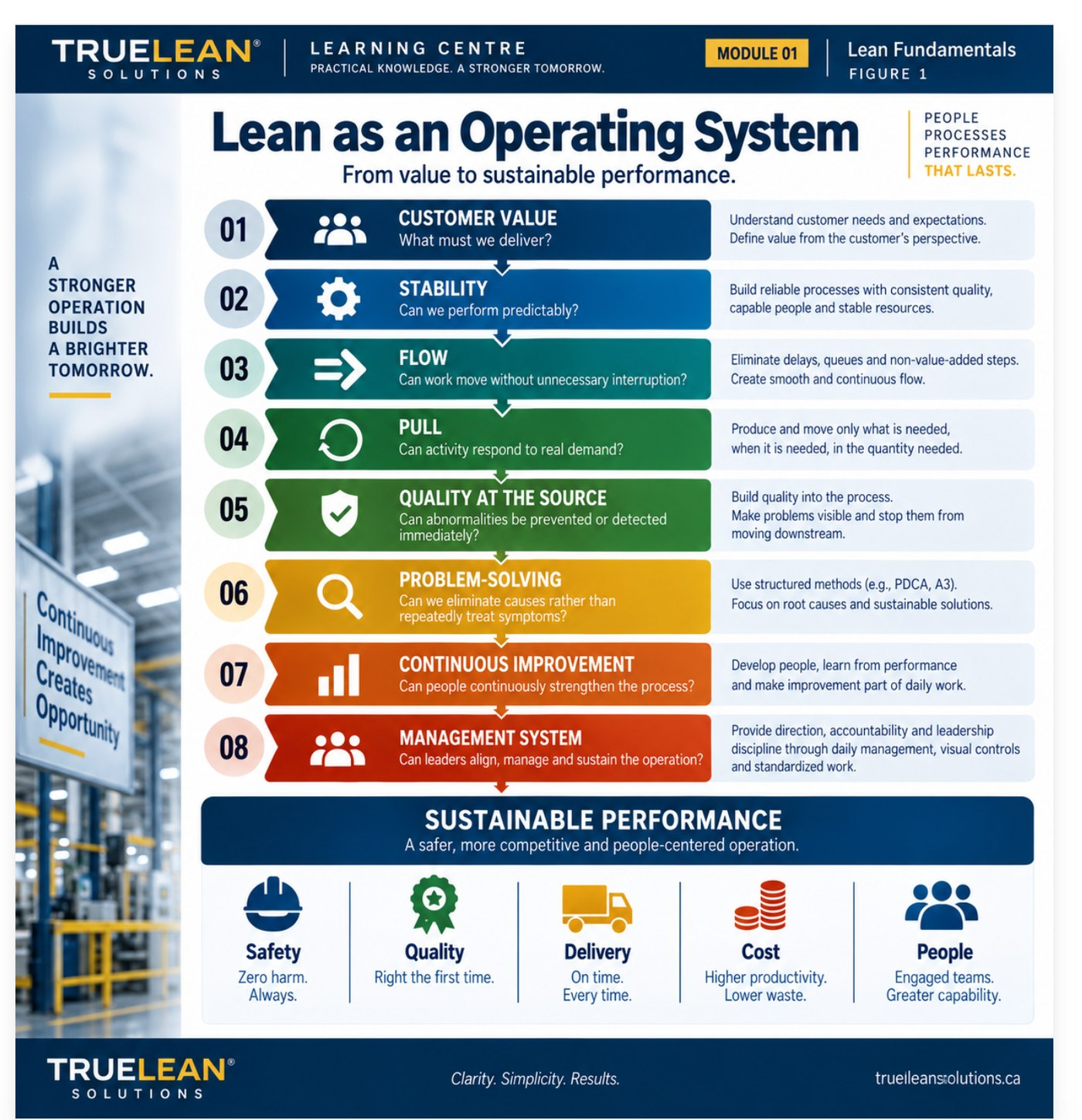
Sustainable Lean performance emerges from the interaction of multiple operating disciplines rather than from the isolated use of individual tools.
Customer Value establishes direction. Stability creates predictability. Flow reduces interruption and waiting. Pull connects activity to demand. Quality at the Source prevents abnormalities from travelling through the value stream.
Structured Problem-Solving addresses causes. Continuous Improvement develops capability. Management Systems establish visibility, accountability, alignment and leadership discipline.
Customer Value → Stability → Flow → Pull → Quality at Source → Problem-Solving → Continuous Improvement → Management System → Sustainable Performance
07 · MANUFACTURING EXAMPLE
From Symptoms to System
Consider an operation experiencing late orders, high work in process, frequent expediting, quality problems, overtime and long changeovers.
A 5S event may improve workplace organization, but it may do very little to improve delivery if the deeper operating system contains capacity constraints, excessive batching, long changeovers, schedule instability, weak Standard Work and late quality detection.
The stronger approach is to observe the work, understand the operating conditions, identify the underlying constraints, and apply focused countermeasures to the problems that matter most.
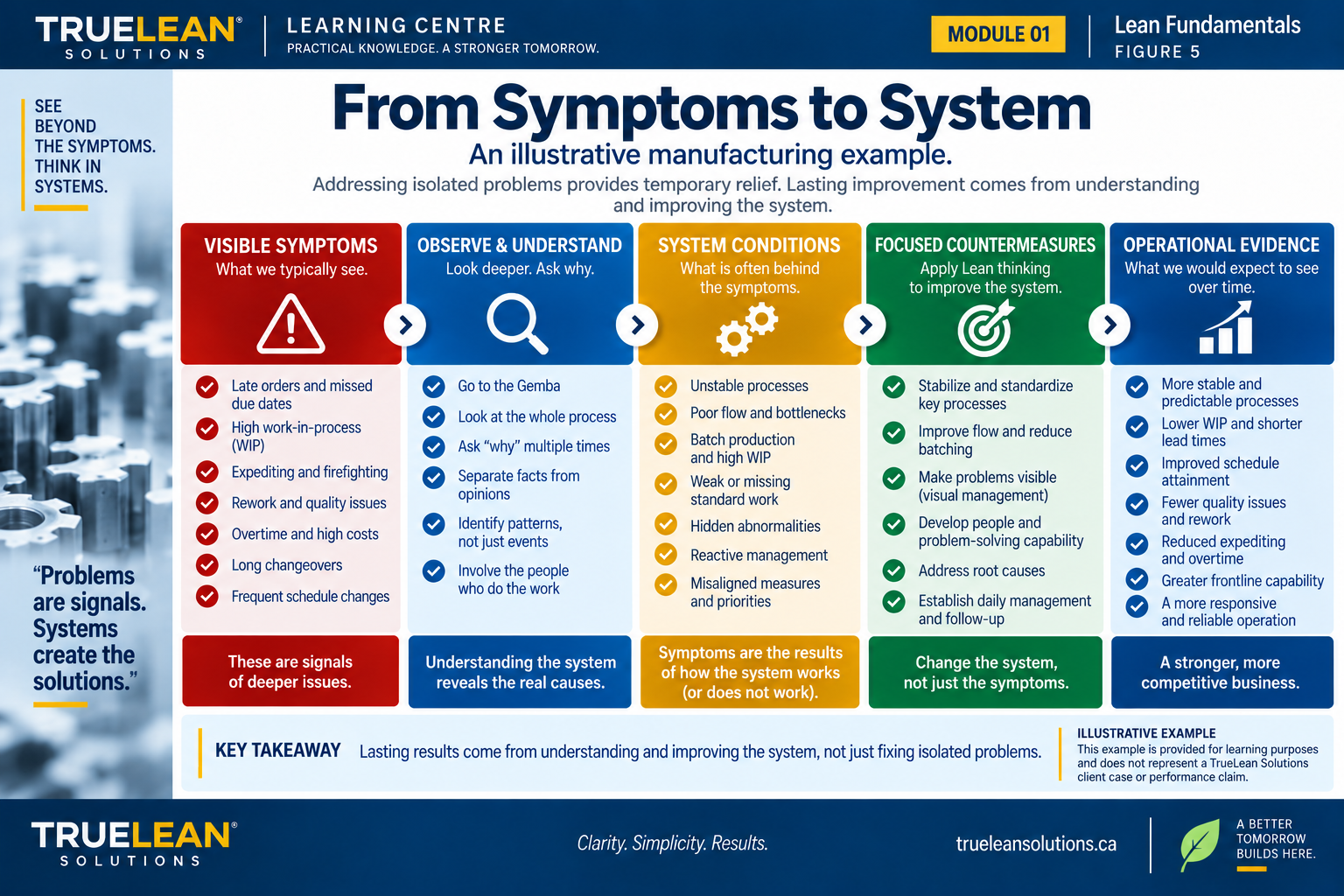
Diagnose the operating system before prescribing the Lean tool.
08 · GETTING STARTED
How Should a Manufacturer Begin Lean?
Organizations frequently begin by asking: Which Lean tool should we implement first?
A stronger starting point is:
What prevents the operation from achieving the performance the customer and business require?
TrueLean organizes improvement through five stages:
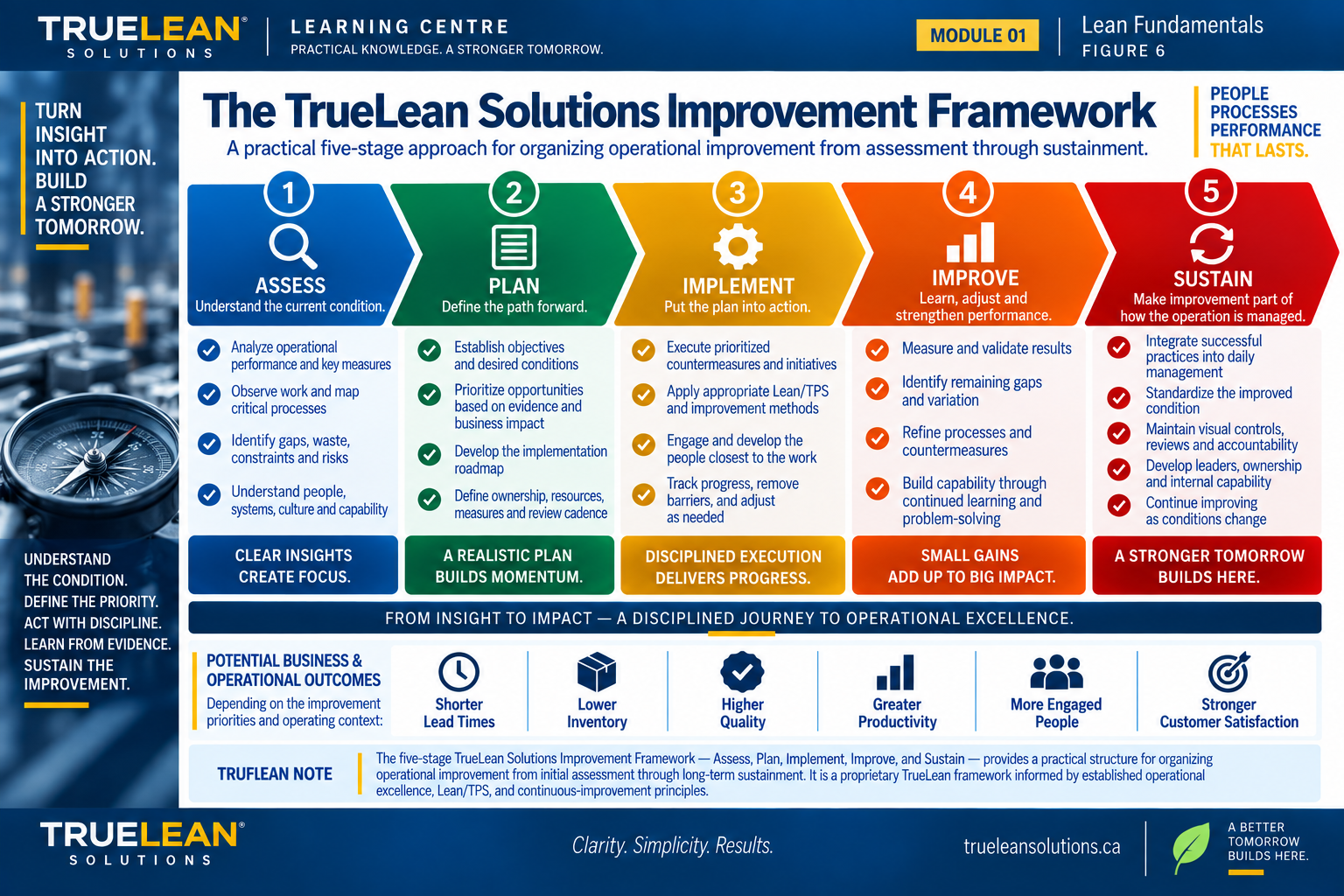
The five-stage TrueLean Solutions Improvement Framework — Assess, Plan, Implement, Improve, and Sustain — provides a practical structure for organizing operational improvement from initial assessment through long-term sustainment. It is a proprietary TrueLean framework informed by established operational excellence, Lean/TPS, and continuous-improvement principles.
Common Lean implementation mistakes
- Starting with a preferred tool instead of the operating problem.
- Launching improvement activities without a reliable baseline.
- Optimizing individual departments while weakening overall flow.
- Treating Lean as a Continuous Improvement department initiative.
- Failing to define ownership for new standards and routines.
- Measuring activity instead of operational outcomes.
- Stopping management attention after initial implementation.
09 · PERFORMANCE
How Do We Know Lean Is Working?
There is no single Lean KPI.
Evidence of progress should appear in a balanced set of measures reflecting both operational performance and the organization's capability to identify, solve and sustain improvements.
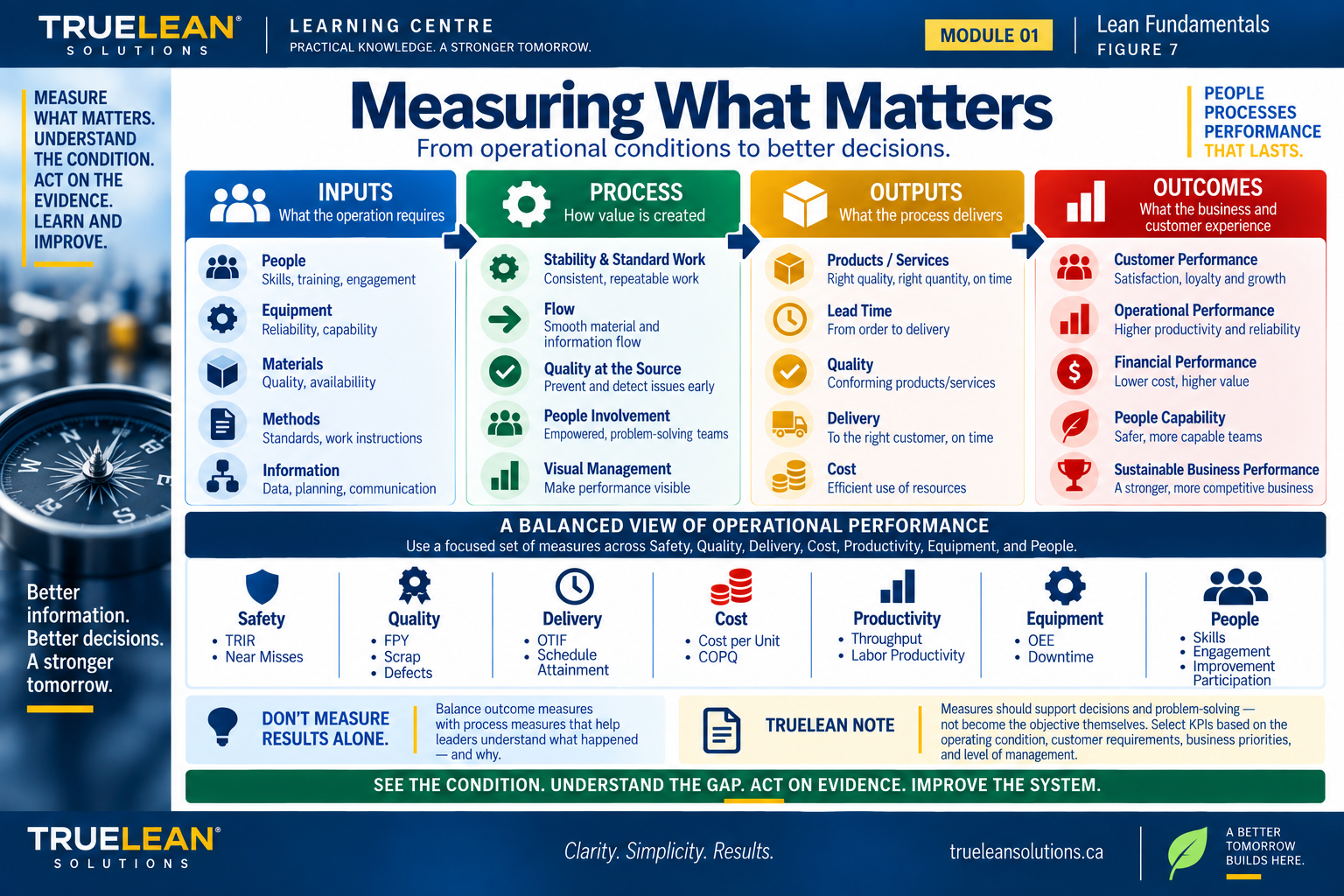
A balanced operational view
| Performance Area | Examples |
|---|---|
| Safety | TRIR, near misses, corrective-action closure |
| Quality | First-pass yield, scrap, defects, rework |
| Delivery | OTIF, schedule attainment, lead time |
| Cost | Cost per unit, cost of poor quality |
| Productivity | Throughput, labor productivity |
| Equipment | OEE, downtime, preventive-maintenance completion |
| People | Skills, engagement, qualification, improvement participation |
Capability check
Performance indicators should be complemented by questions about the organization's improvement capability:
- Are abnormalities becoming visible sooner?
- Are supervisors solving more problems at the appropriate level?
- Are standards being maintained?
- Are employees participating meaningfully in improvement?
- Are leaders regularly observing actual conditions at Gemba?
- Are countermeasures being verified?
- Are improvements still operating months later?
Balance outcome measures with process measures that help leaders understand what happened — and why.
10 · LEADERSHIP
What Lean Requires From Leaders
Set Purpose
Connect operational improvement with customer requirements and business priorities.
Go to Gemba
Reports show what happened. The workplace helps leaders understand why.
Make Problems Visible
A strong management system exposes abnormalities early rather than allowing them to remain hidden until they become larger failures.
Develop People
Develop people capable of understanding and solving increasingly difficult operational problems.
Protect Standards
Standards provide a baseline for reliable work and further improvement.
Remove Systemic Barriers
Conflicting KPIs, weak planning, inadequate resources, organizational silos and unclear ownership often require management action.
Create Accountability
Clear expectations, ownership and follow-through are necessary for reliable operations.
Be Consistent
Leadership behaviour becomes most visible when performance is under pressure.
11 · WHAT COMES NEXT
Lean Concepts You Will Encounter Next
The concepts below are brief orientation points. Later TrueLean Learning Centre modules will examine several of them in greater depth.
The Eight Wastes — DOWNTIME
Lean identifies eight common categories of non-value-added activity:
- Defects — work that must be corrected, scrapped or reworked.
- Overproduction — making more, sooner, or faster than the next process needs.
- Waiting — people, machines or material sitting idle for the next step.
- Non-utilized talent — not using people's skills, knowledge or ideas.
- Transportation — unnecessary movement of materials or information.
- Inventory — more material, WIP or finished goods than the process needs.
- Motion — unnecessary movement of people within a process.
- Extra-processing — doing more work than the customer requires.
PDCA and A3 Thinking
Plan-Do-Check-Act is a disciplined learning cycle used in Lean improvement and problem-solving.
An A3 is a concise way to organize and communicate that thinking. The document supports the problem-solving process; it does not replace the thinking.
Gemba
Gemba is the Japanese term for the actual place. In Lean usage, it refers to the place where value-creating work occurs.
Going to Gemba means directly observing and inquiring into actual conditions before taking action rather than relying only on reports or assumptions.
The Shingo Model
The Shingo Model is an organizational-excellence framework that helps leaders examine how principles, systems and behaviours influence sustainable results.
Lean and Six Sigma
Lean and Six Sigma are frequently paired, but they emphasize different aspects of improvement.
Lean commonly focuses on customer value, flow, waste reduction and better operating systems. Six Sigma places greater emphasis on reducing variation and defects through disciplined, data-based problem-solving and statistical methods.
The method should serve the operational problem rather than become the objective itself.
Lean Beyond Manufacturing
Although this module is intentionally written for manufacturing leaders, Lean principles have also been adapted to service and knowledge-work environments.
Application should always be adjusted to the process, customer, risks and operating context rather than copied mechanically from manufacturing.
12 · SUMMARY
Key Takeaways
What should a manufacturing leader remember?
- Lean is a system. It is a way of managing and improving an operation — not simply a collection of tools.
- Start with value. Customer requirements provide the reference point for improvement.
- Improve the whole. Stability, flow, quality, problem-solving, people and management systems are interconnected.
- Leadership matters. Leadership determines whether improvement becomes part of daily work or another temporary initiative.
- Measure what matters. The strongest evidence of Lean is better operational performance combined with greater capability to keep improving.
13 · APPLY WHAT YOU LEARNED
Practical Resource
TrueLean Lean Leadership & Management System Assessment
Evaluate your organization across 10 leadership and management-system dimensions using the TrueLean Behaviour × System × Evidence model. Identify maturity gaps, validate findings, establish priorities, and develop a focused 30-day action plan.
CONTINUE LEARNING
Where Do We Go Next?
Module 02 — Customer Value & Waste
Learn how to distinguish value-creating work from waste, recognize Muda, Mura and Muri, and begin seeing manufacturing processes through the customer and value-stream perspective.
Coming next in the TrueLean Learning Centre.
Related Deep Dives
14 · SOURCES
Sources & Further Reading
The TrueLean Learning Centre combines original TrueLean teaching with established Lean, TPS and operational-excellence references.
- Toyota Motor Corporation — Toyota Production System
- Lean Enterprise Institute — Lean Thinking and Practice
- James P. Womack and Daniel T. Jones — Lean Thinking
- Jeffrey K. Liker — The Toyota Way
- Shingo Institute — The Shingo Model
FROM LEARNING TO APPLICATION
Need help understanding what is limiting your operation?
TrueLean Solutions works with manufacturing and operations-driven organizations to assess current conditions, identify the constraints that matter most, strengthen operating systems, and develop practical improvement roadmaps.
Request a Consultation