
Continuous improvement becomes sustainable when teams make gaps visible, test changes, learn from evidence, strengthen standards, and connect improvement with daily management.
01 • Learning Objectives
Continuous improvement is the disciplined practice of making performance gaps visible, learning from the work, testing changes, confirming results, and incorporating better methods into the operating system. This module explains how leaders and teams can make improvement part of daily management rather than a separate program.
Explain continuous improvement as an operating discipline based on evidence and learning.
Understand why stability and standards create the baseline for meaningful improvement.
Describe performance gaps using expected and actual conditions.
Select an improvement level that matches the size, risk, urgency, and complexity of the gap.
Convert improvement ideas into clear predictions and controlled tests.
Apply PDCA within daily management and short learning cycles.
Recognize leadership behaviours that encourage participation and safe problem reporting.
Use balanced measures to confirm results, capability, adoption, and sustainability.
Standardize effective changes and share learning across similar processes.
02 • What Continuous Improvement Means
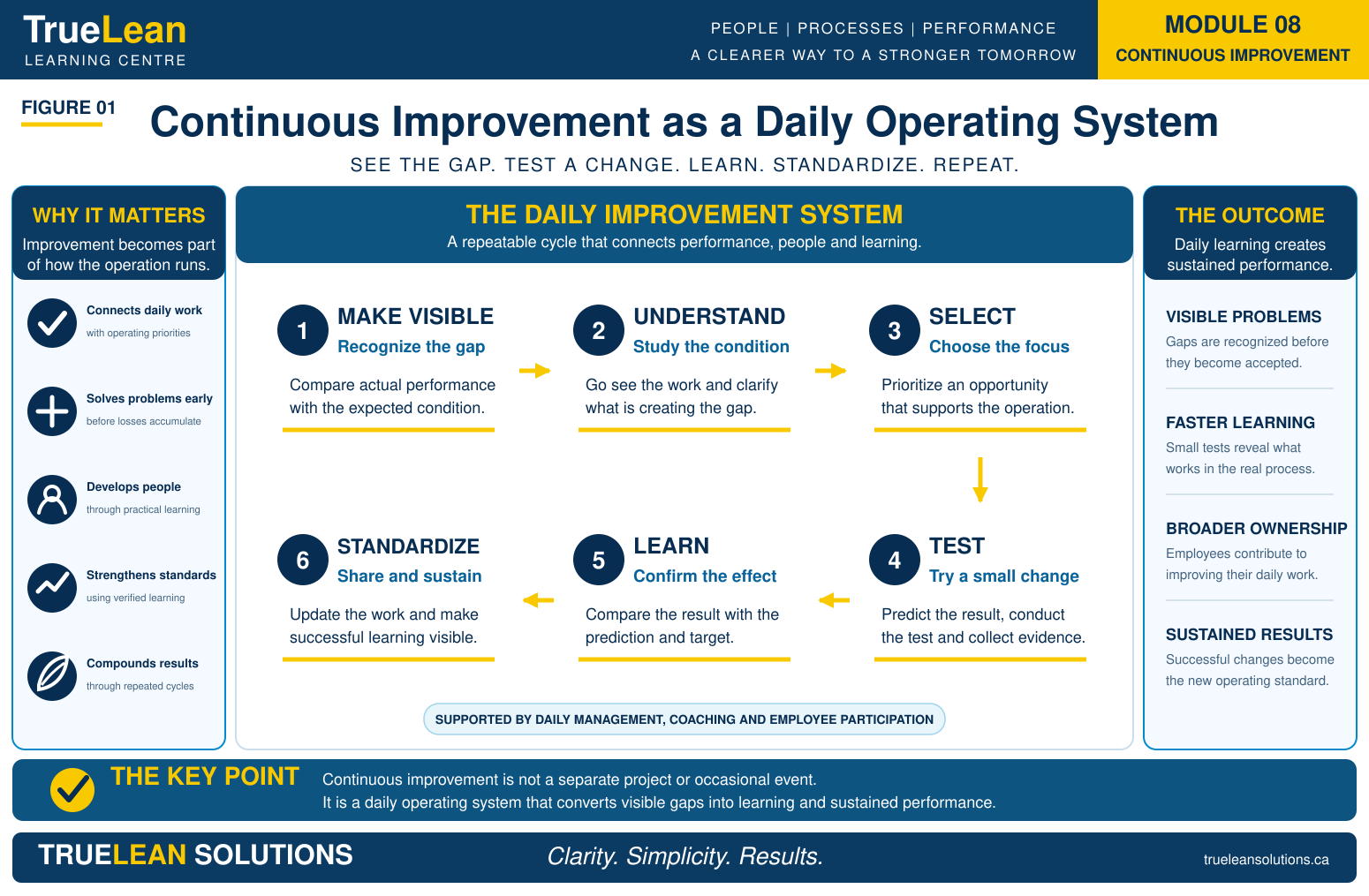
Continuous improvement is the repeated effort to close the gap between current performance and a better condition. It combines direct observation, reliable evidence, employee participation, controlled testing, leadership support, and follow-up. The objective is not constant activity. The objective is better performance and stronger capability.
Improvement as a system
See the gap between expected and actual performance.
Understand the operating condition in which the gap appears.
Select a practical change based on evidence and a clear prediction.
Test the change within controlled limits.
Measure the result and examine unintended effects.
Standardize the better method when the evidence supports it.
Share the learning and continue monitoring performance.
Begin the next cycle when a new gap or opportunity becomes visible.
| Improvement activity | Continuous improvement system |
|---|---|
| Runs occasional events | Uses daily, weekly, and focused learning cycles |
| Counts ideas or actions | Confirms operational results and sustained use |
| Depends on specialists | Builds capability throughout the organization |
| Treats standards as fixed | Uses standards as the baseline for the next improvement |
03 • Stability, Standards and Improvement
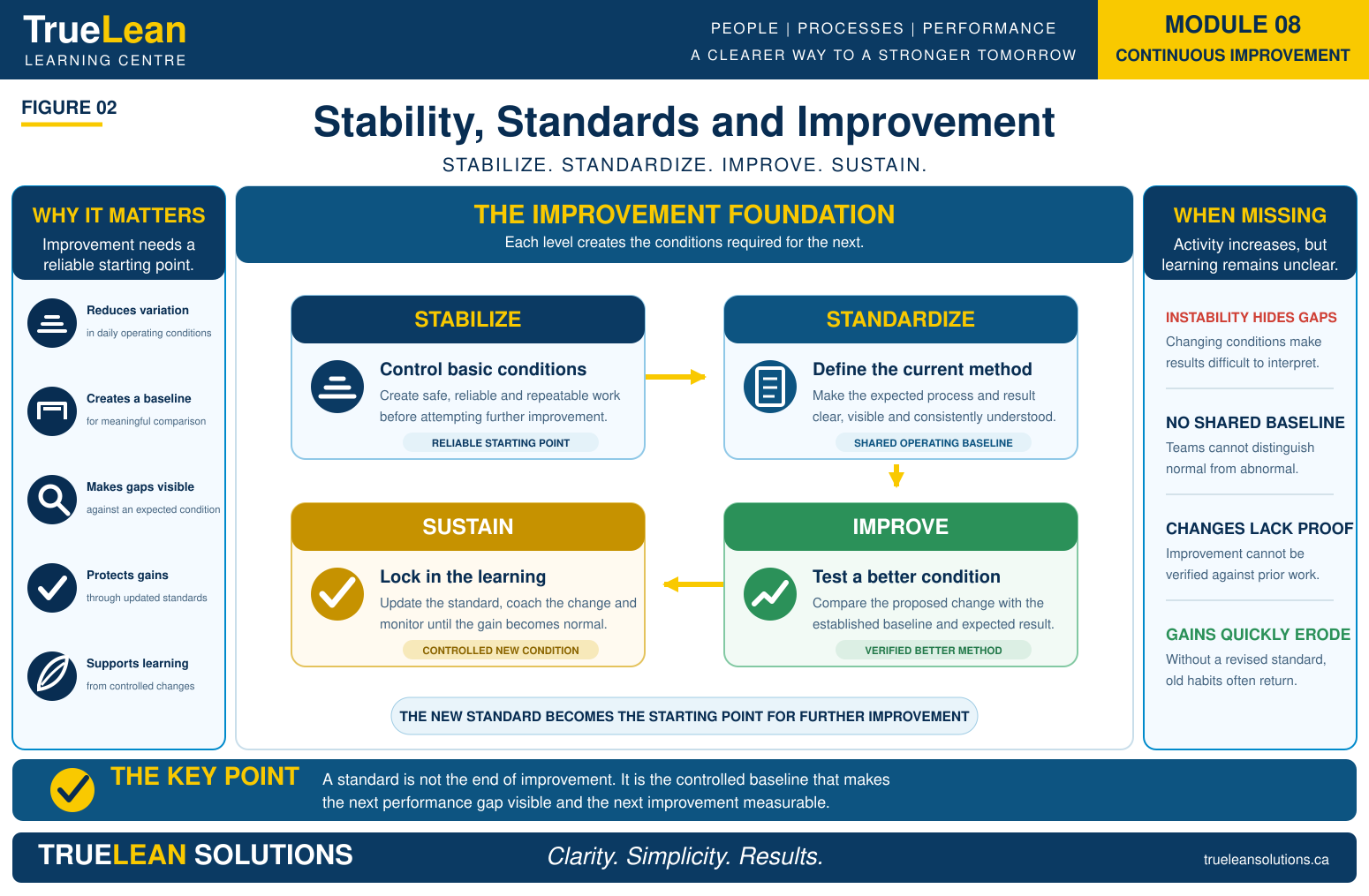
Improvement requires a visible reference condition. When work methods, equipment conditions, material presentation, staffing assumptions, or information flow change unpredictably, the team cannot determine whether a new idea caused the result. Stability does not require perfect performance. It requires enough consistency to distinguish normal operation from an abnormal condition.
A standard describes the current best known method and the expected operating condition. It supports training, observation, problem detection, and measurement. It should be practical, accessible at the point of use, and updated when better evidence becomes available.
What standards make possible
A common expectation for how the work should be performed.
A baseline for comparing actual and expected performance.
Earlier detection of abnormal conditions and process drift.
More reliable training and knowledge transfer.
A foundation for testing and sustaining a better method.
| Without a stable baseline | With a stable baseline |
|---|---|
| Results are difficult to interpret | Changes can be compared with a defined condition |
| Variation is accepted as normal | Abnormal conditions become visible |
| Training depends on personal preference | People learn a shared current method |
| Improvement gains fade quickly | The new method can be verified and sustained |
04 • Make Performance Gaps Visible
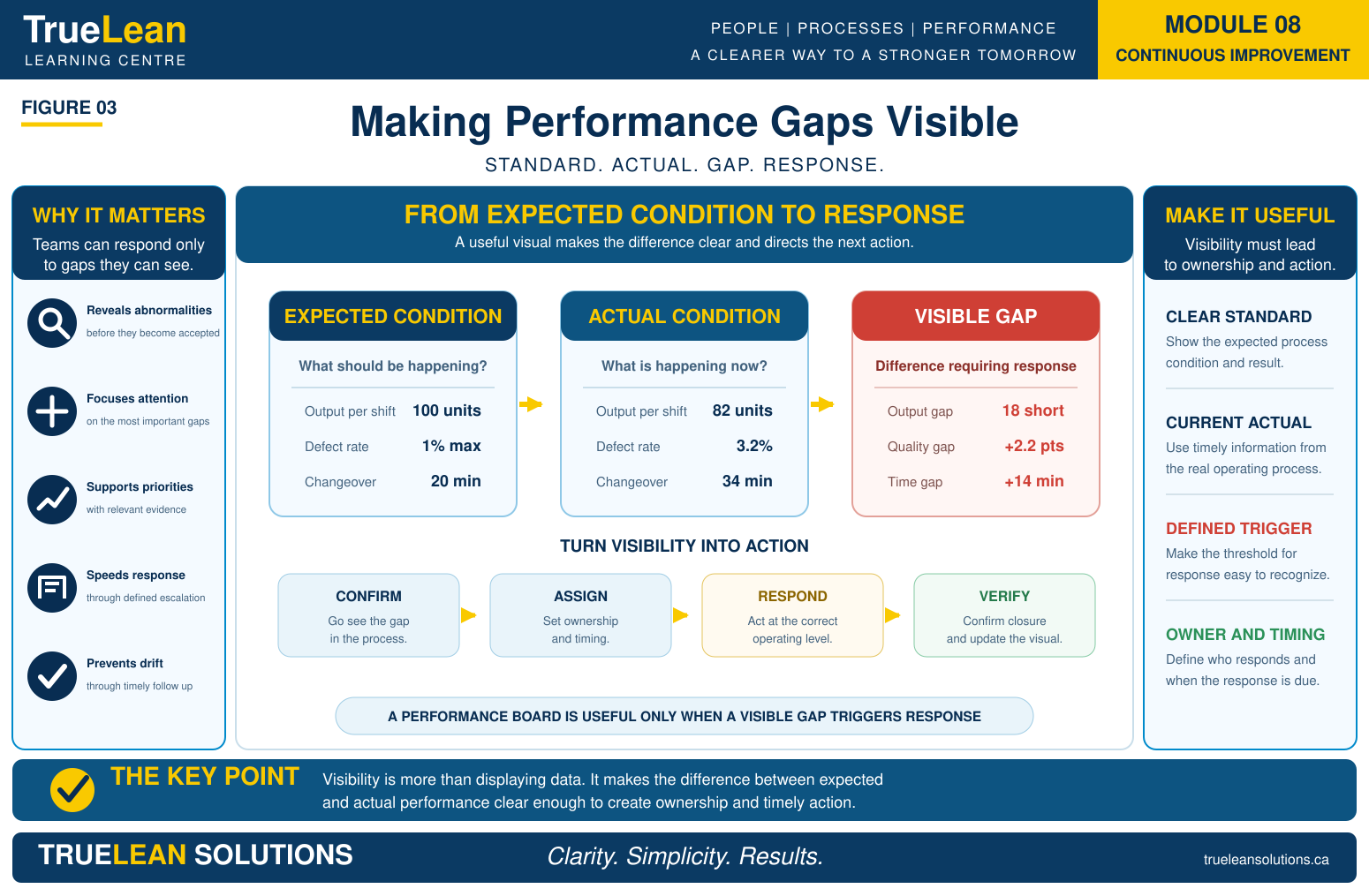
A performance gap is the measurable difference between the expected condition and the actual condition. A clear gap directs attention to the process, avoids premature conclusions, and helps the organization decide what level of response is appropriate.
Describe the gap with facts
Expected condition: What should be happening according to the standard, plan, specification, or customer requirement?
Actual condition: What is happening now, based on direct observation and reliable data?
Magnitude and frequency: How large is the difference, and how often does it occur?
Location and timing: Where and when does the gap appear?
Impact and risk: How does it affect safety, quality, delivery, cost, people, or the customer?
Ownership: Who is responsible for the process and the next learning step?
For example, “output is low” is too broad. A clearer statement is: During the previous five shifts, Assembly Cell 3 averaged 410 units against a planned output of 480 units, with the largest losses occurring during the first hour and after product changeovers.
05 • Select the Appropriate Improvement Level
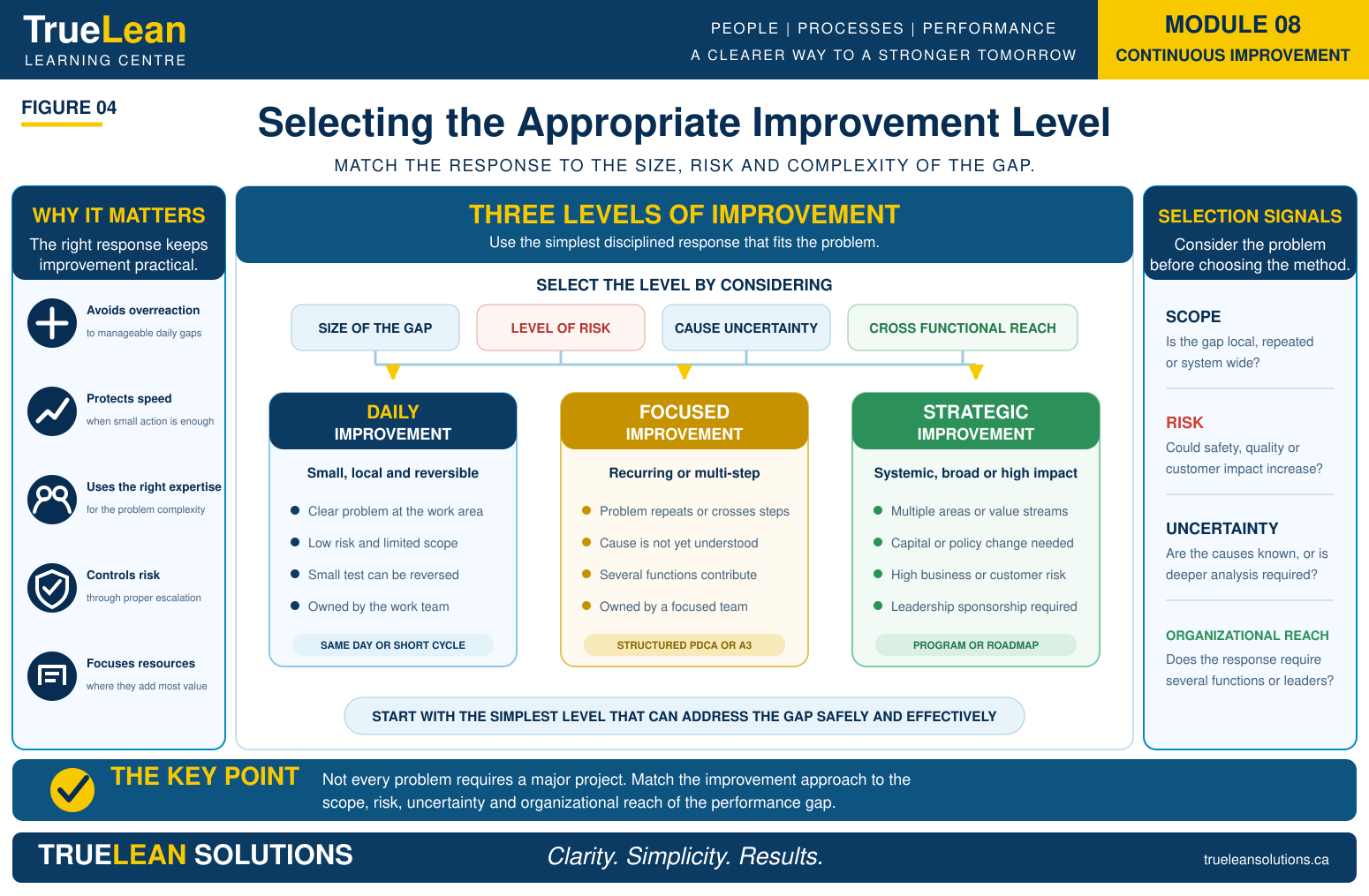
Not every gap requires a project, and not every gap should be handled during a brief stand-up meeting. The response should match the immediate risk, scope, urgency, available evidence, process complexity, and authority required to act.
| Improvement level | Best used when | Typical response |
|---|---|---|
| Daily response | The gap is local, visible, low risk, and can be addressed by the process owner. | Restore the condition, assign a short action, and verify during the next review. |
| Focused improvement | The gap recurs, crosses functions, or requires observation and a controlled test. | Use a small team, defined scope, PDCA, and agreed measures. |
| Strategic improvement | The gap affects multiple value streams, capital, policy, technology, or business priorities. | Use formal sponsorship, governance, resource decisions, and milestone reviews. |
Escalation should move the problem to the level with the knowledge and authority to respond. It should not remove ownership from the people closest to the work.
06 • Turn Ideas Into Testable Changes
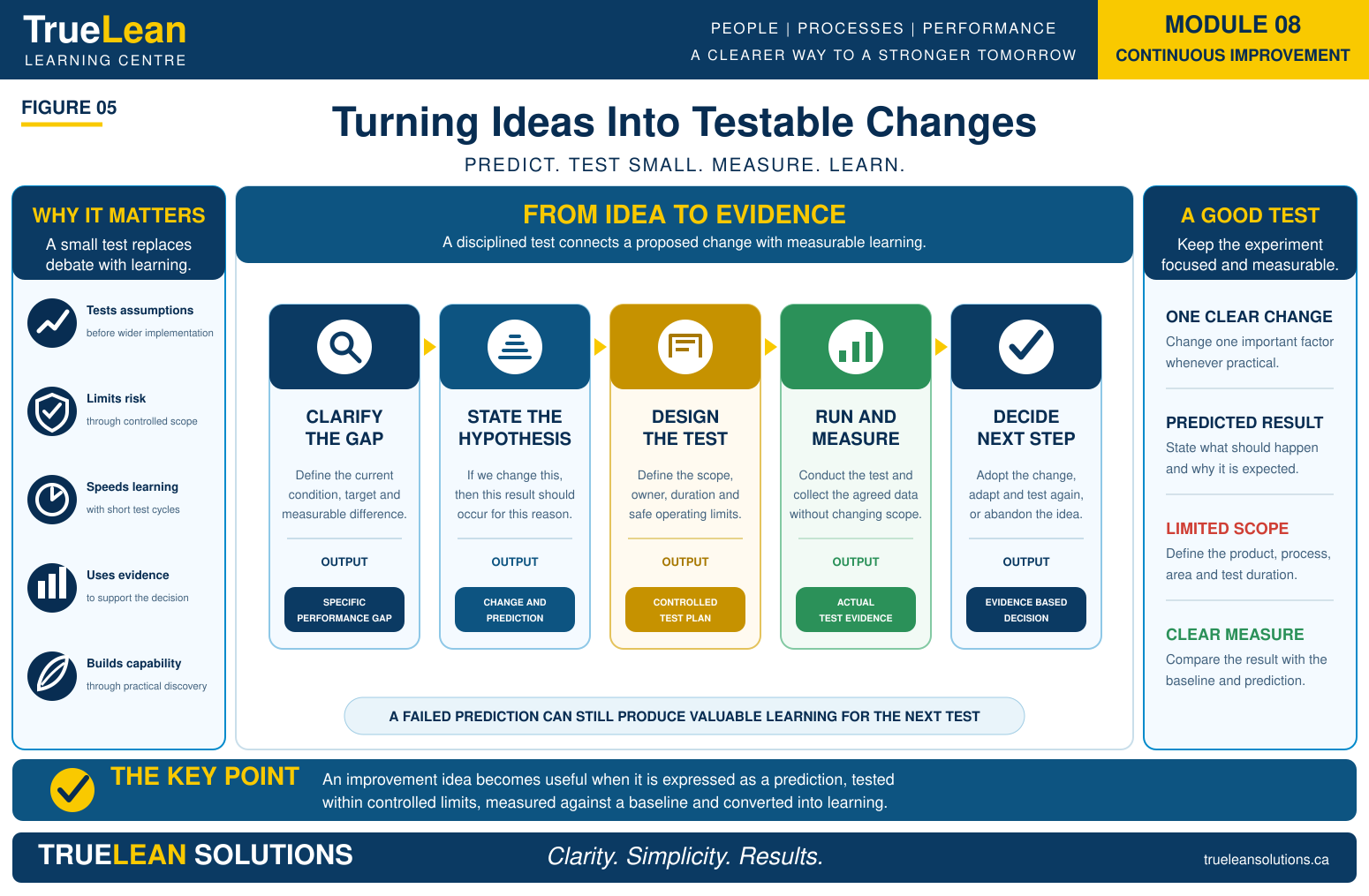
An improvement idea becomes useful when it is expressed as a prediction. A clear hypothesis connects a proposed change with an expected result and identifies why the team believes the relationship exists. This allows the organization to learn even when the prediction is not confirmed.
Elements of a useful test
One clear change whenever practical.
A defined product, process, area, shift, or customer condition.
A predicted result and a reason for the prediction.
A baseline and measure that can be compared after the test.
A responsible owner and defined test duration.
Safe operating limits and a method for stopping the test if risk increases.
A decision rule for adopting, adjusting, or abandoning the change.
Small tests reduce exposure and accelerate learning. They are not an excuse for weak preparation. The team should still define the scope, protect the customer, capture relevant evidence, and avoid changing several variables at the same time.
07 • PDCA as the Learning Method
PDCA connects planning, controlled testing, evaluation, and adjustment. The cycle is effective when the team states what it expects to happen and then compares that prediction with the actual result.
| Stage | Key question | Expected discipline |
|---|---|---|
| Plan | What gap are we addressing, and what result do we predict? | Define the condition, evidence, scope, owner, measure, and method. |
| Do | What happened when the change was tested? | Run the test within the agreed limits and capture facts. |
| Check | How did the actual result compare with the prediction? | Evaluate the evidence, variation, side effects, and operating conditions. |
| Act | What should happen next? | Adopt, adjust, or abandon the change and define the next cycle. |
A failed prediction can still create valuable learning. The difference between expected and actual results may reveal an overlooked condition, an unreliable assumption, or a source of variation that requires further study. When a change works, the team should update the standard, communication, training, ownership, and review routine.
08 • Integrate PDCA Into Daily Management
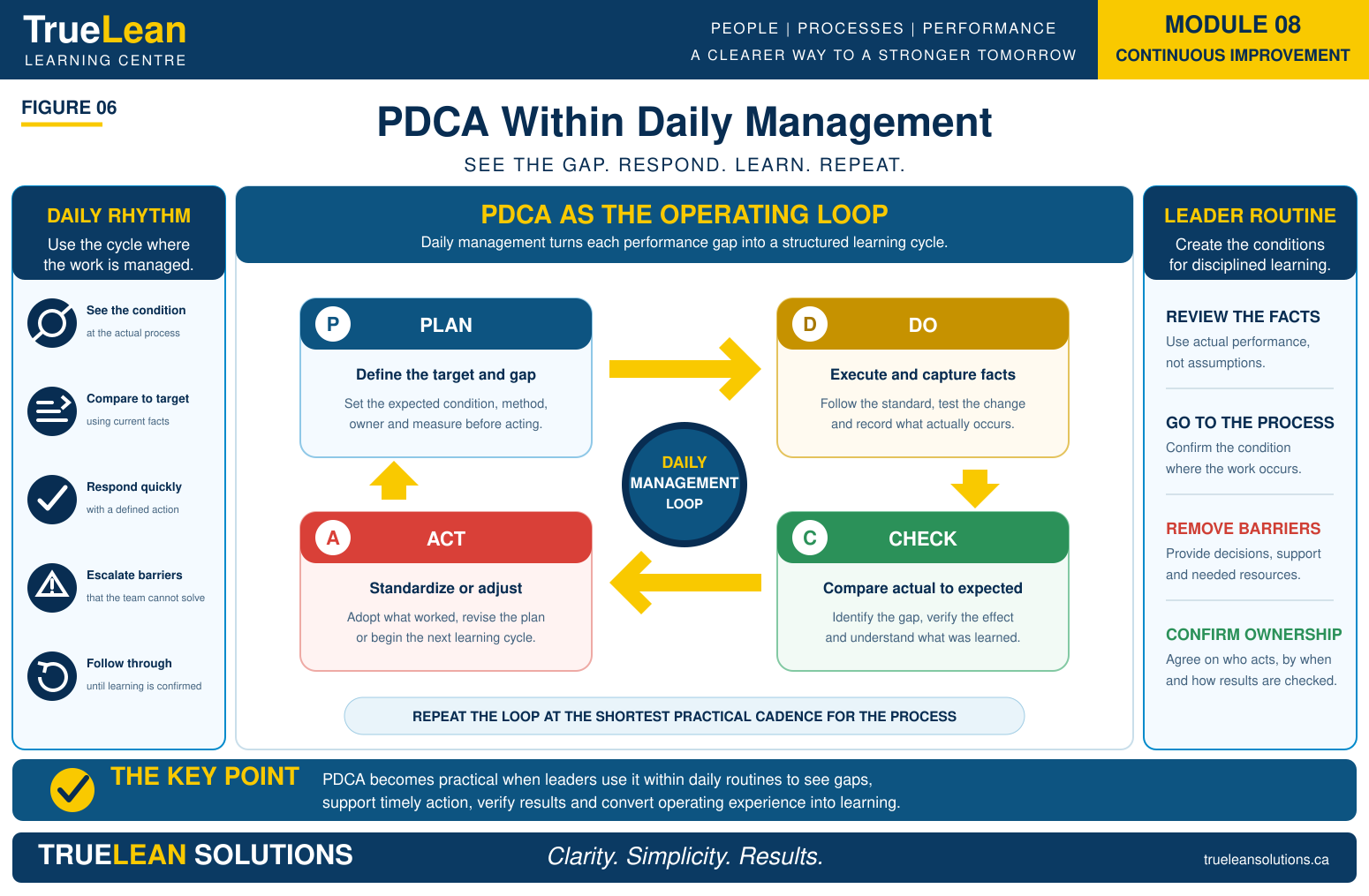
PDCA becomes practical when it is embedded in the routines used to manage performance. Daily boards, tiered meetings, leader standard work, Gemba walks, abnormality response, maintenance reviews, and focused improvement reviews can all support short learning cycles.
A practical daily rhythm
Review current performance against the expected condition.
Identify and describe the most important gaps.
Assign immediate action, investigation, or escalation.
Confirm who owns the next step and when evidence will be reviewed.
Follow through until the result, learning, or required escalation is clear.
| Cadence | Purpose | Typical focus |
|---|---|---|
| Daily | See and respond to current gaps | Safety, quality, delivery, staffing, equipment, material, and immediate barriers |
| Weekly | Review recurring gaps and focused tests | Patterns, overdue actions, verified results, cross-functional support, and resource needs |
| Monthly | Confirm system performance and strategic learning | Trends, capability, benefits, priorities, replication, and governance |
09 • Leadership and Coaching for Improvement
Leaders establish whether continuous improvement becomes disciplined learning or another activity program. Their role is to clarify purpose, make problems discussable, go to the process, ask questions, remove barriers, protect time for learning, and confirm follow-through.
Useful coaching questions
What should be happening?
What is happening now?
What evidence supports that conclusion?
Where and when does the gap appear?
What do the people performing the work observe?
What change do you propose, and what result do you predict?
How will the test be controlled and measured?
What did the team learn, and what happens next?
Coaching should strengthen the problem solver rather than transfer ownership to the leader. Questions should test the reasoning, help the team distinguish facts from assumptions, and connect the next action with the observed condition.
10 • Participation and Safe Problem Reporting
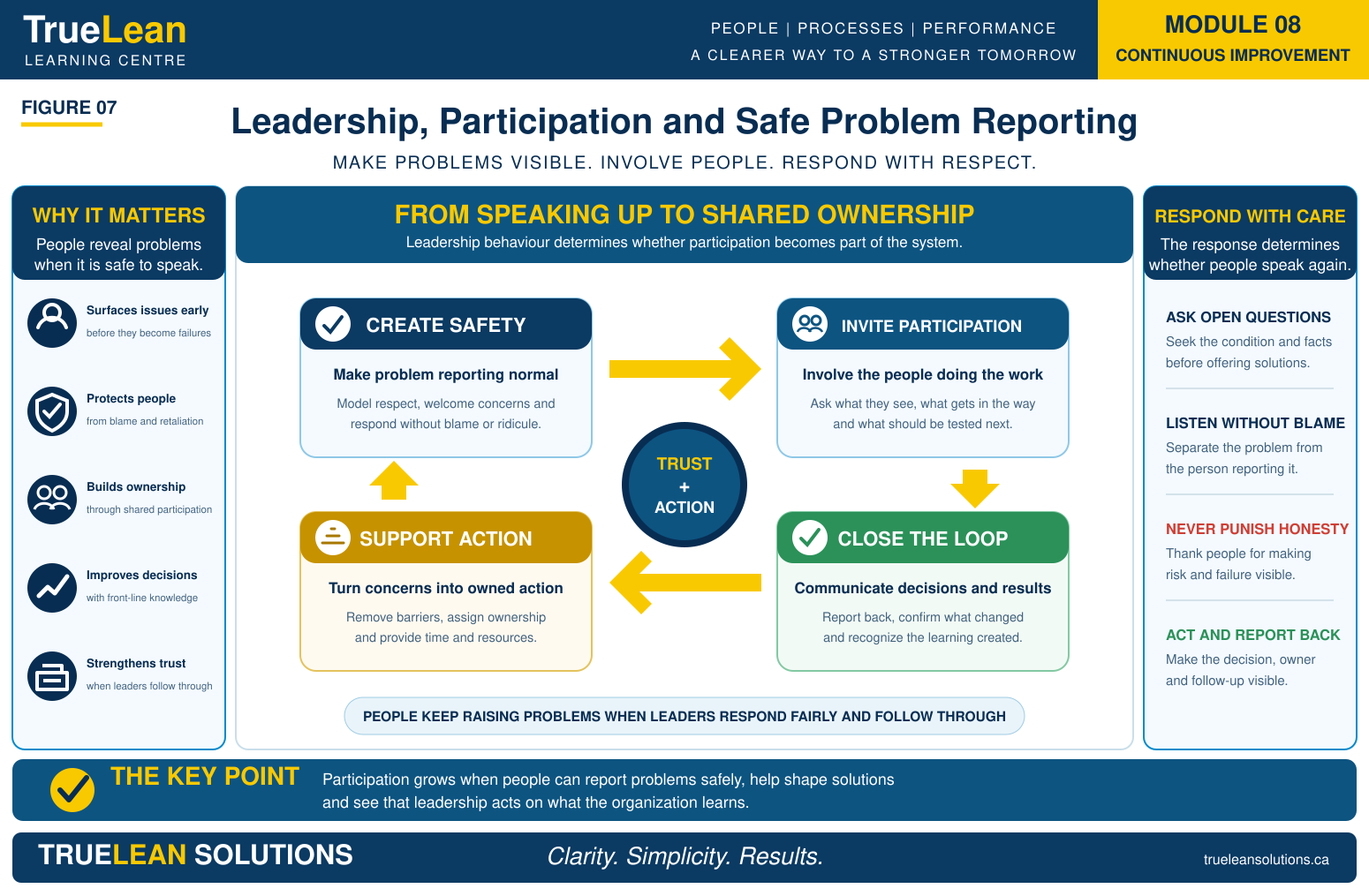
Continuous improvement depends on people making problems visible. If employees expect blame, ridicule, retaliation, or inaction, they will protect themselves by remaining silent. Leaders must respond to honest problem reporting with respect, curiosity, and visible follow-through.
Behaviours that support participation
Ask open questions and listen before prescribing a solution.
Separate the person reporting the problem from the condition being examined.
Thank employees for making risk, failure, waste, and process drift visible.
Involve the people performing the work in observation and test design.
Provide authority, time, access, and cross-functional support appropriate to the issue.
Report back on decisions, actions, results, and lessons learned.
Recognize prevention, learning, and honest escalation rather than rewarding only quick closure.
Psychological safety does not remove accountability. It makes accountability more useful because people can discuss what happened, distinguish system conditions from individual choices, and act on evidence before the impact grows.
11 • Prioritize Improvement Work
Organizations often have more improvement opportunities than available capacity. Prioritization should connect the work with customer impact, safety, quality, delivery, cost, people, strategic objectives, and operational risk. It should also consider whether the problem is observable, measurable, and within a manageable scope.
| Priority factor | Question |
|---|---|
| Safety and compliance | Could the condition harm people, violate a requirement, or create significant exposure? |
| Customer and quality | Does the gap affect product, service, reliability, or customer confidence? |
| Delivery and flow | Does it constrain throughput, lead time, capacity, or schedule performance? |
| Cost and waste | Does it create avoidable labour, material, energy, inventory, or downtime? |
| Strategic importance | Does it support a critical business objective, capability, or transformation priority? |
| Learning value | Will the work develop capability or produce knowledge that can be shared? |
A simple priority matrix can support discussion, but judgement remains necessary. High-scoring work should not automatically displace urgent customer protection, safety action, or legal obligations.
12 • Measure Improvement and Capability
Completed actions, meetings, and events are activity measures. They show that work occurred, but they do not prove that the operating condition improved. A balanced review should examine process results, adoption, sustainability, and the capability developed through the work.
| Measure category | Examples |
|---|---|
| Operational result | Safety incidents, defects, First Pass Yield, lead time, throughput, downtime, schedule attainment, inventory, and cost |
| Process condition | Cycle time, changeover time, queue length, equipment condition, adherence to standard, and abnormality response |
| Adoption | Employees trained, method demonstrated, standard available, leader reviews completed, and ownership confirmed |
| Sustainability | Results held over time, recurrence prevented, process drift detected, and audits or observations completed |
| Capability | Employees participating, leaders coaching, experiments completed, causes verified, and learning shared |
The review period should reflect process frequency, natural variation, risk, and the time needed for recurrence to become visible. Short-term improvement should not be declared permanent before the process has operated through representative conditions.
13 • Standardize, Share and Sustain Learning
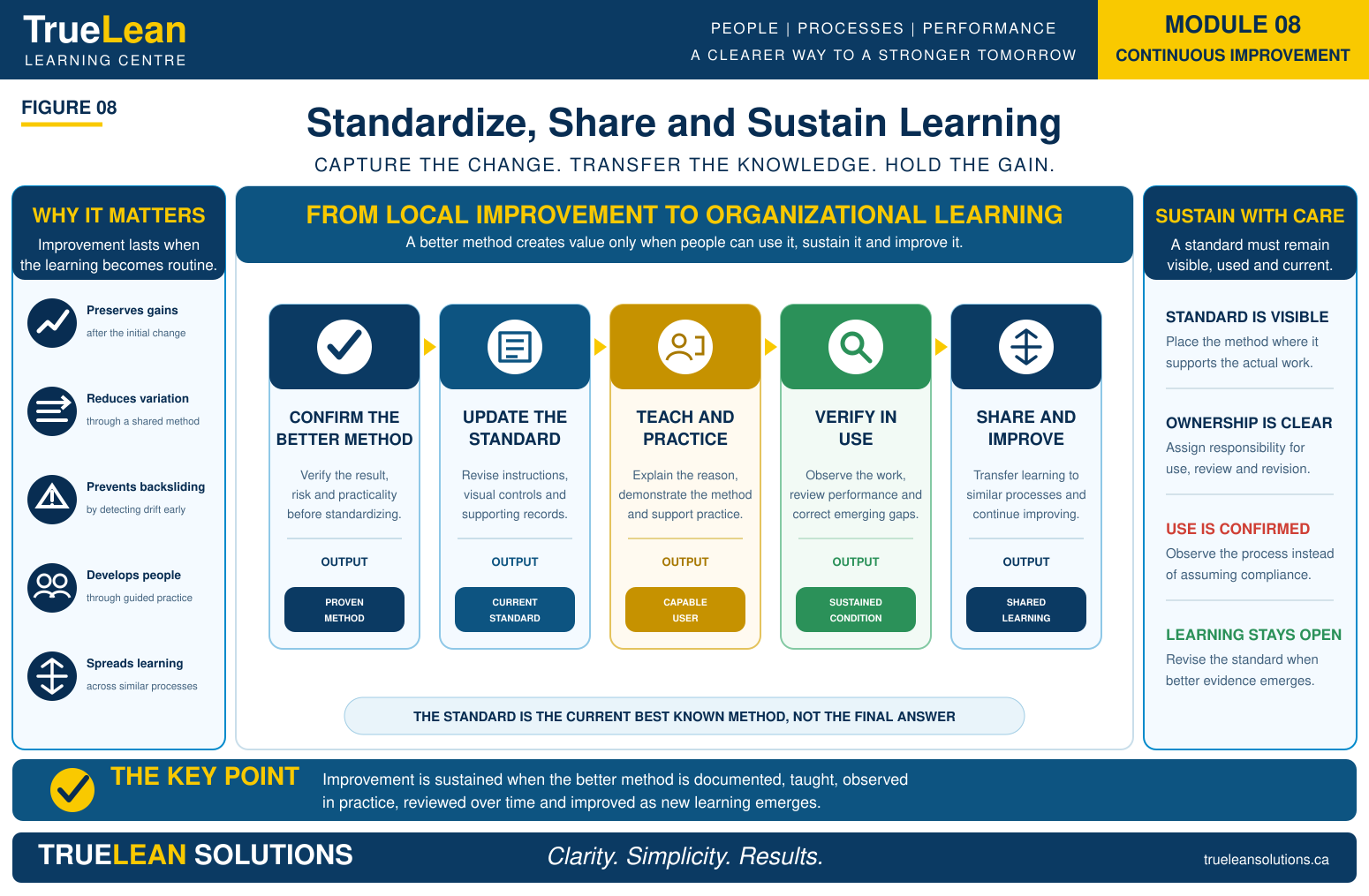
When a tested change produces the intended result, the organization should incorporate the better method into the operating system. This may require updates to standard work, visual controls, work instructions, training, process settings, maintenance routines, digital systems, control plans, inspection methods, and management review.
Confirm the change is embedded
The better method has been verified for result, practicality, and risk.
The current standard and supporting documents have been updated.
Affected employees understand the reason for the change and can demonstrate the method.
Leaders observe the actual process and review relevant performance measures.
Temporary controls are reviewed and removed when they are no longer required.
Ownership is clear if performance begins to drift.
Learning is shared with similar equipment, products, shifts, value streams, or sites.
Standardization does not freeze the process. It establishes the current best known method and creates the baseline for the next improvement. New evidence should lead to a new learning cycle and, when appropriate, a revised standard.
14 • Manufacturing Example
A fabrication cell repeatedly missed its hourly output target after product changeovers. Supervisors responded by adding labour and asking operators to work faster, but the gap returned. The team reframed the issue as a performance gap and observed several changeovers at the process.
Current condition
Expected output was 52 units during the first hour after changeover.
Actual output averaged 39 units during the previous eight changeovers.
Tooling, material, drawings, and process settings were prepared after the machine stopped.
The sequence varied by operator and product family.
Quality checks were repeated because the first-piece method was unclear.
Test and learning
The team predicted that external preparation, a defined changeover sequence, and a clear first-piece check would reduce restart delay without increasing quality risk. It tested the method on one product family for three changeovers. The average first-hour output increased to 49 units, and no additional defects were recorded.
Standardization and follow-up
The team updated the changeover standard, created a visual preparation checklist, assigned material staging ownership, trained all affected operators, and reviewed first-hour output during the daily meeting. After four weeks, average performance reached 51 units and variation among operators declined. The team then adapted the learning for a second cell rather than copying the method without observation.
| Element | Evidence |
|---|---|
| Gap | First-hour output averaged 39 units against an expected 52 units |
| Prediction | External preparation and a defined sequence would reduce restart delay |
| Test | One product family across three controlled changeovers |
| Result | Average first-hour output increased to 49 units without additional defects |
| Sustainment | Standard updated, people trained, ownership assigned, and results reviewed for four weeks |
15 • Practical Gemba Reflection
Select one recurring performance gap that can be observed directly. The purpose is to understand the condition and define the next learning step, not to prescribe a complete solution during the first visit.
Observe the condition
What should be happening?
What is happening now?
Where and when does the gap appear?
What changes by product, shift, operator, material, machine, or customer condition?
What standard or expected method applies?
What workarounds, delays, checks, rework, or interruptions are visible?
What do employees performing the work believe is important to understand?
Define the next learning step
Clarify the gap with a better measure.
Observe another operating cycle.
Compare affected and unaffected conditions.
Review process history or stratify the data.
Confirm whether the standard is current and practical.
Test one suspected influence or one proposed change.
Escalate a barrier that requires additional authority or resources.
Leadership reflection
Did I ask before telling?
Did people feel safe describing the problem and their own uncertainty?
Did we distinguish evidence from assumption?
Did we define ownership and timing for the next step?
Will we return to review the evidence and report back to the team?
Need help building daily improvement capability?
TrueLean Solutions helps manufacturing leaders connect visible performance gaps, employee participation, PDCA, leadership routines, and standardization with sustained operating results.
Schedule a Consultation16 • Key Takeaways
- Treat continuous improvement as a daily operating discipline, not a separate campaign.
- Use stability and standards to create a visible baseline for improvement.
- Define the measurable gap between expected and actual performance before selecting action.
- Match the improvement level to the risk, scope, urgency, complexity, and authority required.
- Express improvement ideas as predictions that can be tested and measured.
- Use PDCA to compare expected and actual results and guide the next learning cycle.
- Embed improvement into daily management, escalation, leader standard work, and review routines.
- Create safe conditions for people to report problems, participate, and share uncertainty.
- Measure results, adoption, sustainability, and capability instead of counting activity alone.
- Standardize effective changes, share learning, and keep the standard open to better evidence.
Continue Learning
17 • Sources and Further Reading
Continuous Improvement and Lean Manufacturing
Michael Ballé, Daniel Jones, Jacques Chaize, and Orest Fiume, The Lean Strategy
Steven Spear and H. Kent Bowen, Decoding the DNA of the Toyota Production System