
An operating strategy works when leaders connect a few priorities with daily evidence, clear ownership and decisions at the appropriate level.
01 Learning Objectives
Explain why a strategy needs a management system to become operational.
Connect annual priorities to plant and team objectives, measures and actions.
Describe how Hoshin Kanri, catchball and routine reviews support alignment.
Recognize the role of leader standard work, Gemba and SQDCIP in daily management.
Distinguish issues a team can resolve from those requiring escalation.
Explain how leaders adjust plans and verify claimed benefits.
02 Why Strategy Needs a Management System
A strategy sets direction. A management system translates that direction into decisions, ownership, work and learning. Without a reliable connection to the plant floor, annual goals can become separate from scheduling, material availability, equipment performance and the needs of the people doing the work.
The system connects a few business priorities with operational objectives, measures, review routines, escalation and follow-through. Leaders check both results and the process conditions that produce them. A gap triggers a decision with an owner and a next check, rather than another report without action.
03 Translate Business Priorities into Operational Objectives
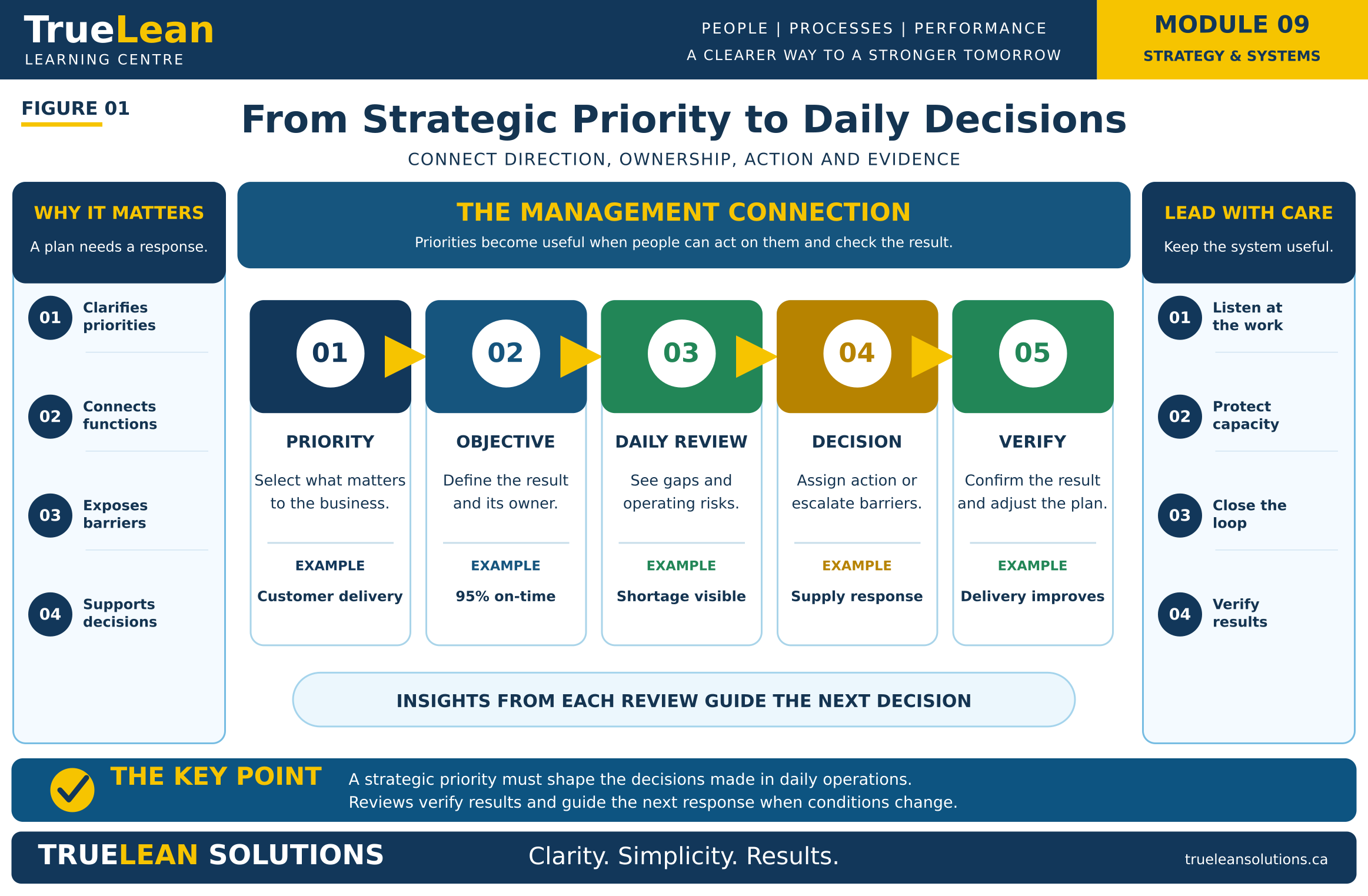
Begin with the result that matters to customers and the business. Define the baseline, a credible target, an accountable owner and the process conditions the team can influence. A useful objective tells people what improvement is expected and how leaders will determine whether work is moving in the right direction.
For example, a plant might seek to improve on-time delivery from an illustrative current level of 82% toward a 95% target. Material availability, schedule adherence and equipment uptime may be useful supporting measures. The 95% is a target, not a result already achieved.
Questions that make an objective usable
Is the calculation and time period clearly defined?
Is the baseline based on reliable, comparable data?
Does the owner have authority to coordinate action?
Do teams understand which process conditions they can improve?
04 Connect Annual Planning and Daily Management
Annual planning identifies the few priorities that deserve capacity and leadership attention. Quarterly and monthly reviews test milestones, resources and assumptions. Weekly reviews coordinate across functions. Daily management sees the actual condition, protects affected work and responds to abnormalities. Each level should feed learning into the next.
A consistent review asks what was expected, what occurred, what changed, who owns the response and when the result will be checked. Frequency alone does not make a review useful. The decision and follow-through do.
05 Hoshin Kanri and Catchball
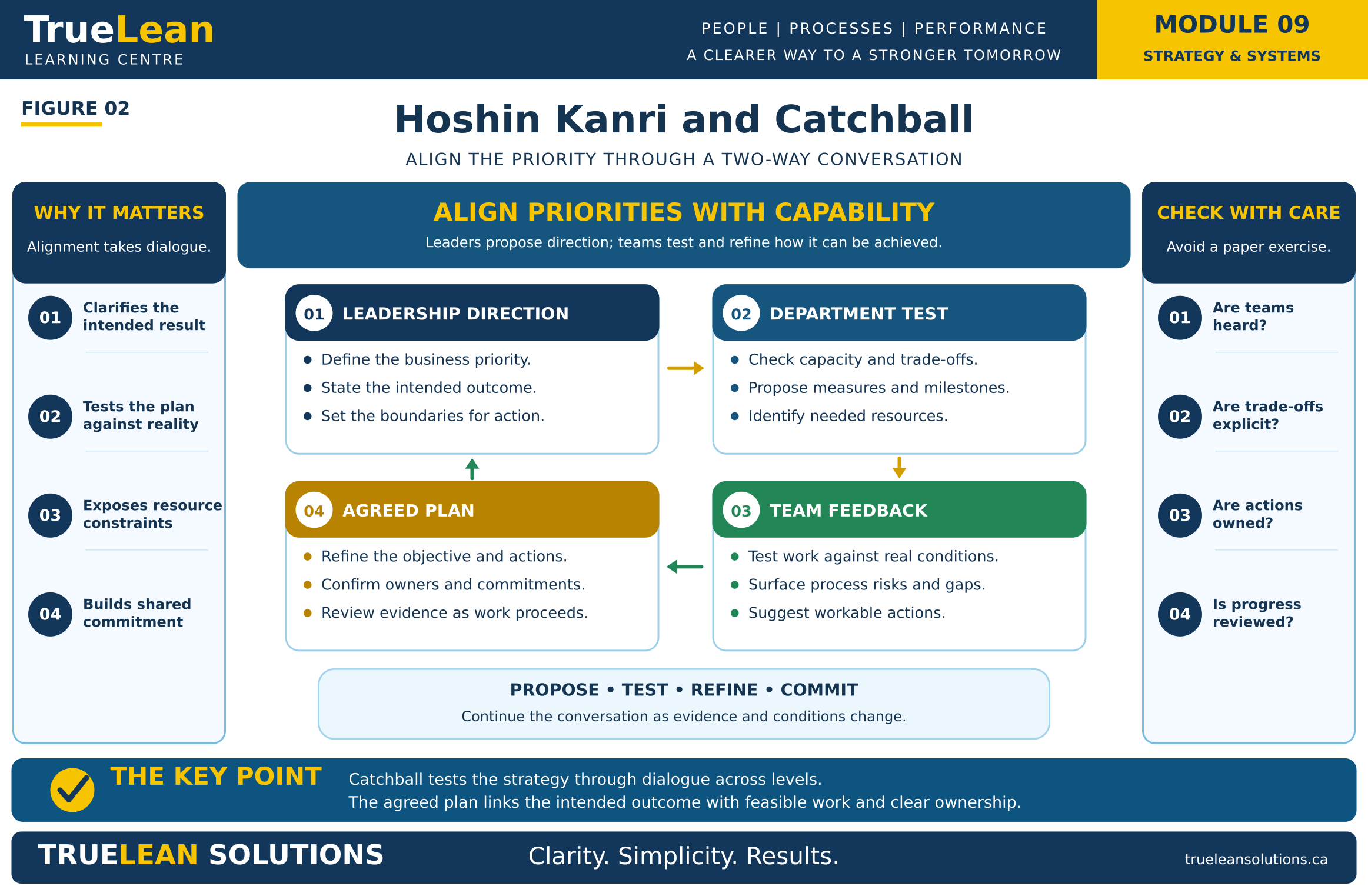
Hoshin Kanri helps align a small number of strategic priorities across levels. Catchball is the dialogue through which leaders propose a direction and departments and teams test it against capacity, constraints and actual work. The discussion may reveal an unrealistic milestone, missing resources or a better route to the same customer result.
The outcome is a clearer plan with agreed measures, ownership, timing and review. A deployment matrix can help show relationships among objectives, initiatives and owners, but the conversation and subsequent action give the plan its value.
06 Measures Targets and Ownership
A result measure shows whether the intended business outcome changed. Process measures show whether the conditions expected to influence that result are changing. Both need consistent definitions, a known baseline, a target, an owner and a review cadence. Too many measures dilute attention; too few hide emerging risk.
Ownership means more than reporting a number. The accountable leader reviews a gap, coordinates the people who can act, checks whether the action occurred and verifies the effect. When a target is missed, a credible explanation includes the condition, the response and the next review date.
07 SQDCIP and Tiered Accountability
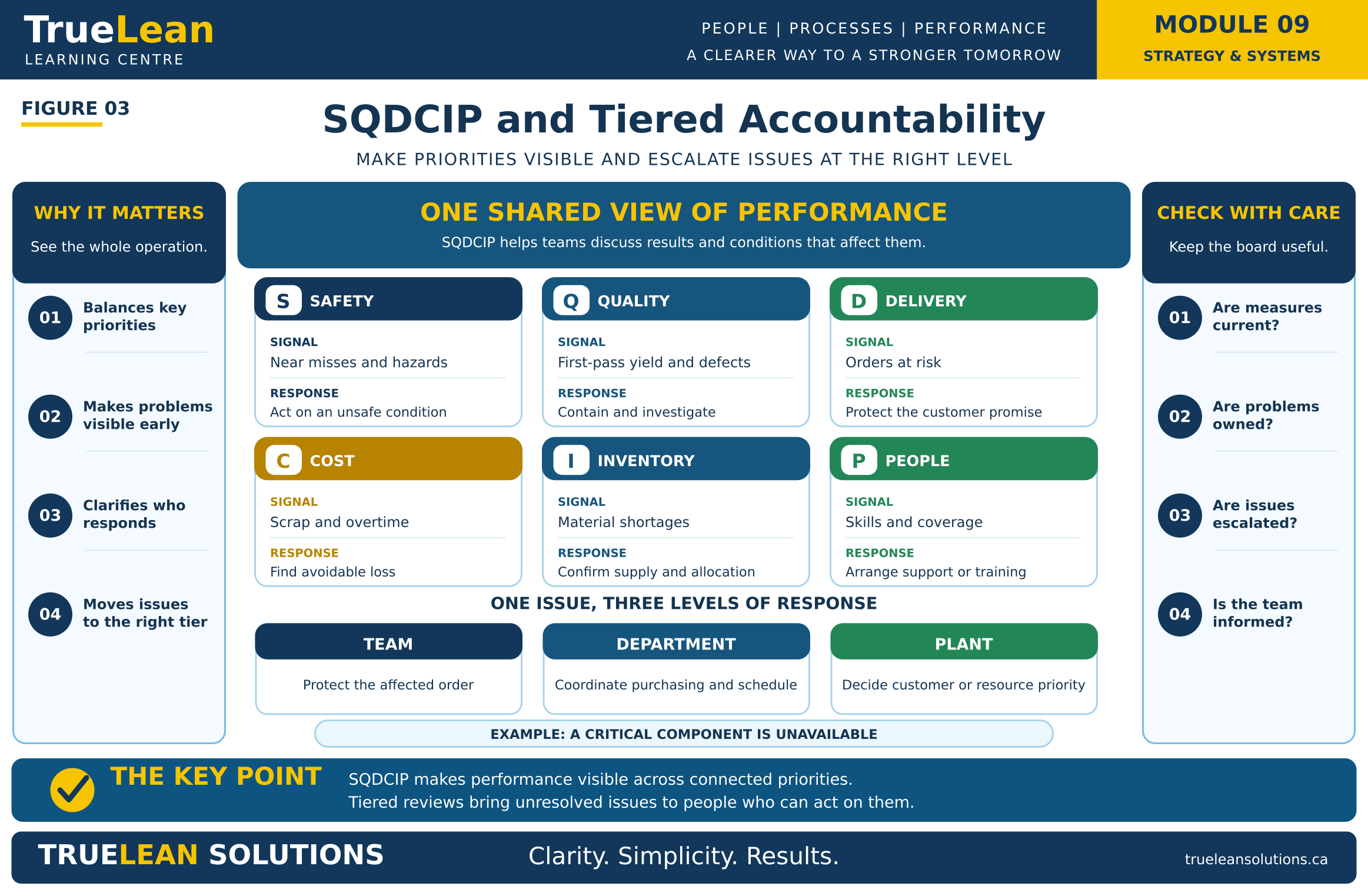
SQDCIP gives a shared view of Safety, Quality, Delivery, Cost, Inventory and People. The board is useful when current signals lead to a named response. Safety may show hazards or near misses; Quality, first-pass yield and defects; Delivery, orders at risk; Cost, scrap and overtime; Inventory, shortages; and People, skills coverage and capacity.
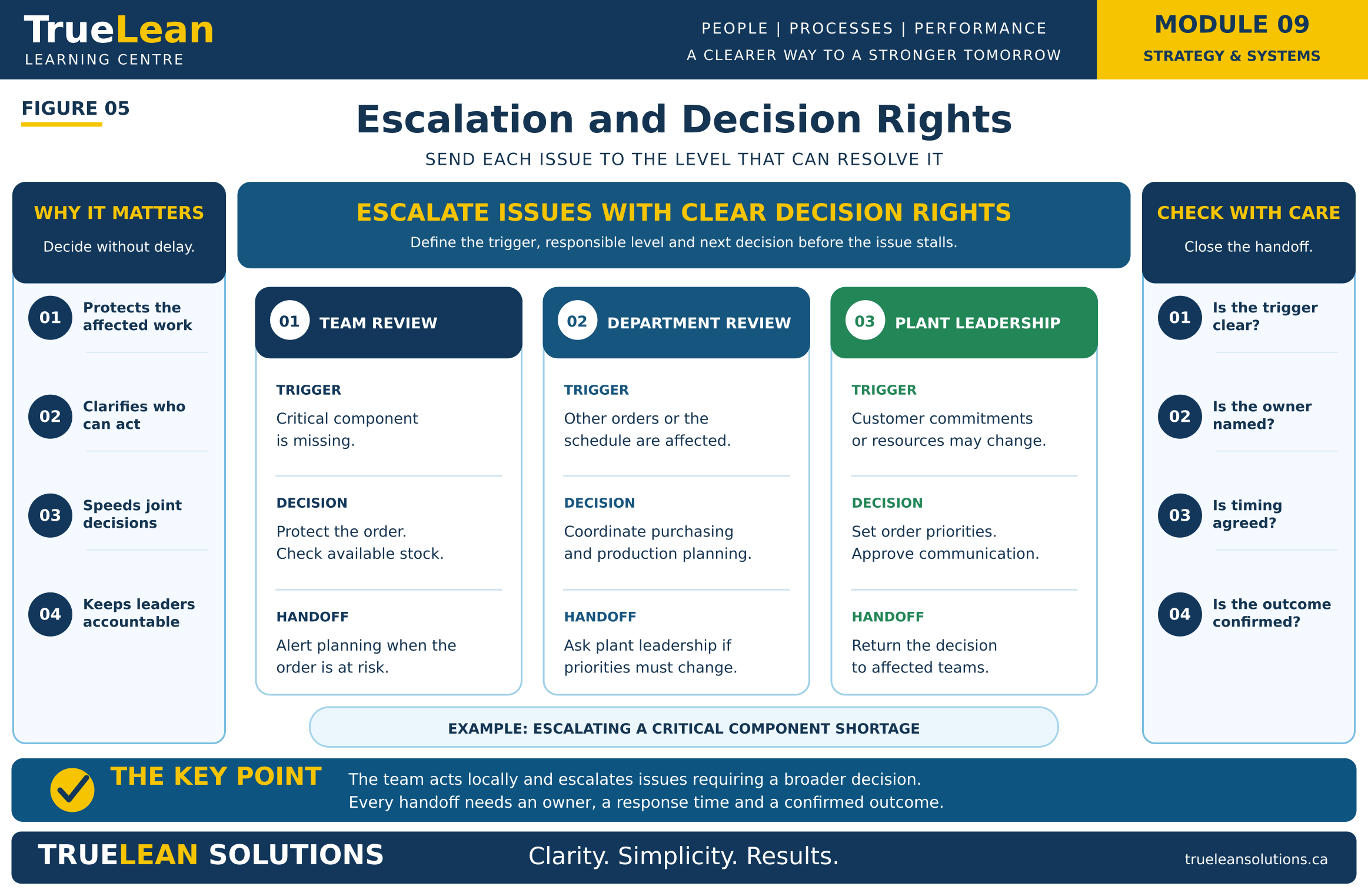
A team review responds at the source. A department review coordinates purchasing, scheduling, maintenance or other functions. Plant leadership resolves customer commitments and resource priorities that exceed department authority. Escalation should move the decision to the right level and return an answer to the team.
If a critical component is unavailable, the production team can protect the affected order and alert planning. If the shortage reflects a wider supplier issue, the department coordinates purchasing and scheduling. Plant leadership becomes involved when customer commitments or resource priorities must change.
If only one qualified operator can run a critical process, the team can make the coverage risk visible. The department arranges training or temporary support. Plant leadership decides when wider staffing or investment priorities must change.
08 Leader Standard Work and Gemba
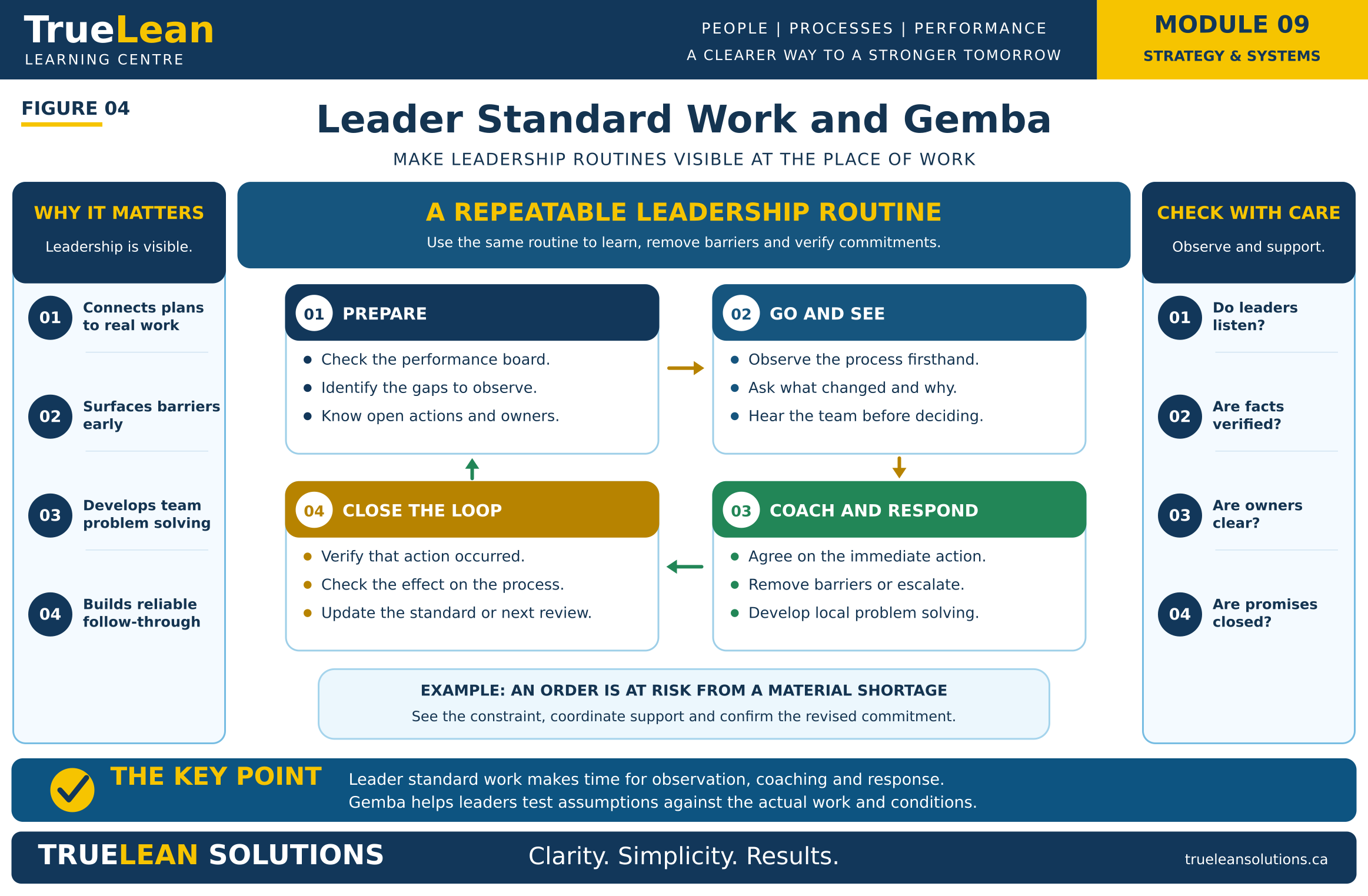
Leader standard work creates reliable time to review performance, go to the work, coach people, remove barriers and close commitments. Gemba means observing the actual work and conditions with the people who know the process. Leaders should check facts and listen before deciding what to change.
A useful routine begins with current signals and open actions, then moves to direct observation and questions. Leaders agree on immediate support, follow the issue through the appropriate tier and return to verify the process and customer result. The routine supports people and problem solving rather than becoming a checklist of visits.
09 Escalation and Decision Rights
Teams need to know what they may decide, when to request help and what information a handoff requires. A useful escalation states the current condition, customer or safety impact, action already taken, decision requested, owner and required response time.
The component shortage example illustrates the distinction. The team protects an order and checks available stock. The department coordinates purchasing and production planning when other orders are affected. Plant leadership chooses among competing commitments or resources and approves customer communication when necessary. The decision then returns to those doing the work.
10 Review Cadence and Course Correction
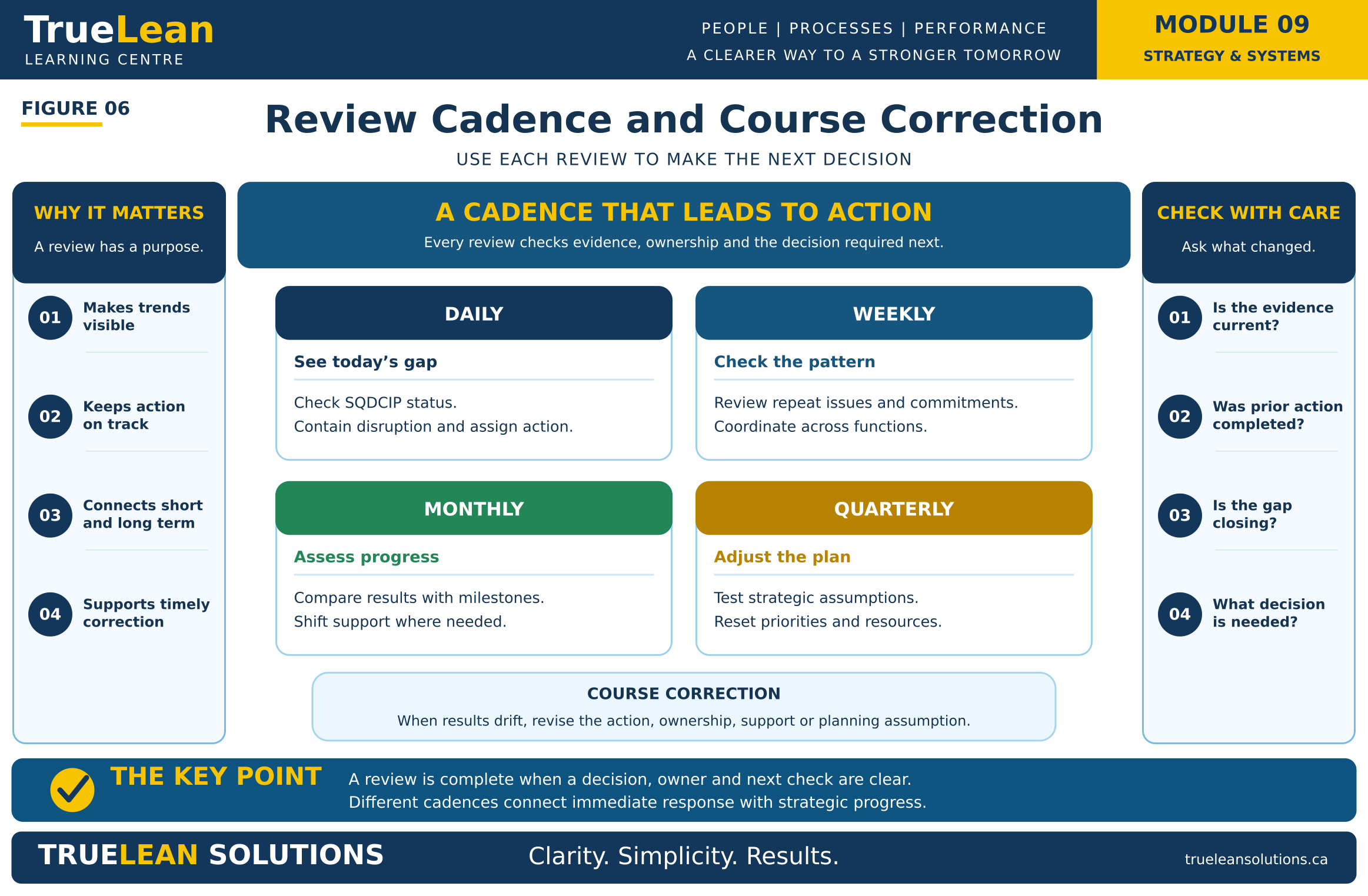
Daily reviews contain immediate disruption and assign action. Weekly reviews examine repeated gaps and cross-functional commitments. Monthly reviews compare results with milestones and adjust support. Quarterly reviews reconsider strategic assumptions and priorities. These are illustrative cadences; the right frequency depends on the pace and consequence of the work.
A review should ask whether the previous action occurred, whether the process changed, whether the result is improving and what decision is required next. When evidence contradicts a plan, leaders may revise the action, ownership, resources or underlying assumption.
11 Governance and Benefits Tracking
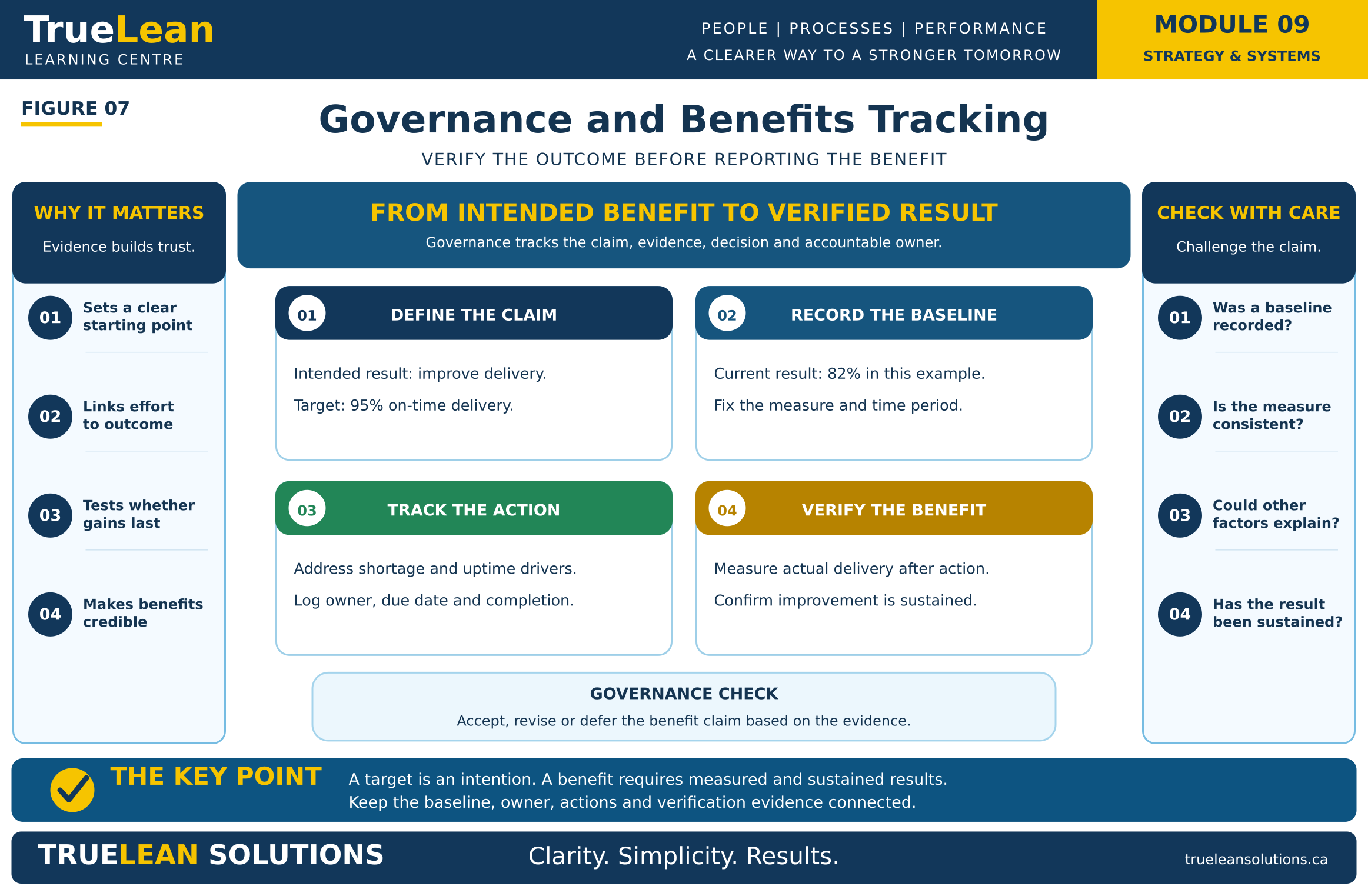
Governance keeps a clear record of the intended outcome, baseline, target, responsible owner, actions, decisions and verification evidence. A target is an intention. A benefit can be reported only after the actual result is measured, considered against other possible influences and shown to persist for an appropriate period.
For the illustrative delivery example, 82% is the starting point and 95% is the goal. Purchasing and maintenance actions should be tracked alongside material shortages, equipment uptime and actual on-time delivery. A leadership review can accept, revise or defer a benefit claim based on the evidence.
12 Manufacturing Example
A plant sees on-time delivery at 82% against a proposed 95% target. The team checks how the result is calculated and identifies two recurring conditions: critical material shortages and unplanned equipment downtime. This diagnosis is a hypothesis to verify, not an automatic explanation of every late order.
At daily reviews, production identifies affected orders, protects customers where possible and makes shortages and downtime visible. Purchasing confirms supplier recovery dates. Maintenance addresses recurring equipment losses. Planning tests the revised schedule against actual capacity. Weekly reviews compare the trend and determine whether actions have changed the process. Monthly reviews assess whether delivery is moving toward the target and whether additional resources or a changed plan are needed.
Leaders measure the new result and confirm that improvement is sustained before reporting a benefit.
13 Practical Leadership Reflection
Which business priority currently fails to appear in daily decisions?
Can each team explain the measure, baseline, target and owner that connect its work to that priority?
What problems are repeatedly escalated without a clear decision?
When did a Gemba observation last change a leadership assumption?
Which claimed benefits have a verified baseline and sustained result?
Connect your strategy with daily execution
TrueLean Solutions helps manufacturing leaders align priorities, management routines and measurable results.
Schedule a Consultation14 Key Takeaways
- A strategy becomes operational through objectives, ownership, review and follow-through.
- Hoshin Kanri and catchball test direction against the capacity and knowledge of teams.
- SQDCIP makes connected priorities visible; tiers move decisions to the level able to resolve them.
- Leader standard work and Gemba connect management decisions to actual conditions.
- A review needs evidence, a decision, an owner and a next check.
- A target is not a verified benefit; report gains only after measuring and sustaining them.
Continue Learning
15 Sources and Further Reading
Lean Enterprise Institute. Hoshin Kanri resource guide.
Mark Reich. Managing on Purpose. Lean Enterprise Institute.
David Mann. Creating a Lean Culture. CRC Press.
Toyota Motor Corporation. Toyota Production System.
ISO. ISO 9001 quality management overview.
Robert S. Kaplan and David P. Norton. The Balanced Scorecard. Harvard Business Review.
Mark Graban. Measures of Success.
Bob Emiliani. Better Thinking, Better Results.
Bob Emiliani. A Changed Perspective.
Bob Emiliani. The Triumph of Classical Management Over Lean Management.