
Quality at Source is not a final inspection activity. It is an operating discipline that creates and verifies quality where the work occurs, protects the next customer and converts recurring problems into learning.
01 · Learning Objectives
Quality at Source means creating, verifying and protecting quality while the work is being performed. It requires a clear expected condition, early detection of abnormalities, authority to respond and disciplined learning from problems.
- Explain the difference between Quality at Source and dependence on downstream inspection.
- Describe how Jidoka connects abnormality detection with stopping, containment and response.
- Recognize how visual controls and Andon make abnormal conditions visible.
- Explain how Poka-Yoke can prevent errors or detect them before defects move downstream.
- Distinguish common-cause variation from special-cause variation at a practical level.
- Explain what First Pass Yield reveals about hidden rework and process performance.
- Identify the responsibilities of operators, supervisors, quality, engineering and leadership.
- Recognize leadership behaviours that encourage escalation, containment and learning.
- Identify common failure modes that weaken Quality at Source.
- Use Gemba observation to evaluate how a process protects its next customer.
02 · Key Terms
Creating, verifying and protecting quality at the point where work is performed.
The ability to detect an abnormal condition, stop or contain the process, signal for help and correct the condition.
A condition that differs from the defined standard, requirement or expected operating condition.
A visible or audible signal used to communicate an abnormal condition and request support.
Mistake proofing that prevents an error or detects it before it becomes a defect passed forward.
Immediate action that protects the customer and prevents suspect output from moving farther through the system.
Action taken to address a detected nonconformity or restore the immediate condition.
Action taken to address the cause of a problem and reduce the likelihood of recurrence.
Variation produced by the current design and routine conditions of the process.
Variation associated with a specific, unusual or identifiable condition.
The proportion of output that completes a process correctly the first time without repair, rework, retest or rerouting.
Completing the work correctly at the first attempt under the defined requirements.
The person, operation, department or customer receiving the output of the current process.
03 · Why Quality at Source Matters
A defect rarely remains an isolated quality issue after it moves downstream. It can consume capacity, interrupt flow, create shortages, distort inventory records, delay shipments and weaken customer confidence. The later the defect is discovered, the more people, materials and commitments may already be affected.
Consider an assembly using two similar fasteners when only one meets the specification. If the error is found immediately, one workstation is affected. If it is found during final inspection, the unit may require disassembly, repair, retesting and rescheduling. If it reaches the customer, the result may include a complaint, return, warranty cost or safety concern.
Quality at Source asks how the work can expose the error before it travels. It connects quality with workplace stability, capacity, flow, pull and reliable delivery. Defects consume productive time and create false availability. Preventing them protects the complete operating system.
04 · Inspection Does Not Create Quality
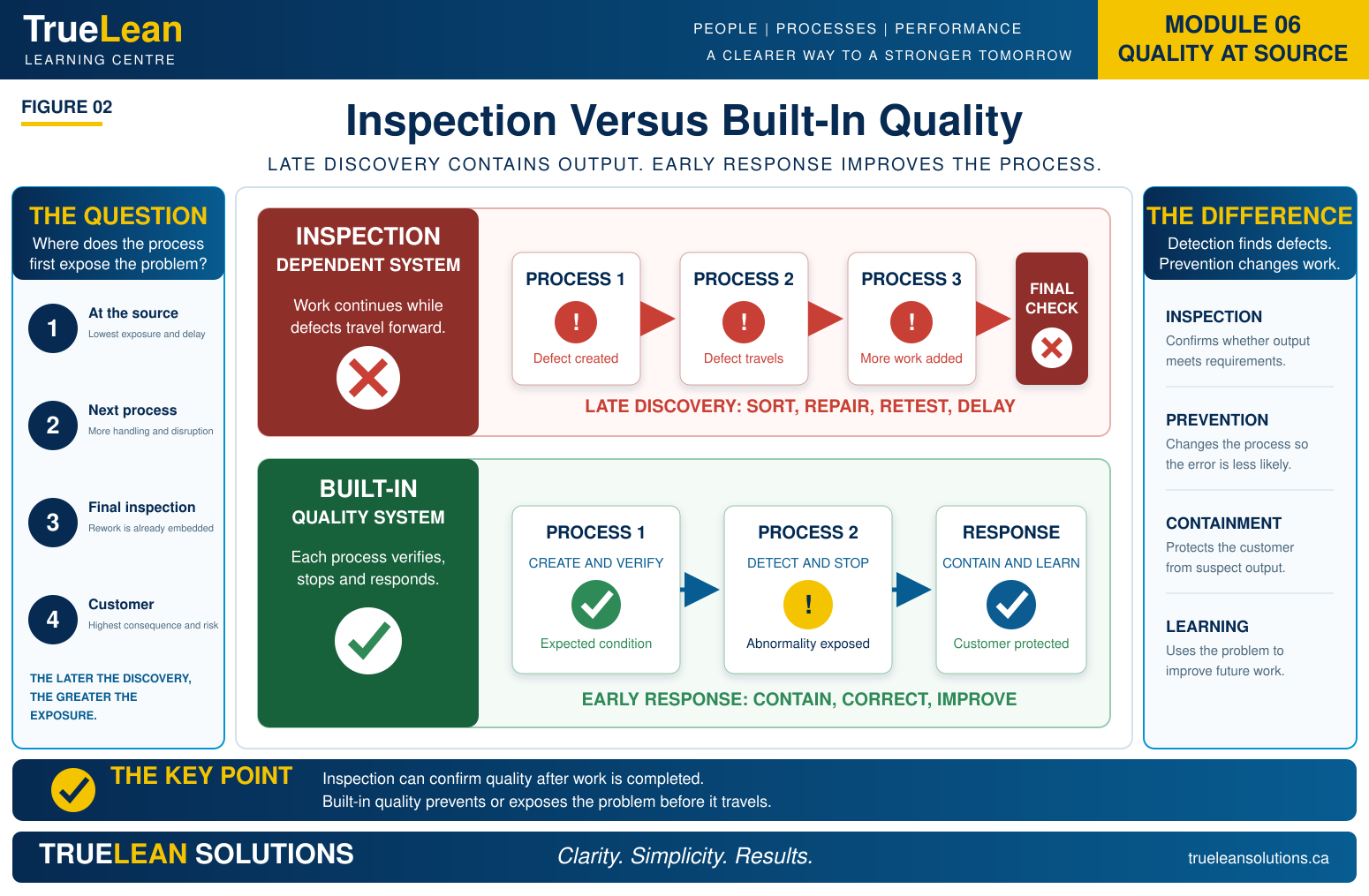
Inspection can detect some defects, confirm requirements and satisfy regulatory or customer obligations. It does not make an unstable process capable and does not prevent the defect from occurring. A system that relies primarily on final inspection finds problems after labour, material and time have already been consumed.
Detection and prevention
Detection identifies that a problem exists. Prevention changes the work so the problem is less likely or impossible to create. Both may be necessary, but prevention should move as close as practical to the point of cause.
Sorting can be a valid short-term containment response. It becomes dangerous when it is accepted as the permanent operating method. Repeated sorting hides process weakness, consumes capacity and can make poor performance appear normal.
05 · The Quality at Source Operating Principle
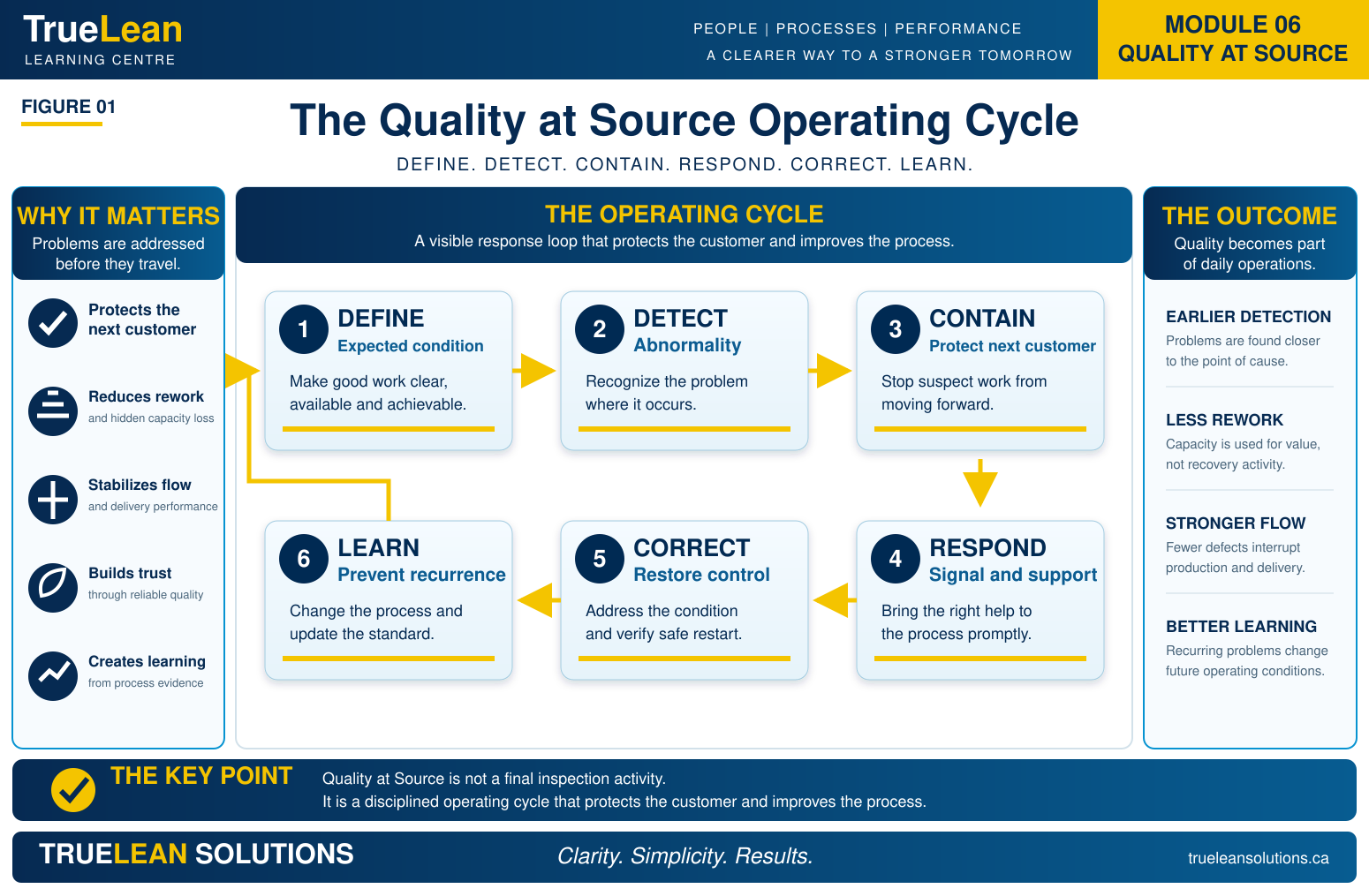
A practical Quality at Source system follows six connected actions:
- Define the expected condition so people can distinguish normal from abnormal.
- Detect the abnormality as close as practical to where it occurs.
- Stop or contain the condition before suspect work moves forward.
- Signal and respond so the right support reaches the process promptly.
- Correct the immediate condition and restore safe, controlled operation.
- Learn from the problem and change the process when recurrence requires deeper action.
These actions form a response loop rather than separate initiatives: Standard → Detect → Stop or Contain → Signal → Correct → Learn.
The sequence must be proportionate to risk. A critical safety characteristic may require automatic shutdown and formal release. A low-risk information error may require immediate correction and verification. The response should be defined before the abnormality occurs.
06 · Jidoka and Built-In Quality
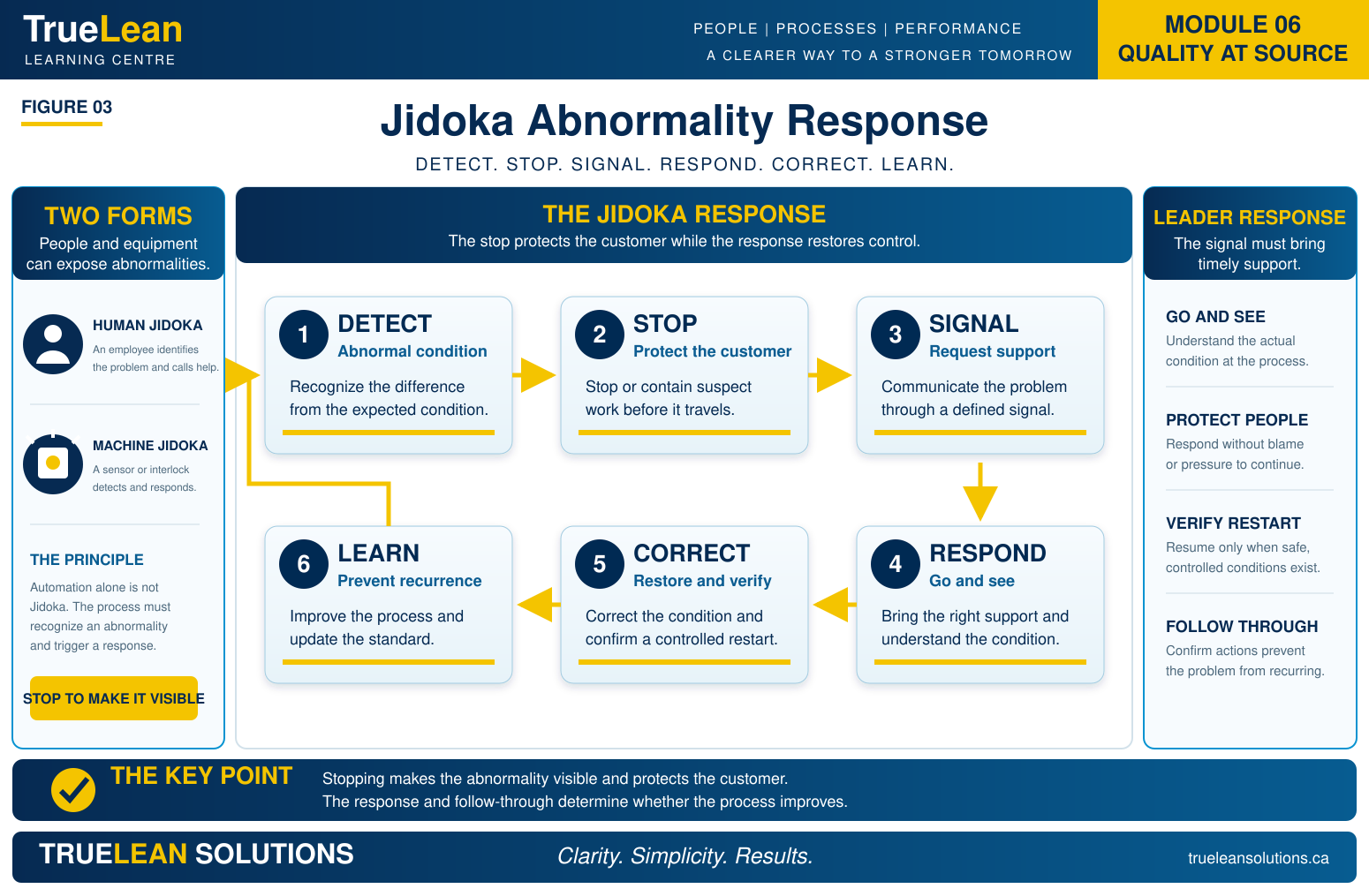
Jidoka connects detection with action. When a person or machine recognizes an abnormal condition, the process stops or contains the output, communicates the need for support and prevents defective work from continuing unnoticed.
Human and machine Jidoka
Human Jidoka allows an employee to identify a problem, stop or contain the work and request help. Machine Jidoka uses sensors, interlocks or programmed logic to detect an abnormal condition and respond automatically. Automation alone is not Jidoka. The equipment must distinguish the expected condition from the abnormal one and trigger an appropriate response.
Stopping is not the final objective. It creates visibility and protects the customer while the organization investigates. If a line stops repeatedly for the same reason and no learning follows, the system is detecting the problem but not improving it.
07 · Making Abnormalities Visible
A process cannot respond consistently when normal and abnormal conditions are unclear. Standards, visual controls, limit samples, status boards, gauges, fixtures and digital validation can make the expected condition easier to understand.
Andon
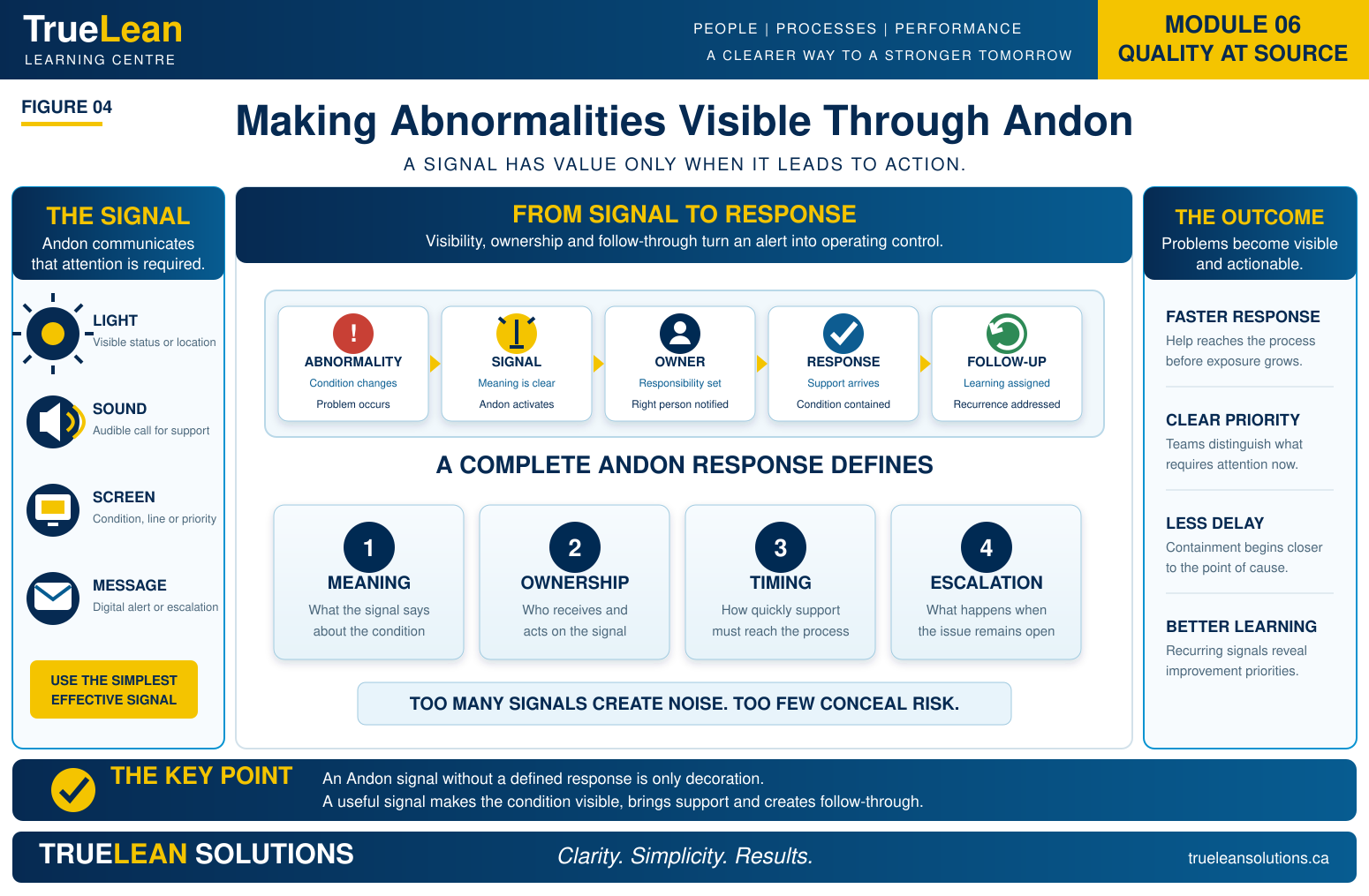
An Andon signal communicates that the process needs attention. It may be a light, sound, screen, message, board or other controlled signal. Its value depends on what happens after it is activated.
- The signal has a clear meaning.
- The responsible person knows where and how to respond.
- Response time matches the risk and production condition.
- Containment rules protect suspect output.
- The issue is recorded when follow-up is required.
- Recurring signals lead to investigation and improvement.
Too many signals can create noise. Too few can conceal risk. Visual management should simplify decisions and help people see what requires attention now.
08 · Poka-Yoke and Error Prevention
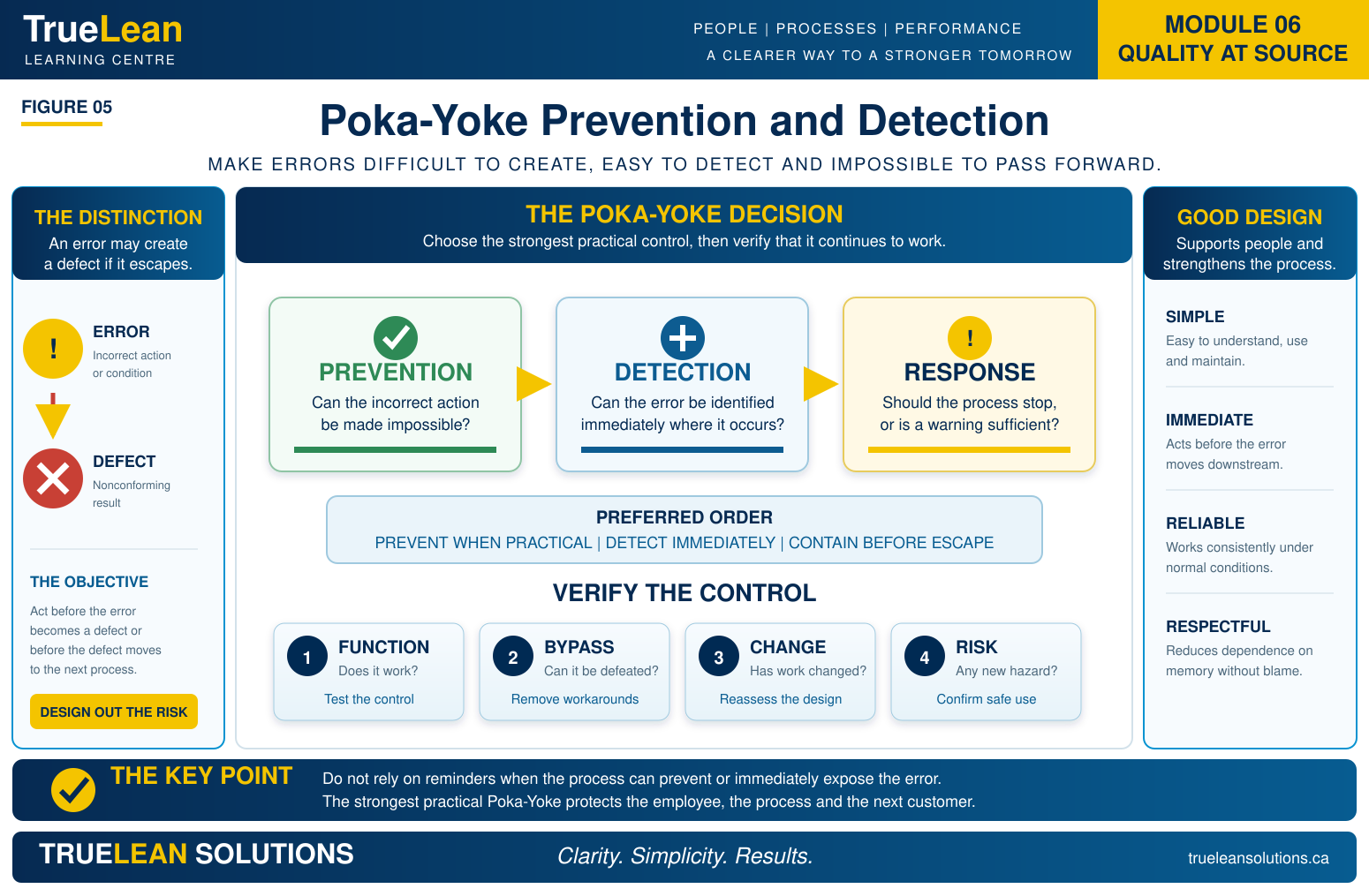
An error is an incorrect action or condition. A defect is the nonconforming result that may follow. Poka-Yoke acts before or immediately after the error so the defect is prevented or contained.
Prevention and detection
A prevention control makes the incorrect action impossible, such as a connector that fits only in the correct orientation. A detection control identifies the error immediately, such as a sensor confirming that all components are present. A shutdown response stops the process. A warning response alerts the employee while allowing controlled continuation.
Simple physical controls are often more reliable than reminders. Good mistake proofing reduces dependence on memory, supports the employee and is verified periodically. It should not create a new ergonomic, safety or process risk.
In an order-entry process, mandatory field validation can prevent an incomplete order. A duplicate-customer warning can detect a likely error. The same principle applies even when the output is information rather than a physical product.
09 · Standards and the Expected Condition
Quality at Source begins with a usable definition of good work. The standard may include dimensions, sequence, torque, material, appearance, documentation, system status or another critical condition. It must be available, understandable and achievable under normal operating conditions.
A standard that is outdated, conflicting or difficult to use weakens accountability. Employees cannot reliably identify abnormalities when drawings, instructions, system data and actual practice disagree.
- Confirm that the current requirement is available at the point of use.
- Make critical characteristics and acceptance criteria clear.
- Provide suitable measurement methods and calibrated equipment where required.
- Train people to recognize both acceptable and unacceptable conditions.
- Update the standard when approved learning changes the work.
10 · Process Control and Variation
Every process varies. The important question is whether the variation reflects the routine design of the process or a specific abnormal condition.
Common and special causes
Common-cause variation is produced by the current process system. Improving it normally requires changing equipment, methods, materials, measurement or other elements of the system. Special-cause variation is associated with a specific event, such as a damaged tool, incorrect material, sensor failure or unapproved setting change.
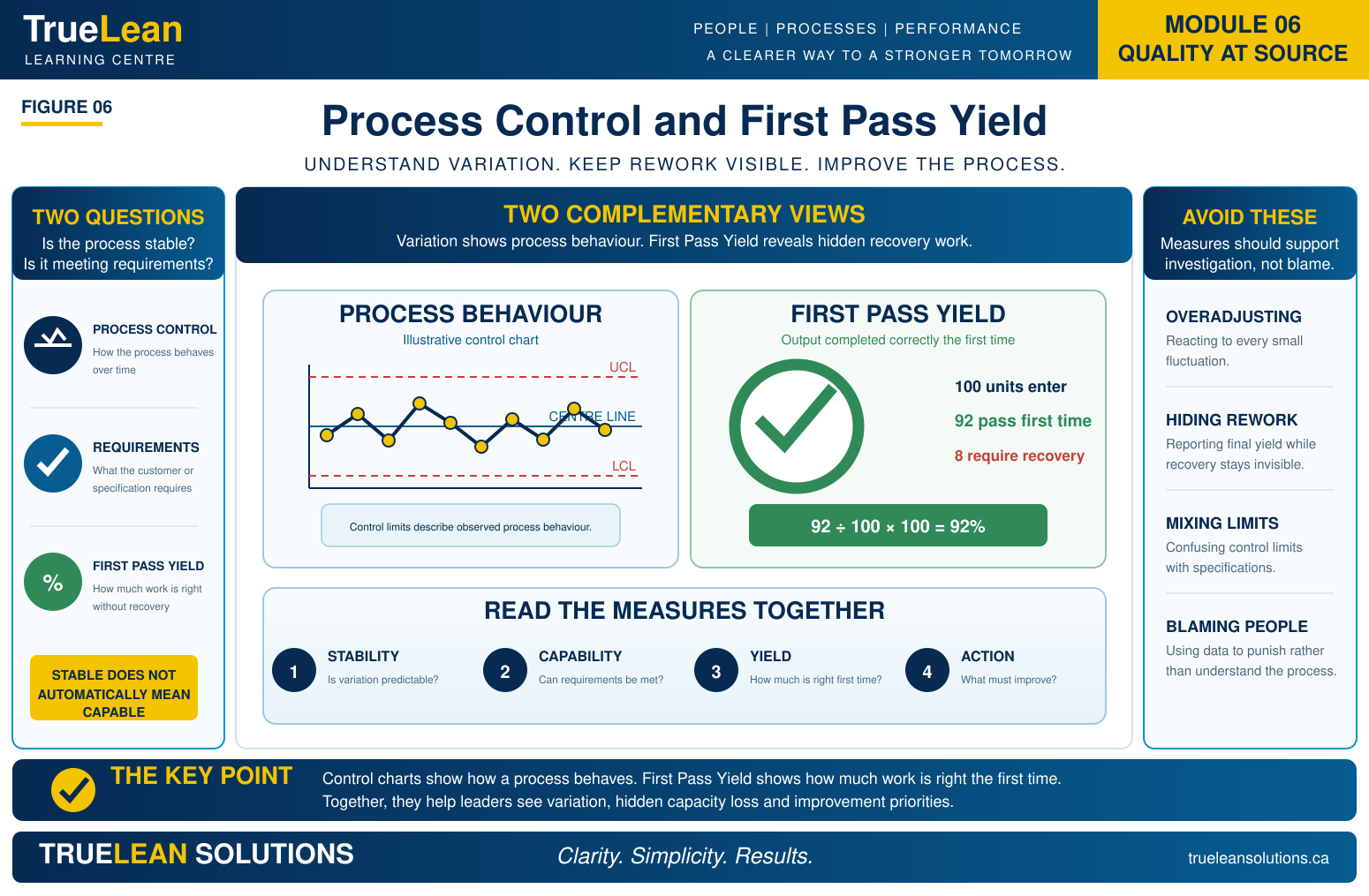
Control charts can help distinguish patterns of variation over time. Control limits describe the behaviour of the process data. Specification limits describe product or customer requirements. A process can be statistically stable and still unable to meet specification. It can also produce acceptable output today while showing instability that threatens future performance.
11 · First Pass Yield and Right First Time
Final yield can conceal the cost of rework. First Pass Yield makes visible how much output completes a process correctly without repair, retest, rerouting or another unplanned recovery step.
If 100 units enter a process and 92 complete it correctly the first time, First Pass Yield is:
If the eight remaining units are repaired and all eventually pass, final yield may appear to be 100%. The operation still consumed additional capacity and carried additional risk.
Across several processes
When three sequential processes have First Pass Yields of 95%, 97% and 98%, the approximate rolled result is:
Measures should support investigation, not blame. Definitions must be consistent, and rework should remain visible. A higher reported yield is not improvement if defects have merely been reclassified or moved to another process.
12 · Quality Ownership at the Source
Quality is shared across the system, but responsibility must still be specific.
- The person performing the work follows the standard, verifies critical conditions and stops or escalates when the condition is abnormal.
- The supervisor provides a capable operating environment, responds to signals and protects the employee from pressure to pass known problems forward.
- The quality function provides expertise, independent assurance where required, measurement discipline and support for investigation.
- Engineering defines capable product and process requirements, controls changes and addresses design-related causes.
- Maintenance restores and improves equipment conditions that affect quality.
- Supply chain protects material requirements, traceability and supplier response.
- Senior leadership aligns priorities, resources and measures so quality is not traded for short-term output.
Shared responsibility does not mean that every person owns every action. Clear roles prevent delay, duplication and the assumption that quality belongs only to the quality department.
13 · Leadership Response to Quality Problems
People learn what the organization values by observing what leaders do when a problem is raised. If an employee is blamed for stopping, support arrives slowly or production resumes without containment, the system teaches people to conceal abnormalities.
A disciplined response
- Go and see the actual condition.
- Protect people and contain suspect output.
- Clarify what is known, what is uncertain and what requires verification.
- Restore the process only when restart conditions are defined and satisfied.
- Assign follow-up for causes, recurrence and standard updates.
- Confirm that corrective actions were effective.
Correction restores the immediate condition. Corrective action addresses why the problem occurred and why the system did not prevent or detect it earlier. Both matter, but they are not the same.
14 · Common Failure Modes
Dependence on final inspection: Move controls closer to the point where the error or abnormality begins.
Continuing after a known abnormality: Define stop, containment and escalation rules before production pressure appears.
Normalizing rework: Measure it separately and investigate repeated recovery activity.
Conflicting or outdated standards: Establish one controlled source and confirm point-of-use availability.
Weak signals or slow response: Clarify signal meaning, ownership and expected response time.
Unreliable measurement: Verify the method, equipment, sampling and interpretation before acting on the data.
Unstable equipment or material: Restore the basic condition and address recurring input variation.
Measures rewarding output at any cost: Balance production with quality, flow, delivery, safety and customer impact.
Blaming the person closest to the defect: Examine the process conditions that allowed the error to occur and escape.
Weak follow-through: Verify effectiveness and update the standard when learning changes the work.
15 · Connecting Quality Problems to Learning
An abnormality is information about the operating system. Learning occurs only when that information changes future work. Containment protects today. Investigation explains the condition. Corrective action changes the process. Updated standards preserve the improvement.
Near misses also deserve attention because they reveal weaknesses before customer impact occurs. Successful performance can provide learning as well. Teams should understand which conditions supported a stable result and protect those conditions during changes in demand, staffing, material or equipment.
The earlier Learning Centre modules remain connected. Lean fundamentals establish the operating philosophy. Customer value clarifies what matters. Workplace stability creates a visible baseline. Flow and capacity expose disruption. Pull connects replenishment to demand. Quality at Source protects every handoff from defects and unreliable information.
16 · Practical Application
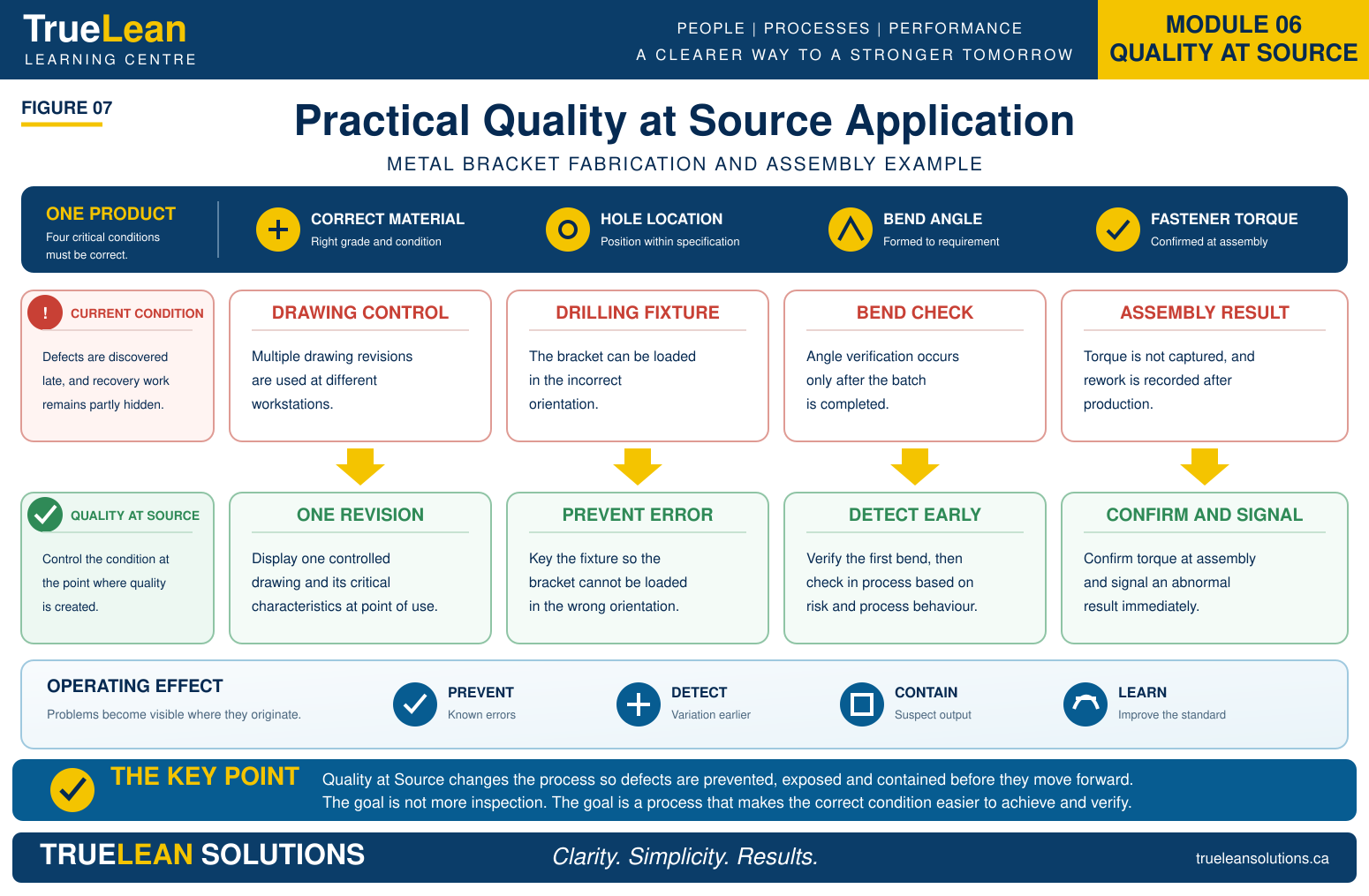
Consider a metal fabrication and assembly process producing a bracket with four critical conditions: correct material, hole location, bend angle and fastener torque. Current performance includes recurring hole-location defects, intermittent bend-angle variation, rework before final inspection and occasional assembly shortages caused by unusable components.
Current condition
- Operators use multiple drawing revisions at different workstations.
- The drilling fixture permits an incorrect orientation.
- Bend-angle checks occur only after a batch is completed.
- Torque results are not captured at the point of assembly.
- Production measures emphasize quantity completed, while rework is recorded later.
Quality at Source design
- Establish one controlled drawing revision and display critical characteristics at each point of use.
- Modify the drilling fixture so the bracket cannot be loaded in the incorrect orientation.
- Verify the first bend after setup and define a practical in-process check based on risk and process behaviour.
- Use a controlled torque method that confirms completion and signals an abnormal result.
- Stop and identify suspect material from the last confirmed good condition.
- Record First Pass Yield and rework at the process where the problem originates.
- Review recurring abnormalities through the daily management process.
Expected operating effect
The redesigned process does not depend on final inspection to discover every problem. Standards define the expected condition, mistake proofing prevents a known orientation error, in-process verification exposes bend variation earlier, torque confirmation protects assembly and measures keep rework visible.
17 · Practical Gemba Exercise
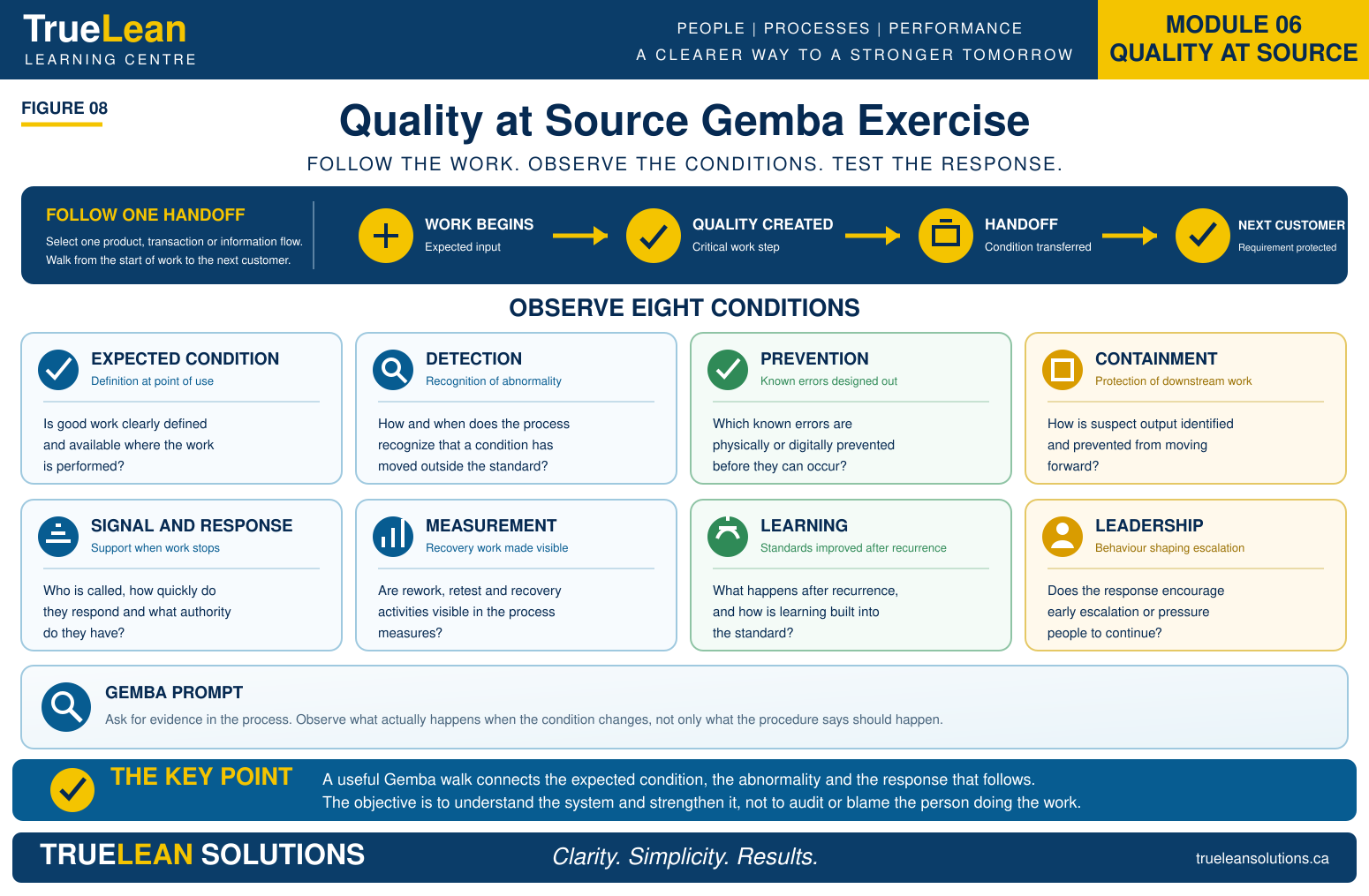
Select one process and follow one product, transaction or information handoff from the point where the work begins to the next customer. Observe:
- Expected condition: Is good work clearly defined and available at the point of use?
- Detection: How and when does the process recognize an abnormality?
- Prevention: Which known errors are physically or digitally prevented?
- Containment: How is suspect output identified and prevented from moving forward?
- Signal and response: Who is called, how quickly do they respond and what authority do they have?
- Measurement: Are rework, retest and recovery activity visible in the process measures?
- Learning: What happens after recurrence, and how are standards updated?
- Leadership: Does the response encourage early escalation or pressure people to continue?
Need help strengthening quality at the source?
TrueLean Solutions helps manufacturing leaders make abnormalities visible, protect the next customer and build disciplined response and learning into daily operations.
Schedule a Consultation18 · Key Takeaways
- Quality should be created and protected where the work is performed.
- Inspection can confirm quality but cannot make an unstable process capable.
- Jidoka connects abnormality detection with stopping, containment, signalling and response.
- Standards provide the reference required to distinguish normal from abnormal.
- Andon is useful only when a clear and timely response follows the signal.
- Poka-Yoke reduces dependence on memory by preventing or immediately detecting errors.
- Control limits describe process behaviour, while specification limits describe requirements.
- First Pass Yield keeps rework and hidden capacity loss visible.
- Quality ownership is shared across the system but must remain specific.
- Leadership response determines whether people expose or conceal problems.
- Containment protects the customer but does not replace corrective action.
- Learning is complete only when it changes future work.
Continue Learning
Module 07 · Structured Problem-Solving
Continue the TrueLean Learning Centre sequence by connecting visible abnormalities with disciplined investigation, root cause and corrective action.
Return to Learning Centre19 · Sources & Further Reading
Foundational Quality and TPS Books
- Taiichi Ohno, Toyota Production System: Beyond Large-Scale Production.
- Shigeo Shingo, Zero Quality Control: Source Inspection and the Poka-Yoke System.
- W. Edwards Deming, Out of the Crisis.
- W. Edwards Deming, The New Economics for Industry, Government, Education.
- Joseph M. Juran, Juran on Leadership for Quality: An Executive Handbook.
- Joseph A. DeFeo and J. M. Juran, Juran's Quality Handbook.
Leadership and Organizational Learning
- Amy C. Edmondson, The Fearless Organization.
- Peter M. Senge, The Fifth Discipline.
- Bob Emiliani and colleagues, Better Thinking, Better Results.
- Bob Emiliani, Practical Lean Leadership.
- Bob Emiliani, The Triumph of Classical Management Over Lean Management.
Professional and Official Resources
- Toyota Motor Corporation, Toyota Production System.
- International Organization for Standardization, Quality Management Principles.
- American Society for Quality, Mistake Proofing.
- American Society for Quality, Control Chart.
- American Society for Quality, Cost of Quality.
- National Institute of Standards and Technology, What Are Control Charts?
- National Institute of Standards and Technology, What Is Process Capability?
Academic and Applied Research
- Victor Azamfirei, Foivos Psarommatis and Yvonne Lagrosen, Application of Automation for In-Line Quality Inspection: A Zero-Defect Manufacturing Approach.
- Grout and Downs, Mistake Proofing: Changing Designs to Reduce Error.
- United States Agency for Healthcare Research and Quality, Mistake-Proofing the Design of Health Care Processes.