
Lean transformation connects the earlier Learning Centre topics into a way of leading and improving a manufacturing operation. This overview examines customer purpose, leadership behaviour, cross-functional flow, capability development and the conditions needed for results to last.
01. Learning Objectives
Explain how Lean transformation connects leadership, people, processes and performance across an organization.
Recognize why isolated improvement projects often fail to produce lasting change.
Describe how leaders establish a clear purpose and understand the current condition before choosing actions.
Explain how coaching, trust and shared ownership help teams develop improvement capability.
Apply the TrueLean five-stage framework to organize a transformation at a high level.
Identify evidence that improvements are becoming part of daily work and continuing to deliver results.
02. What Lean Transformation Means
Lean transformation is a sustained change in how an organization serves customers, develops people, solves problems and manages work. It involves more than introducing tools or completing improvement projects. Leaders and teams must learn to see problems clearly, improve the processes that create them and make better ways of working part of daily operations.
A successful transformation connects several parts of the business. Customer needs shape priorities. Processes make value flow. People have the skills and authority to respond when conditions change. Leaders provide direction, remove barriers and check whether improvements produce the intended results.
Consider a plant that improves one assembly line but still struggles with late materials, changing schedules and recurring defects. The line may perform better for a time, yet customers see little improvement. A broader effort would examine how planning, purchasing, production, quality and leadership decisions affect the complete flow of an order.
Transformation is visible when better decisions and better work continue after the initial project team has moved on.
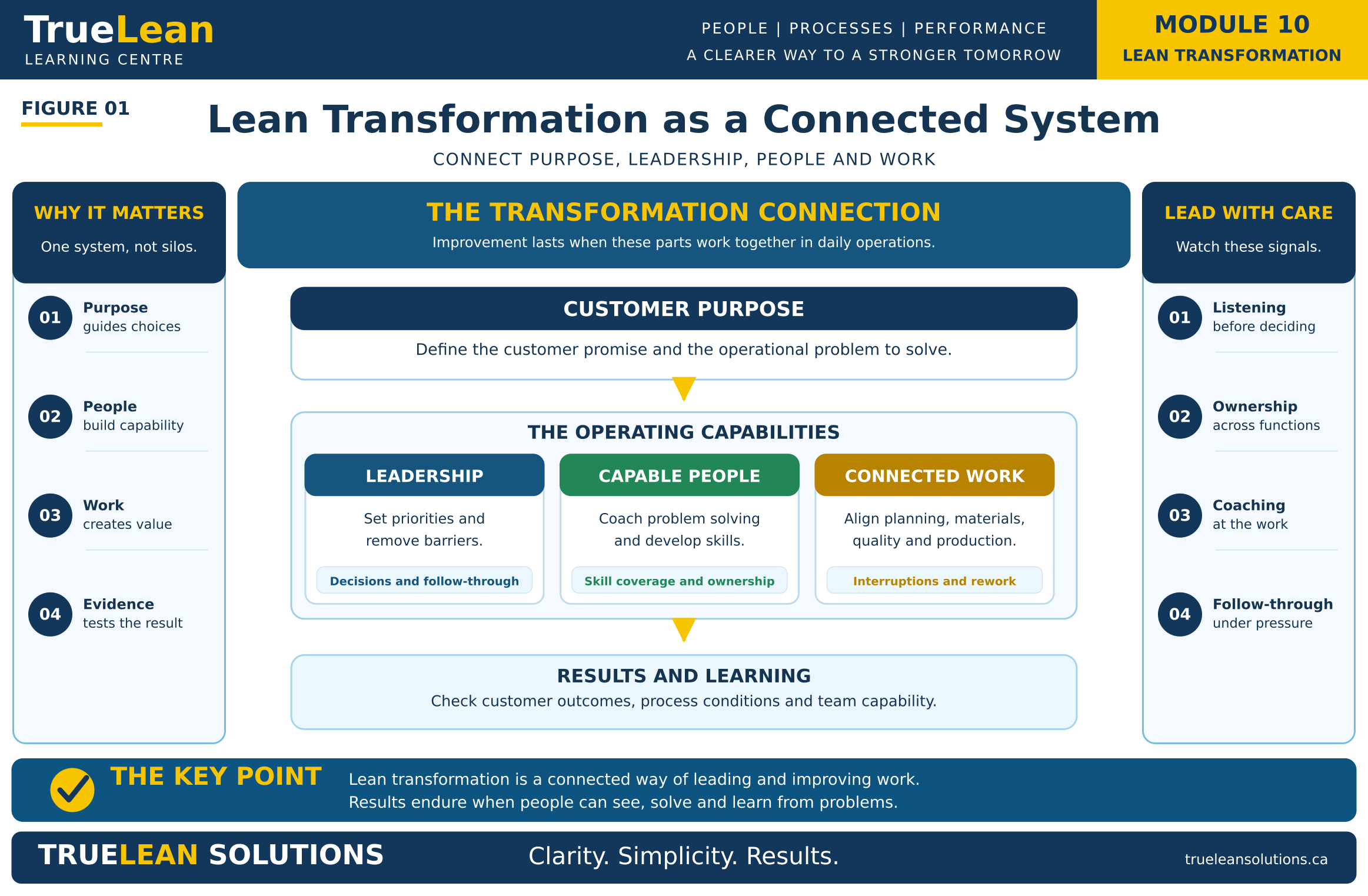
03. Establishing Purpose and Understanding the Current Condition
A transformation needs a clear reason to begin. Leaders should describe the customer or business problem in terms people can recognize, such as missed delivery commitments, long lead times, recurring defects or work that is difficult to perform safely. A broad goal like “become Lean” gives teams little direction.
The next step is to understand how work happens today. Leaders can follow an order from customer request to delivery, observe the work, listen to employees and compare actual performance with customer needs. They should look across functions because a problem seen in production may begin in quoting, planning, purchasing or engineering.
For example, frequent overtime may appear to be a labour capacity problem. Observation may show that material shortages and schedule changes cause lost production time. Adding people before understanding those conditions could increase cost without improving delivery.
State the purpose in terms of customer and operational outcomes, then use evidence from the work to establish the starting point.
04. Leadership Behaviour and Trust
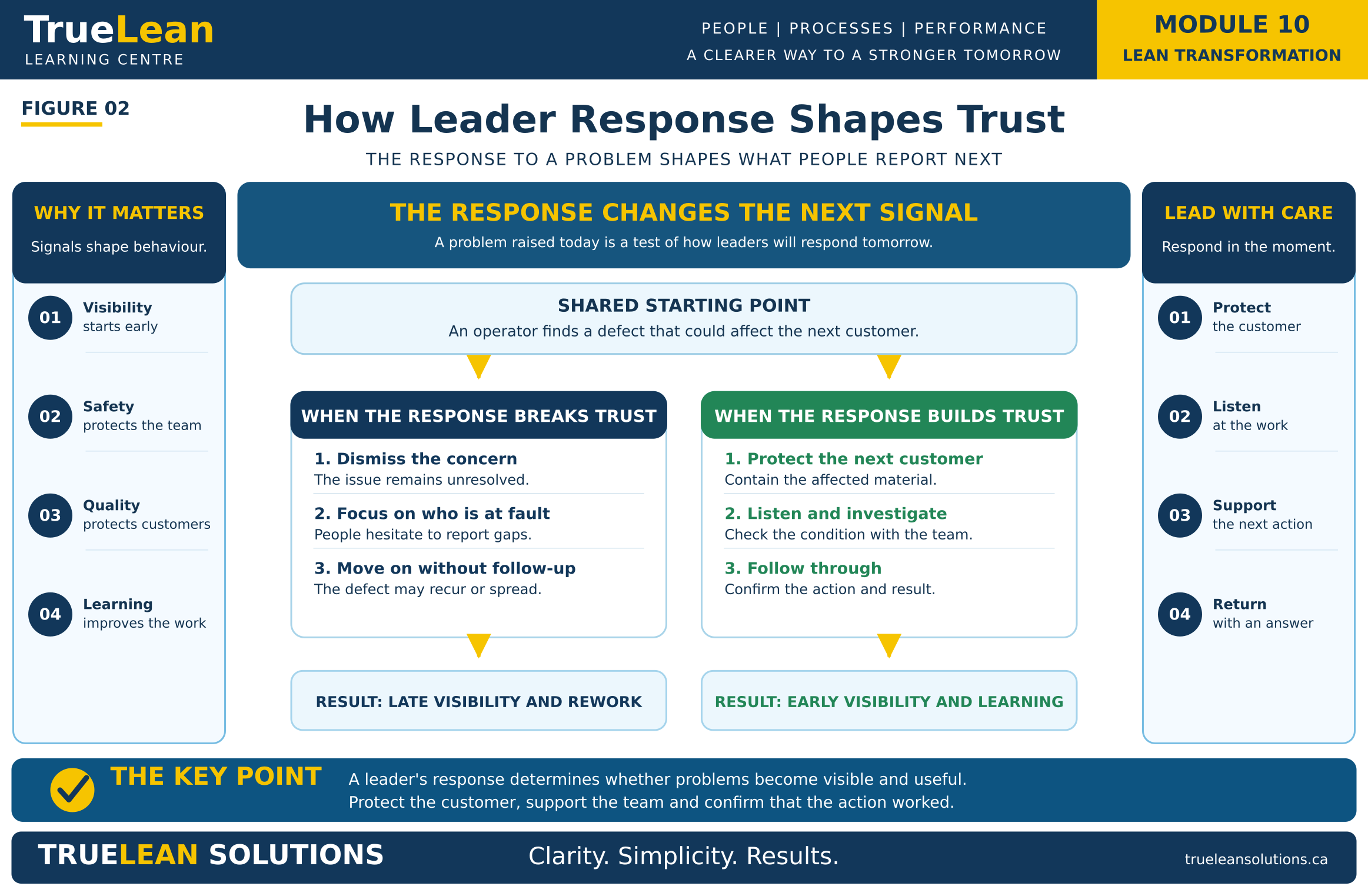
Employees judge a transformation by what leaders do when work does not go as planned. If someone reports a defect or shortage and receives blame, that problem is less likely to be raised early next time. If a leader listens, protects the customer, helps resolve the issue and follows through, reporting problems becomes useful.
Trust also depends on consistency. Leaders should explain priorities, make time to observe the work, respond to obstacles within their authority and close the loop on concerns employees raise. They must follow the same standards of preparation and accountability they expect from their teams.
For example, asking operators to stop a process when they find a defect only works if supervisors support that decision and help restore normal conditions. A production target that routinely overrides the quality standard sends a different message, regardless of what the training says.
Leaders build trust through repeated decisions that show people it is safe and worthwhile to surface problems.
05. Connecting Flow, Quality, Planning and People
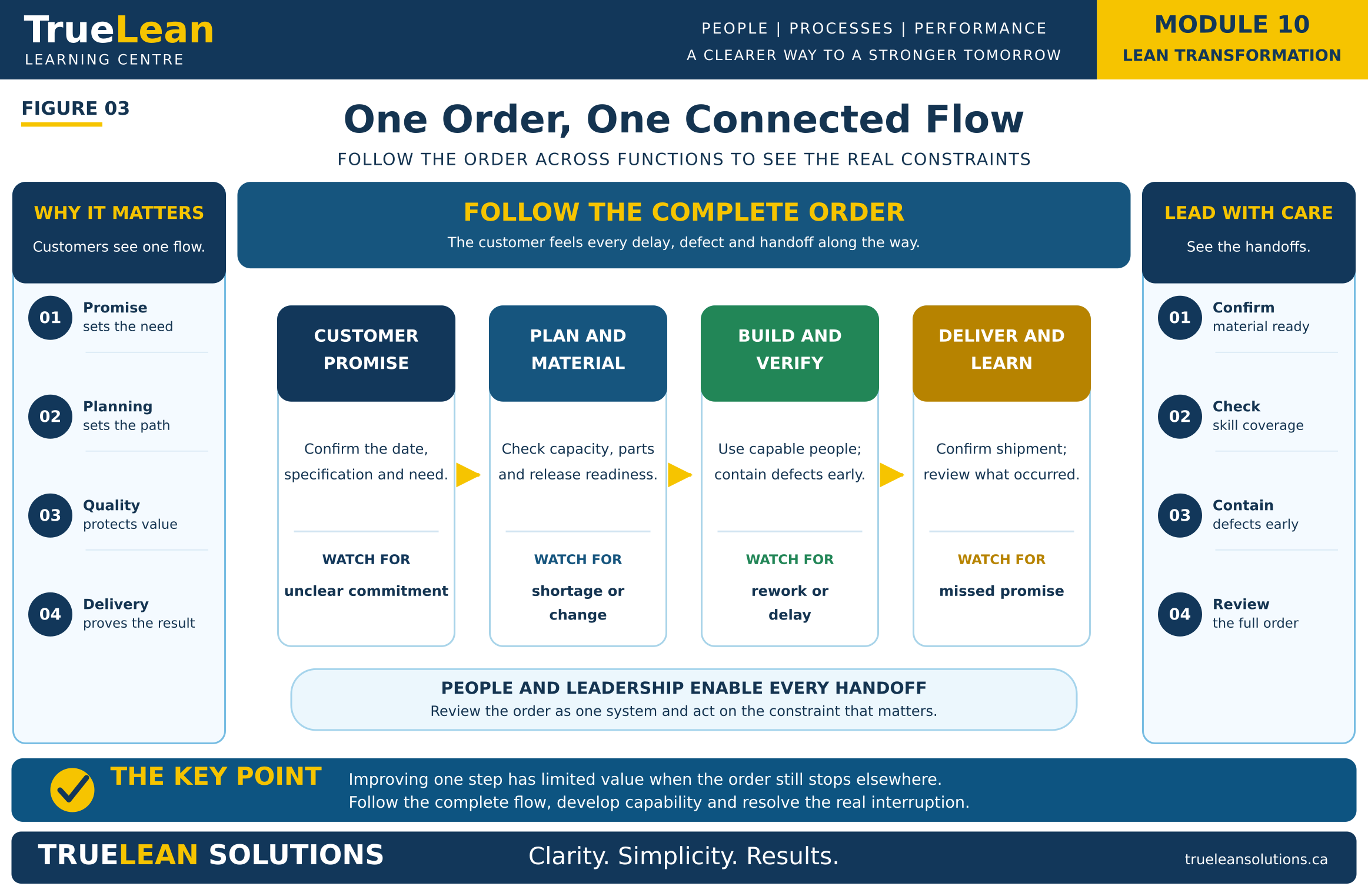
A plant operates as a connected system. An improvement in one area may have little effect on customer delivery if another part of the process remains unstable. Leaders need to examine how work moves across functions and how decisions in one area affect the others.
Consider an order that arrives late despite a faster assembly process. Planning may have released it before materials were available. A quality issue may have required rework. Only one employee may have been qualified to complete a critical operation. Improving assembly speed alone would not resolve those conditions.
A transformation brings the relevant teams together to understand the complete flow, agree on priorities and address the conditions that repeatedly interrupt it. Measures should help them see both the result, such as on-time delivery, and the process conditions that influence it.
Improve the flow of value across the business, including the decisions and capabilities that support the work.
06. Building Capability Through Coaching
Lasting improvement requires people who can recognize a problem, understand its causes, test a change and check the result. Training can introduce these skills, but capability grows when employees practise them in their own work with support from a leader or coach.
A supervisor can begin with a specific issue, such as a recurring machine stoppage. Instead of supplying an immediate answer, the supervisor and team can examine when it occurs, compare actual conditions with the standard and agree on a small test. They then review what happened and decide what to do next. The leader remains responsible for safety, customer protection and decisions outside the team’s authority.
Leaders should also know where skills are concentrated. If only one person can set up a critical machine, a skills matrix and a deliberate training plan can reduce that dependency while giving employees room to develop.
Develop people while improving the work. A result is stronger when the team can understand, maintain and improve the process themselves.
07. Creating Ownership Across Functions
Customers experience the result of the whole process, even when work passes through separate departments. Transformation therefore needs clear responsibility for shared outcomes and a way for teams to resolve problems at the handoffs between them.
Leaders can assign an owner to a value stream or improvement priority, while making each function’s contribution explicit. Planning may own the schedule, purchasing may address supplier commitments, production may manage capacity and quality may define the response to defects. The group must still review how those decisions affect the complete order.
For example, changing the production sequence to protect one urgent shipment may delay several other orders. Planning, production and customer-facing teams need to agree on the trade-off and communicate the decision. Ownership means making the decision visible, following through and checking the outcome.
Give people clear responsibilities while holding leaders jointly accountable for results that cross departmental boundaries.
08. Applying the TrueLean Five-Stage Framework
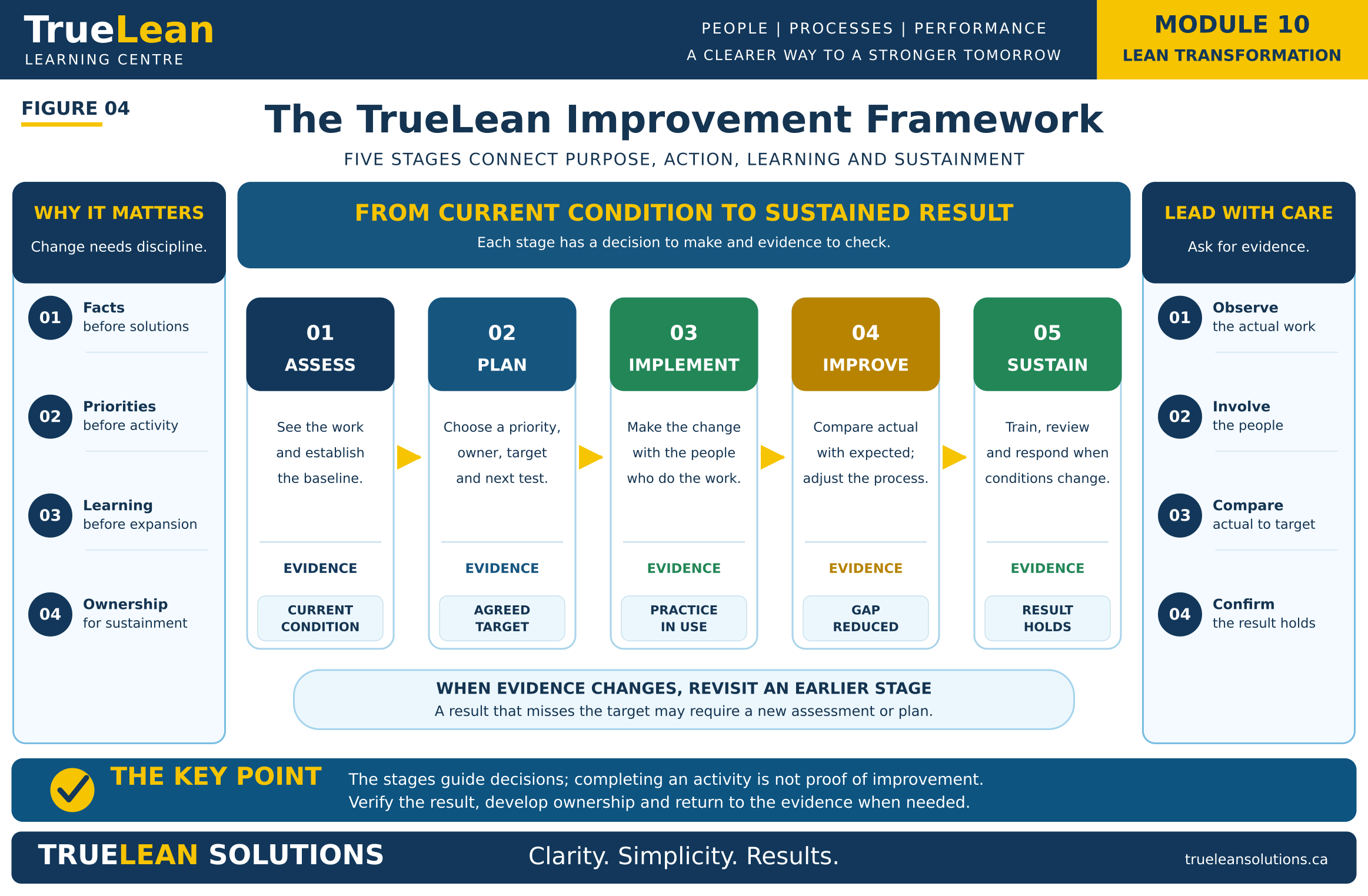
The TrueLean framework gives leaders a practical sequence for organizing change. Each stage answers a different question:
Assess: What do customers need, and what is happening in the operation today? Observe the work and establish a reliable baseline.
Plan: Which problems matter most? Set priorities, ownership, measures and a realistic sequence of actions.
Implement: Put agreed changes into practice with the people who perform and support the work.
Improve: Compare results with expectations, learn from gaps and adjust the process.
Sustain: Establish standards, skills, ownership and review routines that keep the improvement working.
These stages guide decisions; they are not a one-time checklist. If a change produces an unexpected result, leaders may need to reassess the condition or revise the plan. If a standard proves difficult to follow, the team should understand why and improve it.
Progress through the framework with evidence. Completing an activity is not the same as achieving and sustaining an operational result.
09. Starting Small and Expanding What Works
A focused starting point lets a team learn before changing a larger operation. Choose a process with a clear customer need, a measurable problem, an engaged team and leaders who can remove barriers. Define the expected result and observe what changes during the test.
For example, one assembly cell may test a new material replenishment method. The team tracks shortages, delivery performance, excess inventory and the effort required to maintain the method. If results improve, leaders document the conditions that made it work and test whether those conditions exist in the next cell.
Expansion requires preparation. Another area may have different demand, equipment, skills or supplier constraints. Leaders should adapt the method with that team, confirm the result and develop local ownership before moving further.
Start at a scale where the team can learn quickly. Expand an improvement when its results are verified and other teams can make it work in their own conditions.
10. Responding to Resistance and Setbacks
People may question a proposed change because they have seen earlier initiatives fade, do not understand the purpose or can see a practical problem the plan has missed. Leaders should take those concerns seriously. Ask what makes the change difficult, observe the work together and distinguish a misunderstanding from a genuine operating constraint.
For example, a team may stop using a new production board after several weeks. The issue may be that its data arrives too late to guide decisions, or that problems recorded on it receive no response. Requiring the team to update the board more consistently would leave the underlying problem unresolved. Leaders should make the information timely and act on what the board reveals.
Setbacks are also part of testing a change. When a result falls short, protect the customer, examine the evidence and adjust the approach with the people involved.
Treat concerns and setbacks as information about the change and the conditions needed to make it work.
11. Sustaining Standards and Continuing to Learn
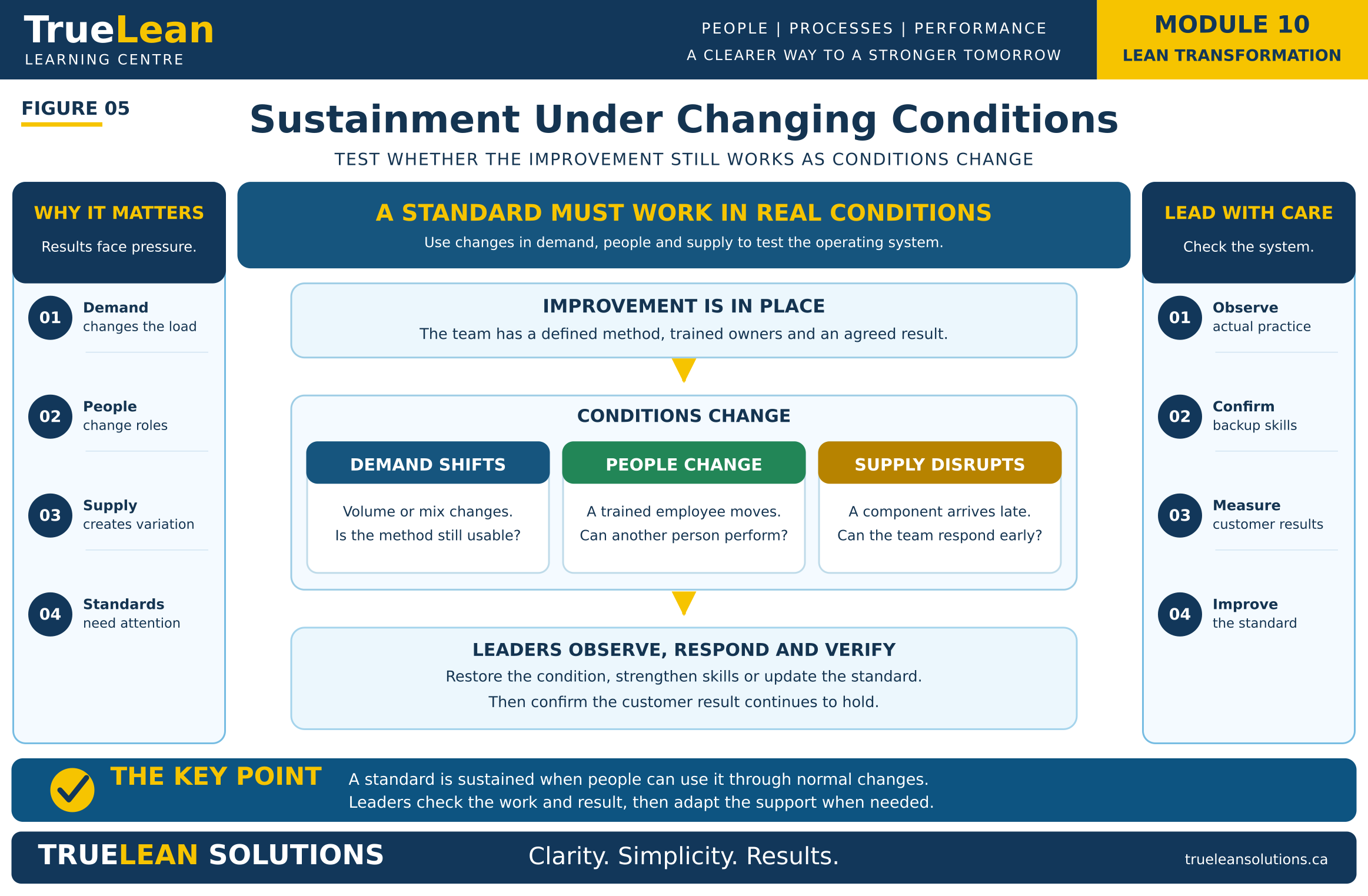
An improvement is sustained when the new way of working remains effective through schedule changes, employee turnover and periods of pressure. Documenting a standard helps, but people also need training, the right materials and equipment, clear ownership and a way to respond when conditions change.
Leaders should check both the process and its result. For example, a replenishment method may appear to be in place while shortages begin to rise again. Observing how it is used, reviewing the shortage pattern and asking employees what has changed can reveal a supplier issue, a demand shift or a standard that needs revision.
Regular reviews should lead to decisions. When results hold, leaders can confirm what is working and develop the next improvement. When results deteriorate, they should investigate and respond before the old problem becomes normal again.
Sustainment is active work. Standards provide a reliable starting point, and continued learning keeps them useful.
12. A Manufacturing Transformation Example
Consider a manufacturer with frequent late orders. Production teams are working overtime, yet completed units wait for missing components or quality rework. Planning changes the schedule repeatedly to respond to urgent requests. Several critical setups depend on one experienced employee.
The leadership team begins by following orders from release through shipment. They establish a baseline for on-time delivery, shortages, rework, schedule changes and overtime. Employees help identify where work stops and which decisions make recovery difficult.
The team then selects a manageable product family for its first improvement effort. Planning and purchasing agree on a material readiness check before release. Production and quality clarify the response to defects. Supervisors begin developing additional people for the critical setups. Daily reviews expose interruptions early and assign responsibility for resolving them.
After testing the changes, leaders compare results with the baseline and ask whether the workload has improved for employees as well as delivery for customers. They adjust what does not work, document effective practices, train others and review performance over time. Only then do they adapt the approach for another product family.
The transformation comes from connecting decisions, processes and people across the order flow, then verifying that the improvement continues to work.
13. Leadership Reflection
Consider one important customer outcome that your operation is struggling to deliver consistently. Use these questions to examine the conditions behind it:
Can employees explain the purpose of the current improvement effort and the result it should achieve?
Where does work stop or require recovery as it moves between functions?
What happens when someone raises a problem that could affect safety, quality or delivery?
Which critical tasks depend on too few people?
How do leaders know whether a recent improvement is still working?
The answers may point to a useful starting place. Observe that part of the work with the people involved, establish the current condition and agree on a problem worth addressing together.
A transformation begins with honest observation and continues through consistent leadership action.
Explore your next improvement opportunity
TrueLean Solutions helps manufacturing leaders connect purpose, people, processes and measurable results.
Schedule a Consultation14. Key Takeaways
- Lean transformation changes how an organization leads, develops people, manages work and improves results.
- A clear purpose and an observed current condition give the effort direction.
- Leadership decisions determine whether people feel able to raise problems and help solve them.
- Customer outcomes depend on the flow of work across functions, not on one department alone.
- Coaching builds the capability to improve and maintain processes over time.
- Small tests provide a way to learn before adapting an improvement for other areas.
- Sustained results require standards, ownership, regular review and a willingness to keep learning.
Continue Learning
15. Sources and Further Reading
01. Toyota Motor Corporation. Toyota Production System.
02. David Mann. Creating a Lean Culture.
03. Michael Ballé and colleagues. The Lean Strategy.
05. W. Edwards Deming. Out of the Crisis.
06. Amy C. Edmondson. The Fearless Organization.
07. Patrick Lencioni. The Five Dysfunctions of a Team.
08. Bob Emiliani. Better Thinking, Better Results.
09. Mark DeLuzio. Flatlined: Why Lean Transformations Fail and What to Do About It.